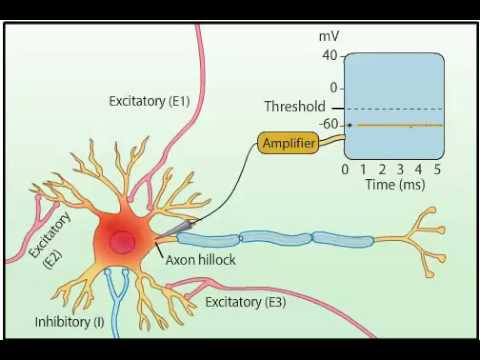
EPSP & IPSP
Understanding Postsynaptic Potentials
Types of Postsynaptic Potentials
- Postsynaptic potentials caused by neurotransmitter chemicals can be either:
- Depolarizing: Often results in an excitatory postsynaptic potential (EPSP).
- Hyperpolarizing: Results in an inhibitory postsynaptic potential (IPSP).
Propagation and Integration of Signals
- Postsynaptic potentials diminish as they spread along the dendritic membrane, leading to:
- More distant synapses producing weaker signals compared to those closer to the axon hillock.
- Most synapses generating potentials that are below the threshold for action potentials.
Summation of Synaptic Inputs
- When two excitatory synapses activate simultaneously, their local depolarizations can sum up:
- This summation can reach the threshold at the axon hillock, triggering an action potential.
Role of Inhibitory Synapses
- Active inhibitory synapses stabilize the membrane potential below threshold:
- They induce hyperpolarizations or sub-threshold depolarizations that prevent reaching action potential levels.
Temporal and Spatial Summation
- The neuron integrates inputs through two types of summation:
- Temporal Summation: Occurs when postsynaptic effects happen close together in time, enhancing overlap and summation.