A Powerful New Neurotech Tool for Augmenting Your Mind | Conor Russomanno | TED
The Relationship Between the Brain and Mind
The speaker became interested in the relationship between the brain and mind after experiencing concussions while playing football and rugby in college. This interest was further fueled by witnessing friends and family members struggle with mental health issues.
Exploring the Brain-Mind Connection
- The speaker's fascination with the brain-mind connection stemmed from personal experiences with concussions during college sports.
- Studying computers at the time, the speaker felt as though their brain's hardware had been damaged, affecting their software (thought processes).
- Witnessing loved ones dealing with nervous system and mental health ailments intensified their curiosity about this topic.
Starting OpenBCI to Help Others
In 2013, the speaker co-founded OpenBCI, an open-source neurotechnology company, driven by a desire to assist themselves and others in understanding and improving brain function.
Founding OpenBCI
- While pursuing an MFA in Design and Technology at Parsons, the speaker discovered an open-source tutorial on building a low-cost EEG system to detect brain activity.
- After successfully seeing their own brainwaves for the first time using this system, they realized its potential to help themselves and loved ones.
- With like-minded friends, they started OpenBCI as an open-source neurotechnology company in 2013.
Contextualizing Brain Data
Brain data alone lacks context. Understanding emotions, intentions, and human cognition requires integrating data from other organs such as muscles, heart, eyes, and environmental sensors.
Importance of Contextual Data
- Brain data alone is insufficient for understanding emotions or intentions; it lacks context.
- Integrating data from other organs like muscles (EMG sensors), heart (ECG sensors), eyes (eye trackers), and environmental sensors enhances the usefulness of brain data.
- The speaker discovered that people were using OpenBCI's technology for various purposes, such as studying gut-brain connections, building muscle sensors for prosthetics, and measuring new types of data.
Closed-Loop Systems and the Future of Computing
Closed-loop systems, which can both read from and write to the brain or body, are considered a profound concept that will shape the next major revolution in computing technology.
The Power of Closed-Loop Systems
- Closed-loop systems refer to combined systems that can read from and write to the brain or body.
- This concept is transformative and will define the future of computing technology.
- When computers can adapt to individual users based on their emotions or feelings, using AI to create constructive or destructive interference patterns, empathetic computing becomes possible.
Resonant Connection with Computers
In the near future, computers will be resonantly and subconsciously connected to individuals, enabling empathetic computing for the first time.
Empathetic Computing
- Resonant and subconscious connection between individuals and computers will enable empathetic computing.
- Understanding emotional data patterns allows for amplifying or suppressing emotions or feelings using AI techniques.
- This development will lead to computers that adapt to individual users' needs in real-time.
Galea - A Tool for Cognitive Exploration
Galea is a multimodal bio-sensing headset developed by OpenBCI. It combines various sensors to measure heart rate, skin response, muscle activity, eye movement, and brainwaves. The software suite provides meaningful metrics about high-level states of mind.
Introducing Galea
- Galea is a multimodal bio-sensing headset developed by OpenBCI.
- It measures heart rate, skin response, muscle activity, eye movement, and brainwaves.
- The software suite translates raw sensor data into meaningful metrics.
- Galea enables real-time interactivity and control, allowing quantifiable inferences about stress, fatigue, cognitive workload, and focus.
The transcript provided does not cover the entire video.
Can We Connect You to Our Sensors?
In this section, the speaker discusses their work with a person named Christian who has been connected to sensors and provided with new inputs to control a computer.
Connecting Christian to Sensors
- After 20 minutes of rigging Christian up with electrodes, he was provided with four new inputs to control a computer.
- These inputs were little digital buttons that he could control voluntarily.
Implementing the Prototype
- The team flew to Germany to work with Christian in person and implement the first prototype.
- Christian spent months training with the prototype and sending his data from Germany to Brooklyn.
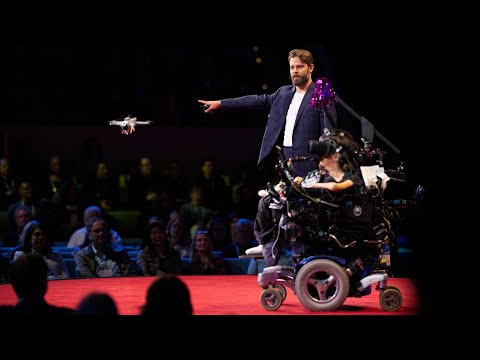
- He was able to fly a virtual drone using the controls developed through this process.
Flying the Drone
In this section, Christian demonstrates his ability to fly a drone using the controls developed through their work together.
Flying the Drone
- Christian is shown attempting to fly the drone using his muscle data as input.
- With guidance from Conor, he successfully flies the drone over the audience.
- Audience members are invited to call out commands for Christian to execute with the drone.
Key Insights and Future Directions
The speaker shares key insights gained from their project and emphasizes the importance of open-source technology access and ethical considerations in introducing neural technology.
Key Insights
- Understanding emotions and tensions requires measuring data from all over the body, not just focusing on brain activity.
- Open-source technology access and literacy can help address ethical challenges associated with neural technology.
Designing a Desired Future
- It is crucial to set up guardrails and actively design the future we want when it comes to integrating neural technology into society.
The Courage and Resilience of Trailblazers
In this section, Christian, a trailblazer with a genetic condition that affects his mobility, shares his perspective on overcoming physical limitations and the importance of creating an inclusive world through technology.
Christian's Introduction
- Christian introduces himself to the audience.
- He expresses his excitement to be present at the event.
Overcoming Physical Limitations
- Despite being born with a genetic condition that affects his mobility, Christian considers himself a happy and fulfilled person.
- He emphasizes that it is not his physical limitations but rather the barriers in the environment that hold him back.
- Christian identifies as a tech nerd and political activist who believes in the power of technology to empower disabled individuals.
Technology for Inclusion
- Christian advocates for using technology to create a better, more inclusive, and accessible world for everyone.
- He highlights how cutting-edge technology combined with human curiosity and creativity can lead to remarkable possibilities.
- Christian encourages building tools, applications, and systems that break down barriers and unlock potential for all individuals.
Turn any video into a summary like this
YouTube links, meetings, lectures. With transcripts, search, and chat.