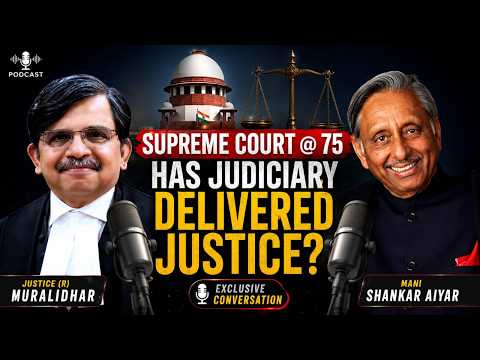
🎙️ Supreme Court @ 75 | Has India’s Judiciary Delivered Justice? |Justice (R) Muralidhar | Ep. 35
Is the Judiciary Delivering Justice?
Introduction to the Discussion
- The episode poses a critical question regarding whether the judiciary is delivering judgments or actual justice, featuring Justice S. Moridhar, a prominent figure in Indian law.
Justice Moridhar's Career and Challenges
- Justice Moridhar faced significant challenges during his career, including transfers after questioning hate speech by political figures, which reflects the pressures within the judicial system.
- Despite these obstacles, he transitioned into a successful legal practice in the Supreme Court after being denied a position on its bench.
Reflections on Law as a Profession
- He emphasizes that practicing law is rewarding and connects lawyers with societal issues, urging young lawyers to embrace their role in nurturing constitutional values.
- Moridhar stresses that engagement with institutions is crucial for their success and encourages lawyers to be courageous in upholding justice.
Perception of Judicial Independence
Concerns About Political Pressure
- There is growing public concern that the judiciary may not uphold democratic principles due to increasing political pressure affecting judicial decisions.
- Judges often reflect societal inequalities and biases, leading them to issue verdicts that align with majority opinions rather than constitutional mandates.
Historical Context of Judicial Resistance
- Historically, few judges have stood against powerful executives when political dominance has influenced judicial independence; this trend continues today.
- The discussion highlights that all levels of judges face various pressures—political, social, media—that can compromise their independence and decision-making processes.
The Role of Judges Under Pressure
Types of Pressures Faced by Judges
- Judges experience multiple pressures: from high court judges influencing lower courts to societal expectations impacting magistrates' decisions. Media scrutiny also plays a significant role in shaping judicial outcomes.
- These pressures contribute to an environment where judges may hesitate to deliver unpopular verdicts necessary for upholding justice under constitutional frameworks.
Optimism Amidst Challenges
- Despite acknowledging these challenges, Justice Moridhar expresses optimism about some judges who resist political influences and maintain their commitment to justice despite external pressures.
Analyzing Landmark Judgments
Critique of the Babri Masjid Judgment
- The 2019 Supreme Court judgment regarding Babri Masjid is critiqued as lacking solid evidence while still favoring one party based on perceived interests of justice rather than legal principles alone.
- The judgment's conclusion appears inconsistent with presented evidence; it controversially allowed for temple construction despite recognizing prior criminal acts related to its demolition.
Implications for Judicial Integrity
- Post-retirement rewards given to judges involved in controversial rulings raise questions about judicial integrity and accountability within India's legal framework.
Evolution of Judicial Activism
Historical Context of Judicial Activism
- Discussion references historical cases like ADM Jabalpur which highlight shifts towards judicial populism as responses to governmental overreach during emergencies.
- This activism was partly driven by public demand for greater access to justice amid oppressive laws during politically turbulent times.
Public Interest Litigation (PIL) Development
- Public interest litigation emerged as a means for addressing social injustices but has faced criticism for straying from strict legal interpretations toward subjective notions of justice.
- Critics argue this approach risks undermining established legal standards while attempting to address systemic inequities.
Current Issues in Bail and Delays
Challenges Related To Bail
- Current laws create barriers preventing timely bail hearings; individuals can remain incarcerated without charges being framed due to procedural delays.
- Calls are made for judiciary intervention at bail stages when prolonged detentions lack justification based on completed investigations.
Need For Reform
- Emphasis on reforming outdated laws used oppressively under current governance structures; calls for re-evaluating anti-terror legislation are highlighted amidst ongoing misuse concerns.
Compliance With Court Orders
Government Disobedience
- Acknowledgment that government non-compliance with court orders leads many judgments rendered against state actors remaining unenforced; this raises serious concerns about rule-of-law adherence.
Addressing Contempt Issues
- High courts have dedicated contempt rosters reflecting widespread disobedience yet struggle with enforcement mechanisms against errant governments leading many cases unresolved or dismissed due fatigue among judiciary members .
Future Directions
Call For Judicial Reform
- Urgent need identified for comprehensive reforms aimed at enhancing judicial independence alongside civil society advocacy efforts pushing back against executive overreach .
Hope For Change
- Optimistic outlook expressed regarding potential future generations of judges who might restore faith in constitutional values through principled adjudication practices .( 1492 )
Supreme Court Dynamics and Judicial Reforms
Current Structure of the Supreme Court
- The Supreme Court currently operates with a mix of conservative and liberal judges, leading to diverse opinions on major issues.
- There are approximately 34 judges who typically sit in benches of two or three, effectively creating around 15 separate courts. This fragmentation can lead to inconsistent rulings.
Concerns Over Judicial Tenure
- Judgments delivered by benches of five judges often do not last even a year, indicating a troubling trend that may require reform.
- A proposal is made to amend the lifetime tenure of Supreme Court judges to align with U.S. law, where justices serve for life unless they resign or pass away.
Post-Retirement Restrictions for Judges
- Currently, provisions exist preventing former judges from taking up post-retirement positions; similar rules could be applied more broadly across the judiciary. A suggested "cooling off" period of two years after retirement could help maintain judicial integrity.
Retirement Age Considerations
- While there is an argument for increasing the retirement age due to improved life expectancy, concerns remain about older judges' ability to perform effectively as seen in historical cases like Oliver Wendell Holmes Jr.'s reluctance to retire. Thus, a balanced approach is advocated—possibly raising it to 70 or even 85 years old for high court judges.
Bail System and Access to Justice
Challenges in Granting Bail
- The current bail system is described as oppressive, with many individuals unable to afford access to higher courts like the Supreme Court; this leads to prolonged detention without trial for common citizens.
- There is a call for proactive measures and effective parliamentary debate regarding legal reforms related to bail practices and overall justice accessibility.
Public Interest Litigation vs Social Action Litigation
Distinction Between PIL and SAL
- A discussion arises comparing Public Interest Litigation (PIL) with Social Action Litigation (SAL), emphasizing that SAL focuses on the rights of marginalized individuals while PIL addresses broader public interests. Professor Bakshi's nuanced understanding highlights this distinction well.
Historical Context and Impact
- An example from early 2000 shows how PIL led by PUCL addressed starvation deaths in Rajasthan successfully expanded rights for those below the poverty line through Supreme Court orders, demonstrating PIL's potential impact when aligned with social justice goals.
Freedom of Speech and Political Protest
Repression of Dissent
- Recent trends indicate a worrying repression of free speech where protests against government policies are labeled as "anti-national," raising concerns about civil liberties in India’s democracy. The case involving Sonam Wangchuk exemplifies this issue as he faces unjust detention despite peaceful protest methods rooted in Gandhian principles.
Importance of Civil Society Engagement
- The ability for civil society members to voice opposition against governmental actions is deemed essential; failure in this regard risks undermining democratic values entirely according to historical judicial definitions concerning public order versus lawful dissenting speech.
Conclusion: Reflections on Judicial Integrity
Final Thoughts on Democracy
- Emphasizing Ambedkar's views on balancing freedoms within democracy suggests that sacrificing one freedom for another undermines fundamental rights; thus maintaining both freedom of expression and security must be prioritized without capitulation under pressure from repressive laws or governance styles.
This concludes our discussion highlighting critical insights into India's judicial landscape, its challenges regarding bail systems, litigation types focused on social justice, and ongoing threats against free speech within political contexts.