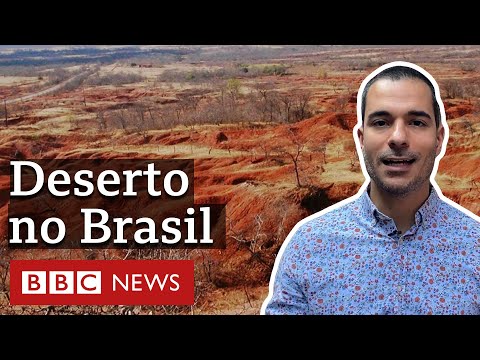
Mudança do clima acelera criação de deserto do tamanho da Inglaterra no Nordeste
Desertification in Brazil: A Growing Crisis
Introduction to Desertification
- The common belief that Brazil lacks deserts is challenged by the emergence of desert-like areas due to deforestation and climate change.
- João Fellet, a reporter from BBC News Brasil, discusses how desertification in the Caatinga has led to lifeless regions.
Overview of the Caatinga Biome
- The Caatinga is Brazil's fourth largest biome, covering 11% of the national territory and spanning parts of all Northeastern states and Minas Gerais.
- This semi-arid ecosystem has flora and fauna adapted over millennia but is now facing extreme conditions due to human actions.
Extent of Desertification
- In 2019, it was reported that 13% of the Semiárido region was undergoing advanced desertification, with irreversible consequences for life.
- Satellite images reveal significant growth in desertified areas over decades, particularly around the São Francisco River valley.
Specific Areas Affected
- Notable desertified regions include Cabrobó (Pernambuco), Irecê, and Gilbués (Piauí), often near large agricultural operations like soybean plantations.
- A map from Universidade Federal de Alagoas highlights varying degrees of desertification across the Semiárido region.
Causes Behind Desertification
- Researcher Humberto Barbosa explains that while tropical regions naturally do not have deserts, land occupation and deforestation have created them.
- Climate change exacerbates this issue; between 2012 and 2017, a severe drought intensified desert expansion.
Process of Desertification
- The process begins with clearing native vegetation for pastureland followed by heavy livestock grazing which compacts soil.
- High soil temperatures (up to nearly 50°C) hinder biological activity essential for maintaining healthy ecosystems.
Impact on Brazilian States
- Alagoas is most affected by desertification (32.8% impacted), followed by other states like Paraíba and Pernambuco.
- Historical deforestation began centuries ago with colonization; recent data shows alarming increases in deforestation rates since early 2021.
Lack of Government Response
Monitoring Deforestation in the Caatinga
Lack of National System for Monitoring
- There is no national system to monitor deforestation in the Caatinga, unlike the established systems for the Amazon.
- The absence of monitoring hampers effective enforcement actions against deforestation in this region.
Climate Change Impact on Semi-Arid Regions
- The latest IPCC report highlights that Brazilian semi-arid regions are likely to experience warming across all future scenarios.
- Increased duration, magnitude, and frequency of heatwaves are anticipated, posing significant risks to local populations.