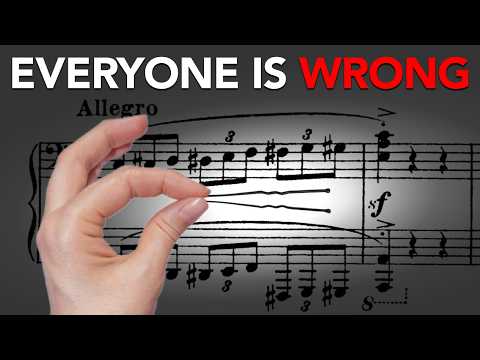
The Most Misunderstood Symbol in Music (ft. Seymour Bernstein)
Understanding Hairpins in Music: Dynamics or Tempo?
Introduction to Hairpins
- The speaker introduces the concept of hairpins in music, explaining their common interpretation as symbols for dynamics (crescendo and diminuendo).
- References sources like Wikipedia and Harvard Dictionary that define hairpins as changes in volume, highlighting a discrepancy with historical composers.
Historical Context and Misinterpretation
- The speaker discusses how renowned composers such as Beethoven and Schubert may not have used hairpins solely to indicate dynamics.
- Seymour Bernstein's claim is introduced, suggesting that hairpins also refer to expressive nuances, particularly fluctuations in timing rather than just volume changes.
Seymour Bernstein's Research
- Bernstein argues against the conventional understanding of hairpins, stating they signify tempo flexibility based on his extensive research over decades.
- He provides evidence from 19th-century musical works where interpreting a hairpin as a dynamic change does not make sense.
Key Evidence from Chopin
- An example from Chopin’s G minor piece illustrates Bernstein's point; the presence of "diminuendo" alongside a closing hairpin suggests an emphasis on timing rather than mere volume reduction.
Discussion with Logan Skelton
- The speaker engages in a conversation with pianist Logan Skelton about their shared interest in the interpretation of hairpins.
- They reflect on past discussions regarding the implications of this interpretation for performance practices among musicians today.
Personal Journeys into Understanding Hairpins
- Seymour recounts his journey into discovering new interpretations of hairpins through articles and discussions with other musicians.
- Both Seymour and Logan share experiences that led them to question traditional teachings about dynamics associated with hairpins.
Understanding Hairpins in Music Interpretation
The Role of Crescendo and Hairpins
- Discussion on the use of crescendo markings combined with expanding hairpins, emphasizing their significance in musical expression.
- Introduction of "expressive accents" that are softer and delayed, particularly over specific notes (D flat, F, A flat), enhancing melodic interpretation.
Insights from Pianists
- Reference to Padari's performance as a notable example of interpreting these musical elements.
- Mention of Rakmanov's technique where he softens his playing while maintaining expressive dynamics.
Analyzing Rakmanov's Techniques
- Observations on common practices among pianists regarding crescendos and endings; highlights a puzzling diminuendo followed by an expanding hairpin.
- Notable moments in Rakmanov’s performance where he employs echo effects and dynamic changes effectively.
Creative Process in Composition
- Suggestion for Rakmanov to adjust his phrasing marks for clarity in expression; emphasizes the relationship between volume increase and tempo changes.
- Recognition of Rakmanov’s unique interpretative style that resonates with audiences, establishing him as a revered pianist.
Musical Communication and Interpretation
- Discussion on how both Padari and Rakmanov embody the essence of Chopin’s music through their interpretations, suggesting they understood the intent behind hairpins deeply.
- Exploration of differing opinions about whether musical insights come from personal interpretation or directly from the music itself.
Historical Perspectives on Hairpins
- Introduction to Brahms' rehearsal anecdote involving Fanny Davies, illustrating historical context around interpreting double hairpins with warmth and affection.
- Skepticism towards sweeping claims about hairpin interpretations; acknowledgment that traditional views require reevaluation based on new evidence.
Evolving Definitions of Hairpins
- Overview of early 19th-century treatises by Johan Napom Hmel and Carl Cherney defining hairpins primarily as dynamic changes rather than tempo fluctuations.
Understanding Hairpins in Romantic Era Music
Coexistence of Definitions
- In the Romantic era, hairpins had dual meanings, potentially representing both dynamics and expressive nuances to various musicians and educators at different times and locations.
- Historical records reveal that hairpins indicated a flow of time in compositions by prominent composers, despite differing interpretations on their execution.
Interpretations by Notable Musicians
- Brock Monoff's interpretation showcases how he lingers within double hairpins in his performance of G-flat, highlighting personal expression.
- Arthur Rubenstein interpreted closed hairpin signs as indicating a crescendo and a slowing down, contrasting with Seymour's belief that they generally imply deceleration.
Contextual Variability
- Different composers utilized hairpins for varied expressions across musical passages; context is crucial for accurate interpretation.
- David Hunsu Kim notes that in Brahms' circles, hairpins inspired diverse realizations including agogic inflection—emphasizing timing over volume.
Specific Examples from Compositions
- Alona Ibenshoots’ recording reveals Clara Schumann’s critique about her tempo choices; she slows down significantly when encountering hairpins.
- Brahms instructed that closed hairpins should evoke a sense of melancholy through deliberate retardando, emphasizing emotional depth.
Broader Implications on Interpretation
- The use of hairpins spans from Beethoven to Scriabin, suggesting rhythmic flexibility rather than merely dynamic changes throughout the repertoire.
- Roberto Poli argues that composers like Chopin used varying sizes of hairpins not only for dynamics but also to clarify polyphony and meter.
The Quest for Interpretive Freedom
- Musicians have often felt constrained by traditional interpretations of symbols like hairpins; breaking free from these dogmas can enhance creative expression.
- Roberto Pulley emphasizes the importance of liberating one's imagination from mechanical interpretations to fully realize musical intent.
Misinterpretations Among Pianists
- Paul Bador Scoda struggled with interpreting an open hairpin amidst diminuendo signs, suggesting it might be an error by Chopin due to rigid adherence to conventional dynamics.
Interpretation of Musical Notation and Personal Expression
The Role of Hairpins in Music Interpretation
- The interpretation of hairpins in music can vary; they may signify a crescendo or serve as expressive timing, allowing for emotional pauses before resolution.
- Many pianists misinterpret rubato as mere personal expression, often leading to less thoughtful performances compared to more deliberate interpretations like Brendel's.
- Engaging deeply with musical texts fosters self-discovery, blending rationality, emotion, and physicality in performance.
- Composers provide hints within scores that guide musicians on how to express themselves freely while adhering to the structure of the music.
- Hairpins symbolize a means to escape conventional constraints in music, promoting a sense of freedom.
Influence of Seymour Bernstein
- The speaker reflects on the lasting impact of Seymour Bernstein's teachings, likening them to celestial influences that alter one's path in music.
- Music notation is seen as a communication tool from composers that conveys timing, sounds, textures, and emotions rather than just technical instructions.
- Musicians should focus on understanding what the score signifies rather than merely imitating its notation.
Inner Spiritual Reservoir
- The speaker discusses an internal microcosm reflecting universal knowledge embedded within all individuals that music can awaken.
- This spiritual reservoir is innate but often remains untapped due to reliance on external influences during early development.
- A transformative experience occurs when one recognizes their own musical potential through emotional projection and connection with music.
Importance of Self-Reliance in Musical Education
- Students are encouraged to rely on their spiritual reservoir for guidance instead of depending solely on teachers' interpretations or instructions.