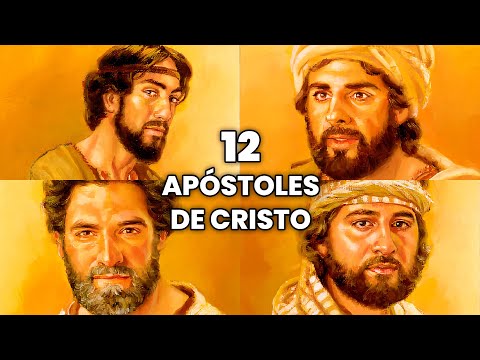
Los 12 Apóstoles de Jesucristo | ¿Quiénes fueron los doce discípulos? | Religión
Who Were the Twelve Disciples?
Overview of the Disciples
- The disciples, or apostles, are considered the cornerstones of Christ's church. Their names will be inscribed on the twelve foundations of the New Jerusalem as mentioned in Revelation 21:14, highlighting their significance.
Apostle 1: Peter
- Simon Peter, son of Jonah, was a fisherman from Betsaida and Capernaum. He engaged in missionary work among Jews and is known for his leadership role among the apostles. Tradition states he was crucified upside down in Rome.
- Peter's name appears first in all apostolic lists; he had multiple names and spoke Hebrew. His name means "rock" in Greek (Simon) and Arabic (Cephas).
- Described as quick-tempered and eager for honor, Peter exemplified typical Galilean traits—loyalty and impulsiveness—making him a natural leader among the twelve disciples.
- He was a key figure who asked about forgiveness frequency and sought rewards for following Jesus; he also denied Christ but showed resilience by regaining courage after failures.
- His martyrdom involved being crucified upside down due to feeling unworthy to die like Jesus; his symbols include an inverted cross with crossed keys.
Apostle 2: James (the Ancient)
- James, son of Zebedee and Salome, brother of John, was also a fisherman from Bethsaida and Capernaum; he was beheaded by Herod around 44 AD due to his prominence among the apostles.
- Little is known about James individually as he often appears alongside John; they were inseparable partners in ministry with shared characteristics such as courage and faithfulness.
- Recognized as the first martyr among the twelve disciples, his symbol is three shells representing pilgrimage through water.
Apostle 3: John
- John Boanerges (son of Zebedee), brother of James, is referred to as "the beloved disciple" within Christ’s Inner Circle; he preached across Asia Minor before dying a natural death later on.
- Known for ambition and temperamental nature early on, John's character evolved over time into one marked by love for God despite earlier explosive tendencies; he remained close to Peter throughout their ministry together.
- His symbol includes a chalice with a serpent due to an attempted poisoning incident that did not harm him thanks to divine intervention.
Apostle 4: Andrew
- Andrew was Peter's brother and initially worked as a fisherman before becoming one of Jesus' first followers after hearing from John the Baptist about Him (John 1:40).
- He played an essential role in bringing others to Jesus without seeking personal recognition or jealousy towards his brother’s prominence; tradition holds that Andrew died a martyr's death in Achaia, Greece.
- After converting many people including influential figures like Governor’s brother Aepeas who became angry at Andrew’s success leading to his arrest—Andrew requested an alternative form of crucifixion which led to what is now called St. Andrew's cross symbolizing him as well as reflecting his background as a fisherman.(572)
Apostle 5: Bartholomew
- Bartholomew Nathanael lived in Cana of Galilee; tradition suggests he served as a missionary in Armenia possibly coming from noble lineage given his royal blood ties through family history.(610)
Apostolic Martyrdom and Legacy
Apostle 5: Unknown Martyr
- The New Testament provides limited information about this apostle, highlighting him as a diligent investigator of Scripture and an adventurous missionary in regions like Phrygia, Hierapolis, and Armenia.
- He faced a brutal martyrdom, being skinned alive with knives; his apostolic symbol is represented by three parallel knives.
Apostle 6: James the Less
- Known as Santiago the Minor or youngest son of Alphaeus, he lived in Galilee and was believed to have authored the Epistle of James. He preached in Palestine and Egypt before being crucified there.
- James was characterized by strong conviction; he also died a martyr's death where his body was cut into pieces. His apostolic symbol is a saw.
Apostle 7: Judas Iscariot
- Judas Iscariot, identified as the traitor from Kerioth in Judah, is considered one of the greatest enigmas of the New Testament due to his betrayal despite close proximity to Jesus.
- His background included being a violent nationalist Jew who hoped for political liberation through Jesus but ultimately betrayed Him for unknown reasons.
- It’s emphasized that while Judas's actions led to Jesus's crucifixion, it was humanity's sins that were truly responsible. His apostolic symbol reflects his betrayal—a noose or bag of silver coins.
Apostle 8: Judas Thaddeus
- Also known as Lebeo or Thaddeus, he was another lesser-known apostle from Galilee who preached in Assyria and Persia before dying as a martyr there.
- He had multiple names throughout scripture (Thaddeus, Lebeo), indicating his complex identity. His character reflected intense nationalism with aspirations for power.
- At the Last Supper, he questioned Jesus about manifesting Himself only to them rather than the world; this shows his desire for broader recognition of Christ’s kingship.
Apostle 9: Matthew
- Matthew (Levi), originally a tax collector from Capernaum, authored the Gospel bearing his name and met martyrdom in Ethiopia.
- Tax collectors were despised among Jews for their perceived corruption; however, Matthew transformed into a devoted follower after encountering Jesus.
A Study of the Apostles: Philip, Simon the Zealot, and Thomas
The Apostle Philip
- Philip is introduced as a fisherman from Bethsaida, sharing a background with Peter and Andrew. His significance grows in the Gospel of John where he becomes a more defined character.
- Scholars debate whether the Philip mentioned in Acts as one of the seven deacons is indeed the same apostle. His missionary work in Samaria and conversion of an Ethiopian eunuch are highlighted (Acts 8:26).
- In John's Gospel, Philip is depicted as one of Jesus' first followers who was called to "Follow me," indicating his early commitment to Christ.
- When introducing Bartholomew to Jesus, Philip demonstrates both a simple faith and an instinct for evangelism by inviting him to "Come and see."
- Despite his warm heart, Philip struggled with pessimism but dedicated himself fully to his mission. Tradition states he died by hanging, requesting humble burial wrappings.
The Apostle Simon the Zealot
- Simon is described as a lesser-known follower known as Simon the Cananist or Zealot. He lived in Galilee and was traditionally believed to have been crucified.
- Little personal information about Simon exists in the New Testament; however, he is characterized as a nationalist zealot who fought against Roman oppression.
- Simon's fervor for Jewish law made him stand out among disciples. His transformation from a violent nationalist to a devoted follower illustrates profound faith.
- Notably, despite his past hatred towards Romans, he shared love with Matthew, highlighting unity among diverse backgrounds within Jesus' followers.
- Tradition holds that Simon became a martyr for his faith after preaching God's will without coercion.
The Apostle Thomas
- Thomas Didimos lived in Galilee and later suffered martyrdom near Madras, India. He had both Hebrew (Thomas) and Greek (Didimos) names.
- In John's Gospel, Thomas appears during significant events like Lazarus' resurrection and expresses doubt about Jesus’ resurrection until he sees physical evidence (John 20:25).
- This skepticism earned him the title "Thomas the Unbeliever." However, through doubt came belief; he ultimately declared faith upon seeing Christ’s wounds.
- Thomas exemplifies childlike curiosity—questioning rather than accepting blindly—and eventually became courageous enough to spread Christianity even unto death by spear.