Capital Structure (2025 Level I CFA® Exam – Corporate Issuers – Module 7)
Introduction to Corporate Issuers and Capital Structure
In this section, the speaker introduces the topic of corporate issuers and focuses on the reading about capital structure. The two main decisions made by executive leadership teams are discussed, including capital budgeting and how to pay for long-term assets.
Capital Budgeting
- Capital budgeting is the process of planning for the purchase of long-term assets.
- It is important to think about the product lines and services generated by these assets.
Capital Structure
- Capital structure refers to the mix of debt and equity used to finance a company's assets.
- When a project with positive Net Present Value is found, the question arises on how to pay for it.
- Options include using internally generated funds or going to external markets such as bond or stock markets.
Factors Affecting Capital Structure
This section discusses factors that influence capital structure and how it changes over time. The speaker mentions topics such as leverage, business model characteristics, tax rate, capital structure policies and guidelines set by the board of directors, and third-party ratings agencies.
Internal Factors
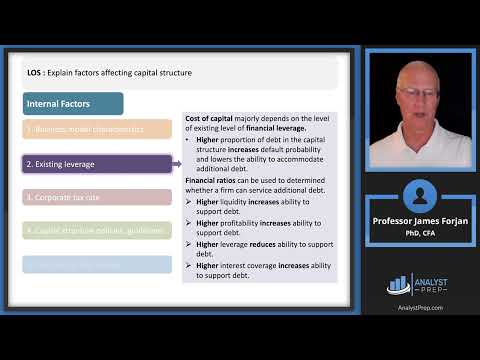
- Existing leverage of the firm, represented by the debt-equity ratio, affects its ability to use debt financing.
- Business model characteristics can influence access to cheaper debt financing. For example, companies with heavy equipment may have more debt in their capital structure.
External Factors
- Market conditions play a role in determining capital structure.
- Third-party ratings agencies like Moody's and Standard & Poor's assess a company's ability to make debt payments based on total debt and annual operating cash flows.
Timestamps provided are associated with English language content.
Stakeholders and Competitors
This section discusses the stakeholders interested in a business's activities, such as local and federal governments and regulatory bodies. It also explores the importance of analyzing competitors' actions.
Analyzing Stakeholders and Competitors
- Businesses attract the attention of various stakeholders, including local and federal governments, as well as regulatory bodies.
- It is crucial to consider what competitors are doing. Comparing metrics like debt equity ratios can help determine if a company's leverage is appropriate compared to its competitors.
Business Model Characteristics
This section focuses on specific characteristics of a business model that impact capital structure decisions.
Factors Affecting Capital Structure
- Revenue and cash volatility should be considered when evaluating a business model. Sustainable cash flows are preferred over highly volatile ones. Brand name product lines and deviations from them also affect earnings predictability.
- Operating leverage, which relates to fixed assets and ownership, is another factor influencing capital structure decisions.
Existing Leverage and Financial Ratios
This section discusses existing leverage and how financial ratios impact capital structure decisions.
Evaluating Existing Leverage
- Existing leverage plays a role in determining capital structure choices. Financial ratios provide insights into a company's ability to support its debt obligations and issue new bonds. Higher liquidity increases this ability, while higher leverage reduces it.
Corporate Tax Rate and Capital Structure Policies
This section explores the relationship between corporate tax rates, capital structure policies, and guidelines.
Impact of Corporate Tax Rate
- The corporate tax rate affects the tax advantage of debt in the capital structure. Higher corporate tax rates increase the tax benefit. It is important to be aware of the current and potential future corporate tax rates when making capital structure decisions.
- Capital structure policies and guidelines should align with the board of directors' objectives and the company's ability to magnify returns.
Third-Party Ratings Agencies and External Factors
This section discusses the role of third-party ratings agencies and external factors in capital structure decisions.
Evaluating Credit Risk
- Third-party ratings agencies assess the quality and safety of a company's debt, considering credit risk and default probabilities. Analysts look for investment-grade bonds based on clients' risk preferences.
- External factors, such as the cost of debt, equity, and weighted average cost of capital (WACC), influence capital structure decisions. Understanding these costs helps determine an appropriate capital structure.
Cost of Debt Calculation
This section explains how to calculate the cost of debt for a risky bond.
Calculating Cost of Debt
- The cost of debt for a risky bond involves adding basis points reflecting the credit spread to a risk-free rate of interest, such as Treasury yields.
The transcript does not provide timestamps beyond this point.
New Section
This section discusses the cost of debt and the importance of third-party ratings in determining the cost of debt for different bonds.
Cost of Debt and Third-Party Ratings
- The cost of debt for a bond is determined by the risk-free rate plus a small credit spread. A AAA-rated bond will have a lower cost of debt compared to a double C-rated bond.
- Understanding third-party ratings is crucial in determining the cost of debt.
- Previous readings on business cycles and sectors are relevant to understanding this topic.
New Section
This section highlights the correlation between different readings and organizations related to government, regulators, financial services industry, and public utility companies.
Correlation Between Readings and Organizations
- There are correlation coefficients between different readings, indicating their interrelatedness.
- Governments and regulators play a role in setting regulations for various industries, such as ensuring safety standards for products like lawn mowers or regulating financial services differently from other industries.
- Public utility companies are subject to regulatory constraints that determine pricing for their services.
New Section
This section discusses competition within industries and compares companies with their peers.
Competition Within Industries
- Comparing companies within an industry can be insightful, similar to espionage in James Bond movies.
New Section
This section explores the life cycle stages of a company, focusing on startup and growth phases.
Life Cycle Stages: Startup
- In the startup stage, business risks are high due to minimal revenues and high expenses.
- Raising capital privately and dealing with unstable cash flows are common challenges for startups.
Life Cycle Stages: Growth
- As a company enters the growth stage, business risks decrease as revenues increase.
- More investment is needed to achieve growth, economies of scale, and possibly economies of scope.
The transcript provided does not include timestamps for all sections.
New Section
In this section, the speaker discusses the mature stage of a business and the importance of branded product lines and low business risk. They also mention the possibility of issuing commercial paper and bonds for financing.
Mature Stage
- The mature stage is characterized by branded product lines with slow or decreasing revenue growth.
- Cash flows are positive and sustainable, and business risk becomes low.
- Branded product lines indicate low business risk as they can be sold easily.
- During this stage, companies may issue commercial paper or bonds for short-term financing needs.
- There is a possibility of deleveraging as debt securities mature or are paid off.
- Mature firms often pay dividends and repurchase shares to maximize shareholder wealth.
New Section
This section focuses on the concept of capital-intensive businesses versus capital-light businesses. It also mentions the importance of understanding these terms for answering related questions.
Capital Intensive vs Capital Light Businesses
- Capital-intensive businesses require significant investments in assets, such as machinery or equipment (e.g., John Deere).
- Marketable assets make it easier to sell product lines in capital-intensive businesses.
- Capital-light businesses, like software or tech companies, require less investment in physical assets.
- Understanding the definitions of capital-intensive and capital-light businesses helps answer related questions.
New Section
The speaker discusses an influential paper published in 1958 by Franco Modigliani and Merton Miller that contributed to the development of finance as a discipline. They emphasize the goal of maximizing shareholder wealth through generating cash flows and finding an optimal capital structure.
Franco Modigliani and Merton Miller's Paper
- Published in 1958, their paper is considered seminal in finance, creating the discipline itself.
- The paper is known for its simplistic language and application of calculus.
- The goal of maximizing shareholder wealth is achieved by generating cash flows and finding an optimal capital structure.
- The weighted average cost of capital (WACC) plays a crucial role in determining the discount rate for present value calculations.
- Minimizing the WACC maximizes the present value of cash flows, contributing to shareholder wealth.
New Section
This section further explores the concept of maximizing shareholder wealth through generating cash flows and finding an optimal capital structure. It introduces the equation for calculating the weighted average cost of capital (WACC).
Maximizing Shareholder Wealth
- Generating cash flows and finding a suitable capital structure are key to maximizing shareholder wealth.
- Making products for pennies and selling them for dollars helps generate significant cash flows.
- Branded product lines contribute to maximizing shareholder wealth.
- The optimal capital structure minimizes the weighted average cost of capital (WACC).
- Minimizing the denominator in WACC calculations maximizes the present value of cash flows.
New Section
In this section, the speaker explains how to calculate the weighted average cost of capital (WACC) using an example involving bondholders' required return.
Calculating Weighted Average Cost of Capital (WACC)
- The WACC is calculated as a weighted average interest rate or required return on debt and equity.
- Using an example with bondholders, assume one-third of investors lend money at a 10% interest rate (required return).
- The weight in debt (WD) represents their proportionate contribution to total financing.
Timestamps were not available for some sections.
Weighted Average Cost of Capital (WACC)
This section discusses the calculation of the weighted average cost of capital (WACC) using different sources of financing.
Calculation of WACC
- The WACC is calculated by taking a weighted average of the costs associated with each source of financing.
- Three sources are considered: debt, preferred stock, and common stock.
- Each source is assigned a weight based on its proportion in the company's capital structure.
- Debt weight: one-third
- Preferred stock weight: one-third
- Common stock weight: one-third
Assumptions for WACC Calculation
- The discussion assumes certain assumptions known as the Modigliani-Miller propositions:
- Homogeneous expectations among investors
- Perfect capital markets without transaction costs or taxes
- Investors can borrow and lend at the risk-free rate
- No agency costs or financial distress costs
- Financing and investment decisions are independent of each other
Proposition 1: Market Value of Company and Capital Structure
- Proposition 1 states that the market value of a company is not affected by its capital structure.
- Changing the debt-equity ratio does not impact the overall value of the company.
Proposition 2: Cost of Capital and Risk
- Proposition 2 states that the cost of capital is directly related to the riskiness of an investment.
- Higher-risk investments will have higher required returns.
New Section
In this section, the speaker discusses the importance of focusing on the quality of assets and the ability to generate cash flows when evaluating a company's value.
Quality of Assets and Cash Flow Generation
- The speaker emphasizes that instead of worrying about the right-hand side of the balance sheet (bonds and equity), it is crucial to focus on the left-hand side in terms of its ability to generate cash flows.
- The concept of EBIT (earnings before interest and taxes) is introduced as a measure for cash flow generation.
- The speaker mentions that Eminem (referring to Modigliani and Miller) suggested substituting EBIT with other versions of cash flow, such as operating cash flow or free cash flow.
- According to Modigliani and Miller, the value of a firm depends on two factors: the quality of its assets (including product lines and property, plant, and equipment) and its ability to generate EBIT.
- The idea of a "no growth firm" is explained, where a company generates consistent EBIT over time without any growth. This concept was criticized but helped emphasize the importance of focusing on core aspects like generating EBIT.
- The formula for calculating firm value using present value terms by dividing by weighted average cost of capital is mentioned.
New Section
In this section, proposition one from Modigliani and Miller's paper is discussed, which states that the market value of a company is not affected by its capital structure.
Proposition One: Market Value Not Affected by Capital Structure
- Proposition one states that changes in capital structure do not impact the market value of a company.
- The speaker reiterates that Modigliani and Miller emphasized focusing on two things: quality of assets and weighted average cost of capital.
- The explicit nature of proposition one is highlighted, stating that the market value of a company is not influenced by its capital structure.
- The speaker mentions that they will provide further evidence to support this proposition in upcoming slides.
New Section
In this section, proposition two from Modigliani and Miller's paper is discussed, which states that the cost of equity is a linear function of the company's debt-equity ratio.
Proposition Two: Cost of Equity and Debt-Equity Ratio
- Proposition two states that without taxes, the cost of equity is directly related to the company's debt-equity ratio.
- The speaker refers to Harry Markowitz and William Sharpe as other finance pioneers who also explored the concept of linearity in variables important in finance.
- The formula for calculating the cost of equity with and without debt financing is explained.
- It is mentioned that adding debt increases the cost of equity linearly but does not change the company's value due to offsetting effects between equity and debt proportions.
New Section
In this section, implications related to leverage and cost of equity are discussed.
Implications of Leverage on Cost of Equity
- Higher leverage increases the cost of equity linearly, as shown previously.
- However, increasing leverage does not change the overall value of the company because any increase in equity is offset by a greater proportionate use of debt.
- An example illustrating these implications will be provided in subsequent slides.
New Section
In this section, an example demonstrating how changes in capital structure affect firm value will be presented.
Example: All-Equity Firm vs. Debt Financing
- A hypothetical all-equity firm with no debt financing is considered.
- The firm generates a cash flow of $10,000 and has a cost of equity of 10%.
- The present value of the perpetual cash flow is calculated using the cost of equity.
- The value of the firm is determined to be $100,000.
- It is emphasized that in an all-equity firm, the cost of equity and weighted average cost of capital are the same.
New Section
In this section, the impact of issuing debt and repurchasing stock on the cost of equity will be discussed.
Impact of Debt Issuance on Cost of Equity
- The company plans to issue $20,000 in debt and use the proceeds to repurchase stock.
- The question posed is: What will be the new cost of equity?
Debt Equity Ratio and Cost of Equity
In this section, the speaker discusses the impact of changing the debt equity ratio on the cost of equity.
Increasing Debt in Capital Structure
- The speaker explains that by increasing the debt in the capital structure, the numerator (debt) increases and the denominator (equity) decreases in the debt equity ratio.
- This change in the debt equity ratio affects the cost of equity.
Calculation Example
- The speaker provides an example where they start with a debt equity ratio of zero over a hundred.
- They add 20 to both sides of the ratio, resulting in a new debt equity ratio of 20 over 80.
- This change leads to a higher cost of equity.
Impact on Cost of Equity
- The speaker states that due to the increase in debt, the cost of equity also increases.
- The previous cost of equity was 10%, but now it becomes 11.25%.
- This demonstrates how changing the capital structure affects the cost of equity.
Clarification on Value Change
- The speaker addresses a potential confusion regarding changes in value.
- They explain that even though changing from 10% to 11.25% may seem like it would decrease present value, it is not necessarily true because there is now some amount of debt included.
Weighted Average Cost of Capital (WACC)
In this section, WACC is discussed as an important metric for evaluating a firm's ability to generate cash flows and obtain external funding at favorable rates.
Evaluating Firm's Ability
- The focus should be on evaluating a firm's ability to generate cash flows from its assets and its ability to obtain funding from external markets at low interest rates.
- Maximizing shareholder wealth involves minimizing the weighted average cost of capital (WACC).
WACC Calculation Example
- The speaker provides an example where debt is issued at a cost of 5%.
- The weight of debt in the capital structure is 20 out of 100, and the weight of equity is 80 out of 100.
- The WACC calculation combines the cost of debt (5%) and the cost of equity (11.25%), resulting in a WACC of 10%.
Implications for Firm Value
- The speaker emphasizes that even though there are changes in the capital structure and costs, the value of the firm remains unchanged.
- They mention a no-growth company with $10,000 in annual operating cash flows, which still has a value equal to its cash flows divided by the WACC.
Medigliani-Miller Propositions
In this section, Medigliani-Miller propositions are introduced as important concepts related to firm valuation.
Medigliani-Miller Propositions
- The speaker introduces proposition one without taxes, which states that the market value of a levered company is equal to the value of an unlevered company plus the value of the debt tax shield.
- They highlight how issuing debt can lower tax liability and increase shareholder wealth.
Linear Relationship with Tax Shield
- A profitable company can increase its value by employing more debt due to higher tax rates.
- There is a linear relationship between profitability and increasing debt when considering tax shields.
Adjustments for Tax Rate
- When calculating firm value with taxes, adjustments need to be made for the tax rate.
- Earnings before interest and taxes should be multiplied by one minus the tax rate before dividing by WACC.
Proposition One with Taxes
In this section, proposition one with taxes is discussed, emphasizing the impact of tax shields on firm value.
Proposition One with Taxes
- The market value of a levered company is equal to the value of an unlevered company plus the value of the debt tax shield.
- Issuing bonds can lower tax liability and increase shareholder wealth.
Maximizing Shareholder Wealth
- Firms will continuously issue bonds and repurchase shares to maximize shareholder wealth.
- This strategy aims to increase the value of the tax shield linearly over time.
Calculation Example
- The speaker provides a calculation example where they divide the bond issue by the cost of debt and divide another amount by the cost of equity to determine firm value.
- The equation shows that the value of the firm is equal to the market value of debt plus equity.
Implications and Adjustments for Tax Rate
In this section, implications related to tax rates are discussed, along with adjustments needed when calculating firm value.
Implications for Profitable Companies
- A profitable company can increase its value by employing more debt due to higher tax rates.
- Higher tax rates lead to greater profitability through increased tax shields.
Adjustment for Tax Rate
- When calculating firm value with taxes, earnings before interest and taxes should be multiplied by one minus the tax rate before dividing by WACC.
- This adjustment accounts for the impact of taxes on cash flows.
These notes provide a comprehensive summary of key points discussed in each section.
Understanding the Value of a Firm
In this section, the speaker discusses the importance of understanding how to calculate the value of a firm. They provide an example and explain the steps involved in determining the value of both the unlevered company and the firm with taxes.
Calculating the Value of the Unlevered Company
- The speaker starts by explaining that in order to calculate the value of a firm, it is necessary to understand how to compute certain mathematical calculations.
- They mention that there are 25 questions at the end of the reading material that involve computations and calculations.
- The first step is to determine the value of the unlevered company, which is represented by an EBIT (Earnings Before Interest and Taxes) of $6000.
- To calculate this value, one needs to subtract one minus the tax rate (30%) from EBIT divided by weighted average cost of capital (12%).
- The resulting value for the unlevered company is $35,000.
Incorporating Debt and Taxes
- Next, they introduce debt into consideration. There is a debt amounting to $18,000.
- To determine its impact on firm value, multiply this debt amount by 30% (tax rate).
- This calculation results in an additional $5400 being added to reach a total firm value of $40,400.
Importance of Cash Flows and Tax Liabilities
- The speaker emphasizes that cash flows generated by a company contribute significantly to its overall value ($35,000).
- Additionally, they mention that governments impose tax liabilities on companies which need to be considered when calculating firm value.
- Due to tax deductibility on interest expenses, an extra $5400 needs to be added ($40,400).
Cost of Equity Calculations
In this section, the speaker discusses how to calculate the cost of equity and its impact on firm value.
Determining Equity Value
- The previous firm value ($40,400) needs to be adjusted by subtracting the debt amount ($18,000).
- This results in an equity value of $22,400.
Computing Cost of Equity
- The speaker mentions that they will now work through some cost of equity calculations.
- They refer back to the weighted average cost of capital (WACC) mentioned earlier (12%).
- By subtracting 6% from 12%, they obtain a difference of 6%.
- Dividing 18 by 22.4 (debt-equity ratio), they arrive at a little over 15% as the cost of equity.
Recomputing Firm Value
- Using present value calculations, they compute the new firm value by multiplying 6% with $18,000 and then dividing it by 6% plus the previous ratio obtained.
- Subtracting interest expense multiplied by one minus tax rate from EBIT divided by the new cost of equity (15%), they determine a firm value of $40,000.
Financial Distress Costs and Indirect Costs
In this section, the speaker introduces financial distress costs and indirect costs into their model for determining firm value.
Relaxing Assumptions about Financial Distress Costs
- The speaker acknowledges that their previous model did not consider financial distress or bankruptcy costs.
- They explain that relaxing this assumption adds complexity to the model but brings it closer to reality.
Direct Financial Distress Costs vs. Indirect Costs
- Direct financial distress costs are actual cash expenses related to bankruptcy such as legal fees.
- Indirect costs are explained using an example where a company's decision to issue bonds and invest in assets does not pay off, causing stress and inefficiency in operations.
- Indirect costs can include loss of efficiency, strained relationships with customers, creditors, suppliers, and increased agency costs.
Expectations Regarding Financial Distress Costs
- Financial distress costs increase as the relative cost of debt finance increases.
- Bondholders may charge higher interest rates (e.g., 13% instead of 10%) due to perceived financial distress.
New Section
In this section, the concept of optimal capital structure is introduced, taking into account corporate taxes and financial distress costs. The unique debt equity ratio that maximizes the value of the firm is discussed.
Optimal Capital Structure
- Mediglian and Miller's work in 1958 laid the foundation for the concept of optimal capital structure.
- Subsequent researchers developed the idea of an optimal capital structure considering corporate taxes and financial distress costs.
- The presence of corporate taxes and financial distress costs leads to a unique debt equity ratio that maximizes firm value.
- Marginal benefits (tax subsidy) and marginal costs (financial distress cost) need to be weighed when determining the optimal capital structure.
- When marginal costs are identical, firm value is maximized.
- The modification of M&M proposition states that the value of a levered firm is equal to the value of an unlevered firm plus tax shield minus financial distressed costs.
New Section
A graphical representation is used to illustrate how different factors impact the market value of a firm and lead to an optimal capital structure.
Graphical Representation
- A graph with market value on the vertical axis and leverage (debt equity ratio) on the horizontal axis is presented.
- The goal is to maximize market value by finding an optimal capital structure.
- Starting from zero debt, as debt increases, so does the market value due to tax benefits (interest tax shield).
- However, as financial distress costs come into play, the slope decreases until it reaches zero at an optimal debt equity ratio (o star point).
- This graph reflects real-world considerations such as bankruptcy costs, indirect financial distress, agency costs, etc.
New Section
The impact of capital structure on market value is further explored, highlighting the importance of considering factors beyond the original M&M proposition.
Market Value and Optimal Capital Structure
- Market value is now affected by capital structure, contrary to the original M&M proposition.
- The quality of assets and weighted average cost of capital determine market value (green line).
- Optimal capital structure adds value to the firm.
- By incorporating factors like taxes, financial distress costs, bankruptcy, and agency costs, a more realistic understanding of maximizing shareholder wealth is achieved.
- Projects with high cash flows and finding the optimal capital structure on the right side of the balance sheet contribute to maximizing shareholder wealth.
New Section
A summary page provides key insights about debt levels, tax benefits, financial distress costs, and optimal capital structure.
Summary
- Lower levels of debt result in tax benefits exceeding financial distress costs (upward slope).
- As more debt is added, financial distress costs increase significantly (downward slope).
- Beyond a certain point (optimal capital structure), excessive debt reduces firm value.
- The optimal debt equity ratio represents an optimal capital structure for maximizing firm value.
Optimal Capital Structures and Target Capital Structure
The section discusses the concept of optimal capital structures and target capital structure. It emphasizes that managers cannot identify the exact optimal capital structure but can determine a range of capital structures.
Optimal Capital Structures
- Managers cannot identify the precise optimal capital structure.
- An article allows executives to find a range of capital structures.
- Factors such as tax rates, business risks, governance, and financial accounting influence the optimal capital structure.
Target Capital Structure
- A target capital structure is a range within the optimal debt-equity ratio.
- Executives use book values and market values to determine the weights in computing the target capital structure.
- Financial analysts need to estimate these weights since they don't have access to daily book and market values.
Weight Calculation and Pecking Order Theory
This section explains how to compute weights using market values. It also introduces pecking order theory, which prioritizes internally generated funds, followed by debt and equity.
Weight Calculation
- When computing optimal capital structure, use market values rather than book values.
- Summary of weight calculation: Use market values for determining weights.
Pecking Order Theory
- Internally generated funds are preferred over debt and equity.
- Debt is preferred over equity due to lower expenses.
- Increasing debt may reduce agency costs of equity by reducing excessive spending by management.
Agency Costs, Stakeholder Interests, and Preferred Shareholders
This section discusses agency costs theory related to increasing debt usage. It also highlights stakeholder interests and characteristics of preferred shareholders.
Agency Costs
- Increasing debt usage may impact agency costs of equity.
- More leverage reduces management's incentive for excess consumption, leading to reduced agency conflict.
Stakeholder Interests
- Bondholders prefer low-risk projects, while shareholders prefer high-risk projects.
- Optimal capital structure can minimize conflicts between bondholders and shareholders.
Preferred Shareholders
- Preferred shares are considered hybrid securities.
- They often pay a fixed dividend but do not mature.
- Preferred shareholders have characteristics of both bonds and equity.
Board of Directors and Compensation Committee
This section highlights the role of the board of directors and the compensation committee in minimizing agency conflict and aligning shareholder and executive interests.
Board of Directors
- The board is hired to maximize shareholder wealth.
- The compensation committee designs contracts to reduce agency conflict.
- Contracts align the interests of shareholders and executive leadership.
Final Remarks and Vignettes
The section provides final remarks on studying optimal capital structures. It also mentions vignettes in some problems that require comprehensive understanding.
Final Remarks
- Studying optimal capital structures is essential for making informed estimates as financial analysts.
- Some problems include vignettes that require a deeper understanding.
Timestamps may vary slightly due to differences in video versions or edits.