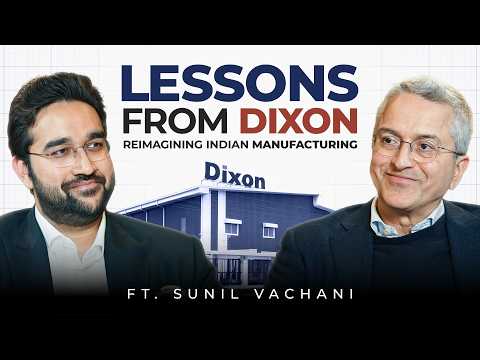
Sunil Vachani on Dixon's 30x Growth and Manufacturing in India | Perspectiv with Parthiv Ep 3
The Intersection of Business and Focus
Business Philosophy
- Mr. Vachani compares business to yoga, emphasizing that proper focus leads to success.
- Dixon Technologies has a production capacity of 70 million smartphones out of the 160 million sold in India, showcasing significant market presence.
- He explains the rationale behind not investing in real estate, stating that it would divert focus from electronic manufacturing.
Growth Metrics
- Dixon's revenue growth is highlighted, increasing from 1,200 crores to 39,000 crores—a remarkable achievement.
- Mr. Vachani notes customer retention as a key factor for their success; no customers have left during their journey.
The Four S's of Manufacturing Success
Key Components for Global Superpower Status
- Mr. Vachani identifies four critical elements: Supply Chain, Scale, Scaling (growth), and Simplicity.
- He emphasizes the importance of fostering an environment where failure is accepted to encourage innovation and entrepreneurship in India.
Introduction to Sunil Vachani and Dixon Technologies
Background on Mr. Vachani
- The host introduces Mr. Sunil Vachani as a transformative figure in Indian industry with a remarkable entrepreneurial journey.
- Dixon Technologies is recognized for its role in India's manufacturing landscape across various electronics sectors.
Company Achievements
- Under Mr. Vachani’s leadership, Dixon has become synonymous with quality manufacturing and execution excellence.
Early Influences and Family Legacy
Family Background
- Discussion about Mr. Vachani's father, who pioneered color television technology in India through his company Weston.
Challenges Faced by Weston
- Weston was an iconic brand but faced challenges due to market dependency on Russia which led to financial struggles when that market collapsed.
Decision-Making and Entrepreneurial Spirit
Starting His Own Venture
- After facing difficulties at Weston, Mr. Vachani chose to start his own business rather than salvage the existing one due to joint family dynamics complicating decision-making.
Involvement with Family Business
- He initially trained within the family business before deciding on his path towards establishing Dixon Technologies independently.
The Journey of Entrepreneurship and Innovation
Overcoming Failure in Business
- The speaker discusses taking over a bankrupt company, Iel Wireless Limited, which was one of the first to venture into cordless telephones but ultimately failed, leading to significant financial losses.
- The speaker reflects on the challenge of regaining trust after experiencing failure at a young age, emphasizing how daunting this experience can be.
- Acknowledges that innovation in India is stifled by a cultural stigma surrounding failure, contrasting it with the U.S. where children are encouraged to learn from their failures.
- The speaker credits their father for supporting them despite previous failures, allowing them to start anew with capital and encouragement.
- Highlights the importance of familial support in entrepreneurship, noting that all three siblings were given opportunities to pursue their own ventures.
Establishing Dixon: Foundations and Support
- The name "Dixon" was chosen by the speaker's father, inspired by a popular UK retail chain; initial capital was provided for starting the business.
- Introduces Atulmy as a co-founder who has been integral since inception; emphasizes the value of blessings and support received during this journey.
- Reflecting on hindsight regarding foundational elements that contributed significantly to Dixon's success.
Family Dynamics in Business
- Discusses whether having too many family members involved can hinder business growth; believes joint families can be strong if structured properly.
- Emphasizes the need for clear boundaries and defined roles within family businesses to avoid conflicts and inefficiencies.
Personal Reflections on Brand Management
- The speaker expresses doubt about their ability to run a brand effectively due to personal inclinations not aligning with brand management tasks.
- Shares an honest reflection that even if they had joined the family business earlier, they may not have made significant contributions due to differing skill sets.
Lessons Learned from Entrepreneurial Experience
- Discusses attempts at managing both EMS operations and brand development but realized early on that focus is crucial for success in business.
- Advises aspiring entrepreneurs that maintaining focus is essential; likens successful business management to yoga—emphasizing clarity and concentration.
Understanding the Shift from Brand to Manufacturing
Transitioning Focus in Business
- The speaker reflects on realizing their strengths lie in electronic manufacturing rather than brand management, leading to significant progress for their company.
- They discuss the differences between running a brand and manufacturing for one, emphasizing that they are better suited for the latter due to their focus on detail and big-picture thinking.
Risks of Running a Brand
- The speaker highlights the substantial risks involved in brand management, particularly in competitive markets like India where marketing costs are high.
- They express uncertainty about what it takes to nurture a successful brand, suggesting that their skills align more with manufacturing processes.
Economic Context of Dixon's Success
- The discussion touches on how Dixon's establishment coincided with India's economic liberalization, which opened doors for outsourcing opportunities.
- Initially, electronic manufacturing as a service was not popular; companies preferred in-house production. However, foreign multinationals began seeking local partners due to changing market dynamics.
Early Partnerships and Breakthroughs
- The speaker recounts how multinational companies entering India were looking for outsourcing partners, which aligned perfectly with Dixon’s capabilities.
- They mention an early partnership with LG (then Lucky Gold Star), which marked a pivotal moment despite initial skepticism about small orders.
Product Range and Market Positioning
- Dixon is described as "the brand behind the brands," focusing on manufacturing various products including LED televisions, lighting systems, mobile phones, IT hardware, home appliances like washing machines and refrigerators.
- The company has established itself by producing goods for numerous iconic brands across different sectors.
Electronics Manufacturing in India: Challenges and Growth
Overview of the Company’s Growth
- The company has established a joint venture with a major customer, expanding its manufacturing capabilities to export products internationally.
- They manufacture for iconic brands like Samsung and various Android manufacturers, showcasing their extensive client base.
Early Challenges in Electronics Manufacturing
- Convincing stakeholders of the business model's viability was difficult due to the parent company's financial struggles, which created stigma.
- Securing funding was particularly challenging; initial loans were hard to obtain until a Japanese bank provided support.
- The ongoing challenge for entrepreneurs remains raising funds, as there is still a lack of strong venture capital networks in India.
Achievements and Market Position
- The company recently surpassed Samsung as India's largest mobile phone manufacturer by quantity, emphasizing scale over direct comparison.
- Scale is viewed as crucial for global competitiveness; past strategies focused on small market segments are shifting towards larger production capacities.
Future Vision and Strategic Shifts
- There is a need for large-scale factories that cater not just to Indian markets but also aim at global standards.
- Dixon aims to produce 30% of India's smartphone market share, highlighting their significant role in domestic manufacturing.
Investment in Ecosystem and Technology
- Sustainable success requires investment in backward integration, component ecosystems, and long-term design initiatives.
- Acknowledging that past successes won't guarantee future growth emphasizes the need for transformation within the company.
Component Manufacturing Strategy
- The focus on creating an internal component ecosystem will initially serve their own needs before potentially expanding into broader markets.
- Currently, only 20% of mobile phone components are made domestically; increasing this percentage is vital for enhancing export potential.
Mobile Manufacturing in India: A Journey of Growth
Evolution of Mobile Phone Industry
- The mobile phone industry in India has transformed significantly over the past 15 years, shifting from nearly complete imports to becoming one of the largest export categories.
- Countries like Vietnam and Thailand took years to achieve value addition in electronics; India aims to accomplish this much faster.
Market Insights
- Mobile phones represent the largest product category in India, with sales reaching approximately $30 billion, compared to home appliances at about $10 billion.
- IT hardware is identified as a promising future product category due to India's annual import expenditure of around $15 billion on these products.
Role of Private Equity
- Dixon's experience with private equity was pivotal for growth; their first investor, Motilal Oswal, aligned with the company's vision and values.
- The involvement of private equity shifted Dixon's focus from day-to-day operations to broader strategic goals.
IPO Experience
- Initial apprehension surrounded the IPO process; early meetings with investors were challenging due to skepticism about India's manufacturing capabilities.
- Despite initial difficulties, effective communication during roadshows led to a successful IPO that was oversubscribed by 128 times.
Advice for Entrepreneurs
- Engaging private equity can provide significant value; entrepreneurs should be prepared for both challenges and opportunities that come with such partnerships.
Private Equity and Corporate Governance
The Role of Private Equity in Business Growth
- Private equity investors have played a significant role in the success stories of companies, particularly through deep involvement in their operations.
- Investors emphasize the importance of corporate governance and believe in scaling investments, focusing on design and people.
- A notable achievement is the increase in revenues from 1,200 crores to 39,000 crores over ten years, highlighting substantial growth.
Vision Beyond Numbers
- Emphasizing that vision should not be limited to numerical goals; it’s crucial for entrepreneurs to think about making impactful changes.
- The speaker expresses pride not just in numbers but also in customer retention, noting that no customers have left them throughout their journey.
Customer Relationships and Trust
- Long-term relationships with initial customers like Philips demonstrate trust built over decades; they started manufacturing VCRs for Philips as early as 1993.
- Joint ventures (JVs) are seen as a strategic move for business expansion; learning from these experiences is vital for growth.
Key Lessons for Entrepreneurs
- Focus is essential; getting it right can lead to significant breakthroughs in an entrepreneur's journey.
- Hiring individuals who align with the company’s values and culture is critical; it's about finding those who resonate with the vision rather than labeling them as good or bad.
Empowerment and Professionalism
- Real magic occurs when entrepreneurs act professionally while professionals adopt an entrepreneurial mindset; this synergy fosters empowerment within teams.
- In early stages, entrepreneurs must be hands-on but eventually need to empower their teams to facilitate organizational growth beyond a certain size.
Core Values and Transparency
- Despite changes over time, core values such as culture and corporate governance remain unchanged within the organization.
- Building lasting customer relationships hinges on transparency, openness, and trust—key elements that ensure clients feel secure and valued.
Setbacks and Growth in Business
Learning from Setbacks
- The customer highlights Dixon's impressive revenue growth of 30x over the last decade, prompting a discussion on setbacks that have shaped the company's business approach.
- The speaker emphasizes that setbacks are significant learning opportunities, particularly regarding their focus on return on capital employed.
- Notably, Dixon has not raised any additional capital since its IPO, which is attributed to a strong emphasis on financial discipline and effective capital allocation.
Capital Allocation Insights
- The speaker reflects on industry trends where many companies faltered due to poor capital allocation rather than losses in core electronics manufacturing.
- Misallocation often involved diverting funds into non-core areas like real estate, leading to detrimental outcomes for those businesses.
- Dixon's decision to rent factories instead of purchasing them was met with skepticism but is justified by the need to maintain focus on electronic manufacturing rather than real estate investments.
Future Aspirations for India
Vision for Manufacturing and Design
- The speaker expresses a dream for India to evolve from merely being a manufacturing hub to becoming a leader in product design for global markets.
- This vision includes creating high-quality, reliable products designed from scratch within India.
Industry-Academia Collaboration
- Acknowledging India's struggles in product design, the speaker points out the lack of collaboration between industry and academia as a critical barrier to innovation.
- Drawing comparisons with the US, where successful innovations often stem from such partnerships, there is an urgent call for improved cooperation in India.
R&D Investment Challenges
Current State of R&D in India
- The speaker notes that India's investment in R&D as a percentage of GDP remains low across various industries.
- Large companies typically do not allocate sufficient resources towards R&D due to cultural attitudes that discourage risk-taking and failure.
Need for National Prioritization
- Emphasizing the importance of leadership messaging, it’s suggested that national priorities should be clearly communicated from top levels downwards to foster innovation culture.
- There’s an urgent need for transparency regarding R&D expenditures and outcomes as part of fostering an innovative environment.
The Impact of PLI on Dixon Technologies and Indian Manufacturing
Overview of the Production-Linked Incentive (PLI) Scheme
- The PLI scheme is recognized as a significant initiative that has shaped the future of Dixon Technologies since 2020, aiming to enhance India's manufacturing capabilities.
- Key objectives of the PLI include fostering large-scale production, nurturing Indian champions in manufacturing, attracting global value chains, creating substantial employment opportunities, and developing a robust component ecosystem.
- The scheme has reportedly created approximately 1.5 million jobs and led to an incremental production increase of around ₹2.5 lakh crores.
Future Employment Trends in Manufacturing
- Despite technological advancements and automation, manufacturing in India is expected to remain labor-intensive for some time due to lower labor costs compared to automation investments.
- Automation adoption may be slower in India; however, job creation will continue with a focus on higher-paid design roles over time.
Recommendations for Future PLI Schemes
- A call for another round of PLI is suggested to sustain growth and support the manufacturing sector while waiting for results from current initiatives aimed at incentivizing the component ecosystem.
- Proposed changes for future PLIs include incentives for companies designing in India, using local components, and rewarding job creation rather than solely focusing on incremental production.
Investment Strategies Moving Forward
- Dixon Technologies plans to invest ₹48,000 crores over six years primarily in the components sector despite traditionally lower return ratios compared to EMS industries.
- Government incentives are crucial; recent examples show potential returns where nearly 100% of capital expenditure can be recouped within five years through government support.
Focus Areas for Investment
- Investments will target core components essential for products like laptops and mobiles—specifically display technology and camera modules—which constitute significant portions of product costs.
- Additional areas include mechanical components and battery technology; there’s also interest in establishing a display fabrication facility in India to create a unique ecosystem.
Growth Without PLI: A Hypothetical Scenario
- The speaker reflects on how without the PLI scheme, growth metrics such as manufacturing's share of GDP would likely have stagnated further.
- Historical context suggests that transitioning from an agrarian economy directly to a services economy is uncommon; thus, India has an opportunity to become a global manufacturing hub before fully evolving into a services powerhouse.
Manufacturing and Social Change in India
The Growth of Manufacturing in Thirupati
- Thirupati has evolved from a small town with minimal manufacturing to a hub for high-tech industries, now employing over 4,000 people.
- A significant aspect of this growth is that 75% of the workforce consists of women, showcasing manufacturing's potential to drive social change.
Impact on Education and Employment
- Previously, poor families hesitated to educate their daughters due to lack of job opportunities; this trend has reversed as factories prefer female operators for their efficiency.
- The speaker emphasizes that manufacturing can catalyze substantial social transformation.
Learning from China’s Manufacturing Success
- India must learn from China's advanced manufacturing practices despite historical suspicions towards it.
- Recommended readings include "Apple in China" and "Break Neck," which detail how China developed its manufacturing capabilities without initial technology.
Strategies for India's Manufacturing Future
- China attracted global value chains (GVCs), which facilitated skill development among local workers through joint ventures.
- The speaker advocates for similar strategies in India: encouraging joint ventures with global companies and fostering innovation within local firms.
Key Areas for Development
- To become a global manufacturing superpower, India should focus on four key areas: supply chain management, scaling operations, skilling the workforce, and simplifying business processes.
- Skilling is highlighted as the most critical factor in shaping the future of India's manufacturing industry.
The Role of Spirituality in Entrepreneurship
Personal Insights on Focus and Pressure Management
- The speaker discusses how spirituality aids in maintaining focus amidst external pressures faced by entrepreneurs.
- An entrepreneur's role includes absorbing outside pressure to prevent it from affecting the organization negatively.
Cultivating a Positive Work Environment
- Maintaining a calm demeanor helps foster positivity within teams during challenging times.
Expectations for the Next Generation
Encouraging Independence and Entrepreneurship
- The speaker expresses openness towards his children pursuing their own paths, including starting businesses if they choose.
Leadership Insights with Sunil Vashani
The Importance of Giving Your Best
- Sunil emphasizes the significance of putting forth one's best effort in any endeavor, highlighting the importance of pride in one’s journey.
Key Leadership Trait: Dual Vision
- He discusses a critical leadership trait: the ability to maintain both telescopic (big picture) and microscopic (detailed) vision simultaneously.
- Many entrepreneurs often lose sight of company details while focusing on broader goals, making this dual vision a rare but essential skill.
Learning from Generations
What the Younger Generation Can Learn
- Sunil believes that younger generations should learn about value systems, corporate governance, and transparency from older generations.
- He stresses the need for clear distinctions between ownership and management roles within companies.
What Older Generations Can Learn
- He admires the younger generation's quest for knowledge and openness to learning, which he feels was less prevalent in his own early experiences.
Legacy Aspirations
- Sunil expresses a desire for his legacy to reflect how manufacturing transformed in his country and how belief in oneself can drive progress.
Key Takeaways from the Conversation
- Encourage failure to foster innovation by reducing stigma around it.
- Business is likened to yoga; focus is crucial for achieving success.
- Assemble a team where values align rather than categorizing people as good or bad.
- Leaders should possess both telescopic and microscopic vision for effective management.