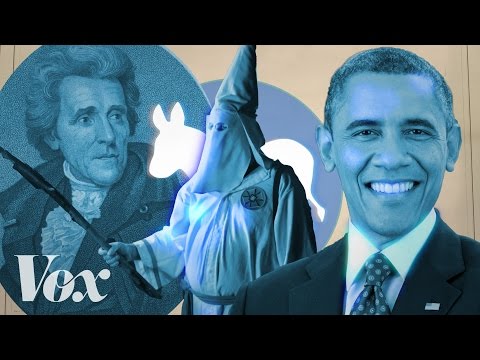
From white supremacy to Barack Obama: The history of the Democratic Party
The Evolution of the Democratic Party
Origins and Early History
- The modern Democratic Party emphasizes government intervention to combat economic inequality and discrimination, a significant shift from its historical roots in white supremacy and slavery.
- Founded in the mid-1820s, the party initially supported Andrew Jackson's candidacy, who was seen as an outsider challenging political elites.
- Jackson adopted the donkey as a symbol of determination after critics called him a "jackass," leading to its association with the party during his 1828 landslide victory.
Expansion and Controversy
- Jackson's administration enforced policies like the Indian Removal Act (1830), forcibly relocating Native Americans westward.
- The doctrine of "manifest destiny" emerged in the 1840s under President James K. Polk, promoting territorial expansion at the expense of Mexico and indigenous peoples.
- Post-Civil War, Democrats gained popularity in the South by opposing federal intervention for black citizens' rights, becoming synonymous with racial oppression.
Shift Towards Progressivism
- As reformers pushed for progressivism in response to corporate power, Woodrow Wilson's presidency marked a turning point for Democrats embracing government regulation.
- The Great Depression solidified this identity; Franklin Roosevelt’s New Deal expanded government roles significantly to address economic crises.
Civil Rights Movement
- By 1964, progressive reformers within the party began steering it away from its racist past towards supporting civil rights legislation despite Southern Democrats’ opposition.
- This period saw a demographic shift where black voters increasingly supported Democrats while white Southerners moved away due to race issues and distrust of big government.
Modern Demographics and Political Landscape
- The changing demographics of America have benefited Democrats; increased Hispanic voter turnout has contributed to their resurgence since losing influence among white voters.