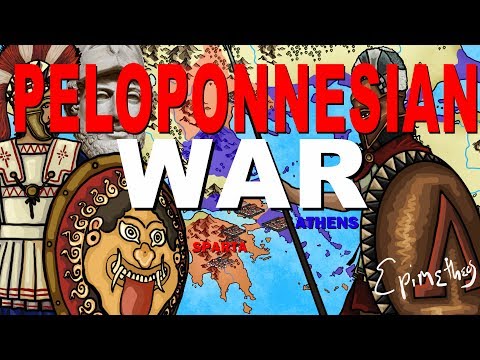
The Peloponnesian War (extended video)
Peloponnesian Wars: A Defining Conflict in Classical Greece
Overview of the Peloponnesian Wars
- The Peloponnesian Wars exemplified the extreme characteristics of classical Greek civilization following the Persian defeat.
- Athens and Sparta consolidated power over anti-Persian city-states, leading to significant geopolitical shifts.
Athenian Naval Power
- The Delian League, led by Athens, was a coalition of city-states that paid tribute for naval protection, resulting in a fleet of over 300 triremes.
- Each trireme was manned by 170 professional rowers, showcasing advanced maritime technology compared to other city-states that relied on slave labor.
Causes of the War
- Athenian ambitions for trade control in the West conflicted with Corinth's dominance, particularly after Athens intervened on behalf of Megara against Corinth during the First Peloponnesian War.
- Despite initial reluctance from Sparta to engage Athens directly, tensions escalated into open conflict due to ongoing hostilities and territorial disputes.
Key Events and Strategies
- The rebuilding of Athens' walls post-war was controversial; Spartans feared it could serve as a base for future Persian invasions. This structure connected Athens to Piraeus for supply during sieges.
- The "Thirty Years Peace" between Athens and Sparta did not last as hostilities resumed with Corinth lobbying Sparta for war against Athens in 431 BC.
Phases of Warfare
- The first phase of the Second Peloponnesian War is known as the Archidamian War, characterized by annual Spartan invasions into Attica while attempting to provoke Athenians into battle.
- Athenian strategies included leveraging their naval superiority while maintaining fortified positions within their walls despite Spartan pillaging efforts in rural areas.
Impact of Disease and Leadership Changes
- Overcrowding in Athens led to a devastating plague that killed up to two-thirds of its population, including key leaders like Pericles, severely impacting morale and military capability.
- Calls for peace arose amidst suffering from disease; however, radical leadership emerged advocating aggressive policies against Sparta and fortification efforts within the Peloponnese region.
Spartan Society Structure
- Spartan society was unique with dual kingship; one king would lead campaigns while another governed at home—emphasizing military readiness without city walls as defense mechanisms.
- Citizens underwent rigorous training from age seven; failure in this system resulted in second-class citizenship status among Spartans who did not meet expectations or were not voted into full membership roles within society.
This structured summary encapsulates key discussions surrounding the Peloponnesian Wars based on provided timestamps from the transcript while ensuring clarity and accessibility for study purposes.
Spartan Society and the Peloponnesian War
The Role of Spartan Women
- Spartan women were educated in reading, writing, and mathematics, allowing them to own property independently from their husbands.
- They owned about a third of the land in Sparta and played a significant role in economic activities, including investments and trade.
- Renowned for their beauty and outspoken nature, Spartan women challenged societal norms that were prevalent in other Greek city-states.
Helots: The Enslaved Population
- Helots were a unique class of slaves who could marry freely, maintain families, and keep part of their labor's produce.
- Spartans declared annual ritual wars on helots, allowing them to kill any helot without repercussions; this was aimed at controlling potential uprisings.
- Unlike other Greek city-states that enslaved foreign populations, helots were fellow Greeks conquered by Spartans.
Key Events During the Peloponnesian War
- In 425 BC, a minor engagement involving stranded Peloponnesian soldiers led to significant Athenian victories that boosted morale among plague survivors.
- Following these events, both sides negotiated the Peace of Nicias but soon resumed hostilities over territorial disputes.
The Battle of Mantinea
- The Spartans defeated an alliance between Athens, Argos, and Arcadians at the Battle of Mantinea; this victory solidified Spartan dominance in the region.
- Alcibiades played a crucial role in rallying Athenian support for military campaigns despite his controversial reputation.
The Sicilian Expedition
- Alcibiades proposed an ambitious plan to invade Sicily; however, he faced opposition from Nicias who warned against it due to strategic risks.
- Before setting sail for Sicily amidst political turmoil back home, Alcibiades was accused of sacrilege which led him to defect to Sparta after escaping trial.
Consequences of Defections and Military Strategies
- The disastrous Sicilian expedition resulted in heavy losses for Athens—over 10,000 hoplites killed or captured—and severely weakened its naval capabilities.
- While serving Sparta, Alcibiades provided critical intelligence on Athenian strategies which allowed Sparta to gain advantages during subsequent battles.
Peloponnesian War: The Role of Naval Power
Spartan Naval Victory Over Athens
- Admiral Lysander learned from Athenian strategies and achieved a decisive naval victory against them in 406 BC, culminating in the final blow at Aegospotami in 405 BC.
- Following this defeat, the Spartan Navy effectively cut off Athens' grain shipments, leading to starvation and ultimately the city's surrender, which ended the war.
Aftermath of Spartan Victory
- Ironically, it was not Sparta's renowned hoplites but their previously underdeveloped navy that secured their victory over Athens during the Peloponnesian War.
- Despite becoming leaders of the Greek world for a decade post-war, Sparta's dominance was short-lived due to chaotic governance attempts and insufficient manpower to control the Aegean region.
Decline of Spartan Power
- After suffering a crushing defeat in the Spartan-Theban War, Sparta withdrew to its homeland and never regained its status as a major power.
- This decline left Greek city-states vulnerable to conquest by Philip of Macedon, father of Alexander the Great, who managed to conquer much of Greece while sparing Sparta.