The Atanasoff-Berry Computer In Operation
Introduction to the ABC Computer
Overview of the ABC Computer
- John Guston introduces Charles Shorb and presents a replica of the Atanasoff-Berry Computer (ABC), built between 1939 and 1942 at Iowa State.
- The ABC is noted as the first electronic digital computer and also the first parallel computer, utilizing modular vacuum tube assemblies for arithmetic operations.
Functionality and Storage
- The ABC can hold two equations simultaneously on memory drums, using binary digits (bits) for storage; it has a total capacity of 3,000 bits.
- Demonstration involves solving two equations with two unknowns: 2x + 4y = 8 and x - 3y = -11.
Data Entry Process
Punch Card System
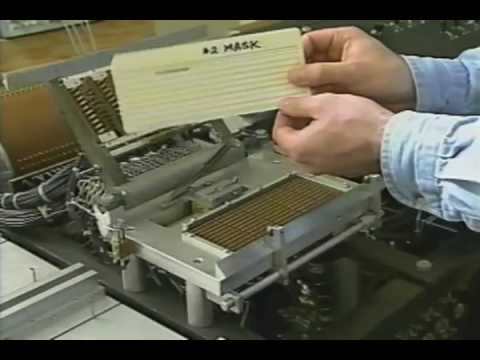
- Data entry into the ABC is done via punch cards, which were standard until the 1970s; whole numbers are used as floating points are not supported.
- To denote negative numbers, a zero is typed in place of a blank space.
Conversion to Binary
- Decimal numbers entered on punch cards are converted to binary using a conversion drum that represents binary values through pegs touching brushes.
Operational Mechanics
Power Consumption and Synchronization
- The machine operates on less than 1,000 watts, comparable to a hair dryer, and connects to standard wall outlets.
- A motor keeps memory drums spinning at one revolution per second while synchronizing with power outlet cycles.
Memory Management
- The ABC features dynamic memory with capacitors storing voltage for each bit; these need refreshing every second.
- A mechanical card reader processes data by completing circuits when brushes pass over holes in punch cards.
Solving Equations
Inputting Equations
- The logic within the ABC adds bit patterns from inputted punch cards into its rotating drum memory.
- An oscilloscope displays binary representations of numbers processed by the machine during calculations.
Calculation Process
- The operator instructively clears one drum after copying data to another for safekeeping before entering new equations.
- The speed of computation is limited by input/output times; reading decimal takes about one second per digit.
Understanding the Mechanism of Early Computers
The Odometer-Like Functionality
- The output mechanism resembles an odometer, where independent decimal values are subtracted from a memory number. A solenoid activates to increment the digit wheel until the subtraction results in a sign change.
- Dials are numbered in alternating directions to facilitate this process, allowing for mechanical reading of values stored in the computer.
Solving Equations with Early Computers
- The forward reduction of equations is completed mechanically; for example, solving 10y = 30 yields y = 3. This value is then back-solved into the original equations.
- Eliminating variables can be time-consuming, especially with larger numbers. For 15-digit precision, it may take about two minutes to eliminate one variable, which is still more efficient than manual calculations.
Challenges and Innovations
- Using y = 3, the second equation allows for solving x. Adding this equation three times results in x = -2, indicating a negative answer.
- Prior to advancements like ABC computers, solving large systems (e.g., 10x10 matrices) was impractical due to exponential increases in workload as equations doubled.
Intermediate Storage Solutions
- To manage intermediate work efficiently at NASA, Barry invented an electronic recorder capable of storing all bits onto stiff paper using high-voltage arcs that punch holes representing binary data.
Demonstration of Computational Capability