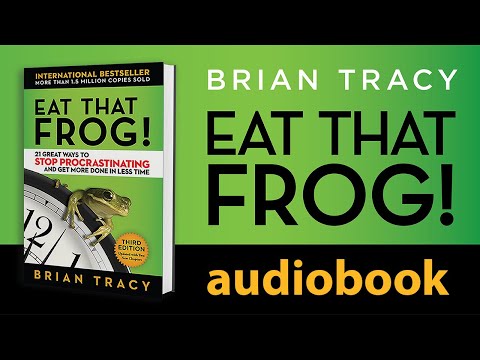
Eat That Frog!: 21 Great Ways to Stop Procrastinating and Get More Done in Less Time Audiobook
Introduction
The author introduces the book and explains that time management is a problem for everyone. He argues that becoming more productive is not enough to solve this problem, and that changing the way we think and work is necessary.
- The author hopes that the book will help readers change their lives forever.
- There is never enough time to do everything, and personal productivity techniques are not enough to solve time management problems.
- Changing the way we think, work, and deal with responsibilities is necessary to get control of our time and tasks.
Learning from Successful People
The author shares his personal story of how he learned about time management by asking successful people what they did differently. He emphasizes that success is predictable because some people do things differently than others.
- The author studied time management for over 40 years by reading books and articles on personal efficiency.
- He learned about time management by asking successful people what they did differently.
- Success is predictable because some people do things differently than others.
- Coming from an unsuccessful background, the author had developed feelings of inferiority and inadequacy until he realized that he could learn what successful people were doing.
Introduction
The introduction provides an overview of the author's background and the purpose of the book.
About the Author
- Started and built several companies
- Earned a business degree from a major university
- Learned to speak French, German, and Spanish
- Been a speaker, trainer, and consultant for more than one thousand companies
- Currently gives talks and seminars to more than 250,000 people each year with audiences as large as 20,000 people
Purpose of the Book
- To show readers how to get ahead more rapidly in their career while enriching their personal life
- Contains 21 most powerful principles on personal effectiveness that are practical, proven, and fast acting
Personal Effectiveness Techniques
This section explains that this book contains specific actions readers can take immediately to get better results in their work and increase their happiness.
Fast Acting Techniques
- No lengthy departures into theory or research
- Specific actions you can take immediately to get better faster results in your work
- Increase your happiness
- All techniques are complete in themselves
Importance of Action
This section emphasizes that taking action is key to success when applying these principles.
Key Insight
- The ability to concentrate single-mindedly on your most important task is key to great success achievement respect status and happiness in life.
Principles Work Fast
- These principles work fast to bring about predictable improvements in performance and results.
- Faster you learn & apply them faster you will move ahead in your career.
Overwhelmed with Too Much To Do
This section highlights how many people today are overwhelmed with too much work but have many options available. It also emphasizes that selecting the most important task and getting it done quickly and well is critical to success.
Too Much To Do
- Many people today are overwhelmed with too much to do in too little time
- Struggle to get caught up, new tasks and responsibilities keep rolling in like waves of the ocean
Selecting Most Important Task
- Your ability to select your most important task at each moment
- Getting it done both quickly and well will probably have more of an impact on your success than any other quality or skill you can develop
The Truth About Frogs
This section explains that the biggest, most important task is often the one that is most likely to be procrastinated on. It also emphasizes that selecting this task first and completing it before moving on to others is key.
Eating a Frog
- If the first thing you do each morning is to eat a live frog, you can go through the day with the satisfaction of knowing that that is probably the worst thing that is going to happen to you all day long.
Biggest Task First
- Your frog is your biggest, most important task
- The one you are most likely to procrastinate on
- If you don't do something about it, it's also the one task that can have the greatest positive impact on your life and results
- Start with biggest, hardest, and most important task first
- Discipline yourself to begin immediately
- Persist until the task is complete before moving onto something else
Eat That Frog
This transcript discusses the importance of tackling your major task first thing each morning and developing the habit of eating your frog before you do anything else. It emphasizes that successful people are those who launch directly into their major tasks and then discipline themselves to work steadily and single-mindedly until those tasks are complete.
The Habit of Tackling Major Tasks First Thing in the Morning
- Develop the lifelong habit of tackling your major task first thing each morning.
- Successful, effective people are those who launch directly into their major tasks and then discipline themselves to work steadily and single-mindedly until those tasks are complete.
- Failure to execute is one of the biggest problems in organizations today.
- Many people confuse activity with accomplishment; they talk continually, hold endless meetings, and make wonderful plans but no one does the job and gets results.
Developing Habits for Success
- Your success in life and work will be determined by the kinds of habits that you develop over time.
- The habit of setting priorities, overcoming procrastination, and getting on with your most important task is a mental and physical skill that is learnable through practice and repetition over time.
- Once it becomes a habit, starting and completing important tasks has an immediate payoff: it triggers endorphins in your brain which give you a natural high.
The Three D's of New Habit Formation
- You need three key qualities to develop habits: decision, discipline, determination.
- Make a decision to develop the habit of task completion.
- Discipline yourself to practice principles over time until they become automatic.
- Back everything you do with determination until the habit is locked in permanently.
Visualizing Yourself as You Want to Be
- Visualize yourself as an action-oriented, fast-moving, and focused person who gets important jobs done quickly and well on a consistent basis.
- Your mental picture of yourself has a powerful effect on your behavior.
Eat That Frog Chapter One: Set the Table
This chapter emphasizes the importance of clarity in personal productivity and outlines a seven-step formula for setting and achieving goals.
The Importance of Clarity
- Greater clarity about your major goals and tasks makes it easier to overcome procrastination.
- Only about 3% of adults have clear written goals, but those who do accomplish 5-10 times as much as those who don't.
- Vagueness, confusion, and fuzzy-mindedness about what you're trying to do can lead to procrastination and lack of motivation.
The Seven-Step Formula for Setting and Achieving Goals
- Decide exactly what you want.
- Write it down.
- Set a deadline on your goal.
- Make a list of everything you need to do to achieve your goal.
- Organize the list into a plan by priority and sequence.
- Take action on your plan immediately.
- Evaluate your progress regularly and adjust your plans accordingly.
Overall, this chapter stresses that having clarity about what you want to achieve is critical for personal productivity, and provides a simple yet effective formula for setting and achieving goals.
The Importance of Setting Goals
This section emphasizes the importance of setting goals and how it can increase productivity.
Benefits of Written Goals
- Clear written goals have a positive effect on thinking, motivation, and action.
- They stimulate creativity, release energy, and help overcome procrastination.
- The bigger and clearer the goals are, the more excited one becomes about achieving them.
Goal Setting Exercise
- Write down 10 goals to accomplish in the next year as if they have already been achieved.
- Review the list and select one goal that would have the greatest positive impact on life.
- Write this goal on a separate sheet of paper with a deadline, make a plan, take action daily towards it.
Planning for Productivity
This section highlights planning as an essential tool for overcoming procrastination and increasing productivity.
The Power of Planning
- Planning unlocks mental powers, triggers creativity, increases energy levels.
- Taking action without thinking things through is a prime source of problems.
- Good plans before taking action measure overall competence.
The 6P Formula
- Proper prior planning prevents poor performance.
Increase Return on Energy
- Every minute spent in planning saves up to 10 minutes in execution.
- A small investment of time (10 to 12 minutes) can save up to two hours (100 to 120 minutes) in wasted time throughout the day.
Working from a List
- Always work from a list; add new tasks before doing them.
- Consistently working from a list can increase productivity by about two hours per day.
- Make your list at night for the workday ahead; move unfinished tasks onto your next day's list.
The Power of Lists
This section discusses the importance of creating lists to increase productivity and efficiency.
Types of Lists
- Create a master list for everything you want to do in the future.
- Make a monthly list at the end of each month for the upcoming month.
- Plan your entire week in advance with a weekly list.
- Transfer items from monthly and weekly lists onto daily lists.
Benefits of List-Making
- Visualize progress and generate feelings of success and forward motion by ticking off completed tasks.
- Develop positive momentum that helps overcome procrastination.
- Spend 10% of time planning and organizing work before starting to save up to 90% of time later on.
Eat That Frog
This section discusses how to prioritize tasks using the 80/20 rule, also known as the Pareto Principle, and how to tackle difficult tasks first.
Prioritizing Tasks
- Make a list of everything you need to do in the next 24 hours, including new items that come up.
- Lay out major goals, projects, and tasks by priority and sequence. Start with what's most important and work backward.
The 80/20 Rule
- The Pareto Principle states that 20% of people have 80% of money and influence. Apply this principle by focusing on the top 20% most important tasks.
Tackling Difficult Tasks First
- Do not procrastinate on difficult tasks. Instead, tackle them first thing in the morning to increase productivity and motivation.
Conclusion
This section summarizes the importance of list-making, prioritizing tasks, and tackling difficult tasks first to increase productivity and efficiency.
- List-making is a powerful tool for increasing productivity.
- Prioritize tasks using the 80/20 rule and tackle difficult tasks first.
- By following these principles, you can become more productive and efficient in your work.
Eat That Frog
This section discusses the importance of prioritizing tasks and focusing on the most valuable ones.
The 80/20 Rule
- 20% of your tasks account for 80% of the value.
- One or two tasks will contribute five or ten times the value of any of the others.
- Most people procrastinate on the top 10 or 20 percent of items that are the most valuable and important.
Focus on Activities, Not Accomplishments
- People who appear to be busy all day long but seem to accomplish very little are often working on low-value tasks.
- The most valuable tasks you can do each day are often the hardest and most complex.
- You must adamantly refuse to work on tasks in the bottom eighty percent while you still have tasks in the top twenty percent left to be done.
Motivation and Satisfaction
- The hardest part of any important task is getting started on it in the first place.
- Once you actually begin work on a valuable task, you will be naturally motivated to continue.
- Completing something valuable and significant gives a tremendous feeling of pride and satisfaction.
Taking Control with Time Management
This section emphasizes taking control over what you do next by choosing between important and unimportant tasks.
Personal Management
- Time management is really life management personal management.
- Your ability to choose between important and unimportant is key determinant of your success in life and work.
Eating That Frog
- Make a list of all key goals, activities, projects, and responsibilities in your life today which could represent 80 or 90% of your results
- Resolve today that you are going to spend more time working in those few areas that can really make a difference in your life and career
- Spend less time on lower value activities
Consider the Consequences
This section discusses how evaluating the potential consequences of a task or activity is key to determining its importance.
Predicting Consequences
- The mark of the superior thinker is their ability to accurately predict the consequences of doing or not doing something.
- The potential consequences of any task or activity are the key determinants of how important a task really is to you and your company.
Evaluating Significance
- Evaluating the significance of a task involves determining what your next frog really is.
- Dr. Edward Banfield's research shows that evaluating potential consequences is how you determine what your next frog really is.
Attitude Towards Time
This section emphasizes the importance of having a long-term view of one's life and career. It explains how taking a long-term view can help individuals make better decisions about their time and activities.
Long-Term Thinking Improves Short-Term Decision-Making
- Successful people have a clear future orientation, thinking 5, 10, and 20 years into the future.
- Having a clear idea of what is important in the long term makes it easier to make better decisions about priorities in the short term.
- Before starting any task, consider its potential consequences.
- A clear long-term vision helps evaluate present activities for consistency with desired outcomes.
Delay Gratification for Greater Rewards
- Successful people delay gratification and make sacrifices in the short term for greater rewards in the long term.
- Unsuccessful people prioritize short-term pleasure over long-term goals.
Winners vs Losers
- Winners are motivated by their desires toward goal achieving activities while losers try to escape from fears and drudgery with tension-relieving activities.
Prioritizing Tasks
This section discusses how prioritizing tasks based on potential positive or negative consequences can improve productivity and success.
Large Potential Consequences = Top Priority
- If a task has large potential positive consequences, make it a top priority.
- The law of forced efficiency states that there is never enough time to do everything but always enough time to do the most important thing.
Motivation and Time Management
This section explains how motivation is linked to time management and the importance of continually starting and completing tasks that can make a major difference.
Greater Potential Positive Impact = More Motivated
- The greater the potential positive impact an action or behavior can have on one's life, the more motivated they will be to overcome procrastination and complete it quickly.
- Continually starting and completing tasks that can make a major difference is key to staying focused and forward-moving.
Conclusion
This section emphasizes the importance of considering potential consequences when making decisions about how to spend time. It also highlights the fact that time will pass regardless of how it is used, so it's important to use it wisely.
Consider Potential Consequences
- Thinking about potential consequences helps determine true priorities in work and personal life.
Use Time Wisely
- Prioritize tasks based on potential consequences.
- Continually start and complete tasks that can make a major difference.
- There is never enough time to do everything, but always enough time to do the most important thing.
Final Thoughts
- Attitude towards time has an enormous impact on behavior and choices.
- Prioritizing tasks based on potential consequences improves productivity and success.
- Motivation is linked to time management.
The Importance of Planning and Prioritizing
This section emphasizes the importance of planning and prioritizing tasks to increase productivity.
Planning for Success
- Deadlines are not an excuse for procrastination, as working under pressure often leads to stress, mistakes, and redoing tasks.
- Plan your time carefully in advance and build in a buffer to compensate for unexpected delays.
- Ask yourself three questions regularly to stay focused on completing important tasks:
- What are my highest value activities?
- What can I do that will make a real difference?
- What is the most valuable use of my time right now?
Prioritizing Tasks with "Eat That Frog"
This section introduces the concept of "eating that frog" or tackling the most important task first thing in the morning.
Maximizing Productivity
- Review your list of tasks regularly and determine which project or activity would have the greatest positive consequences if done well.
- Determine the most important thing you could be doing every hour of every day and discipline yourself to work continually on it.
- Practice creative procrastination by making time for big tasks every day. Plan your daily workload in advance, single out small jobs that must be done immediately, then pursue big tasks until completion.
Eat That Frog
This section discusses the importance of prioritizing tasks and procrastinating on low-value activities. It emphasizes the need to set proper priorities and posteriorities, say no to lower value activities, and engage in creative procrastination.
Prioritizing Tasks
- High performers prioritize tasks by doing the biggest and ugliest frogs before anything else.
- To get your time and life under control, discontinue lower value activities.
- Set posteriorities as well as priorities. A priority is something that you do more of sooner while a posteriority is something that you do less of later if at all.
- Say no politely but firmly to avoid agreeing to something against your will.
Creative Procrastination
- Deliberately decide upon the exact things you are not going to do right now or ever.
- Engage in conscious procrastination by procrastinating on purpose.
- Avoid unconscious procrastination which leads to putting off big valuable important tasks with significant long-term consequences in their lives and careers.
Abandoning Time-consuming Activities
- Continually review your duties and responsibilities to identify time-consuming tasks and activities that you can abandon with no real loss.
- Cut down on television watching and internet surfing instead spend time with family, read, exercise or do something else that enhances the quality of life.
- Identify work activities that you could delegate or eliminate to free up more time for work that really counts.
Zero-based Thinking
This section discusses zero-based thinking as a method for evaluating personal and work activities based on current situations. It emphasizes the importance of concentration, planning, setting priorities before beginning any task.
Zero-Based Thinking
- Continuously ask yourself if you were not doing this already knowing what you now know would you start doing it again today.
- Evaluate each personal and work activity based on the current situation.
- Select at least one activity to abandon immediately or at least deliberately put off until your more important goals have been achieved.
Concentration
- The first law of success is concentration. Bend all energies to one point and go directly to that point looking neither to the right nor left.
- The more thought you invest in planning and setting priorities before beginning, the more important things you will do in the faster you will get them done.
First Things First
This section discusses the importance of focusing on first things first. It emphasizes that successful people concentrate their efforts on the most important tasks and avoid distractions.
Focusing on First Things First
- Successful people concentrate their efforts on the most important tasks and avoid distractions.
- Use the ABCDE method continually. A is for tasks that are very important, B is for tasks that are somewhat important, C is for tasks that are nice to do but not essential, D is for tasks that can be delegated, E is for tasks that can be eliminated altogether.
- Start with A1 task which has the greatest potential consequences if it's done well or poorly.
- Discipline yourself to start immediately and then persist until task completion irrespective of any obstacles.
Avoiding Distractions
- Avoid time-wasting activities such as excessive socializing, idle chatter, unnecessary meetings, etc.
- Focus single-mindedly on your key result areas (KRAs) which are those areas where superior performance will make a significant difference in achieving your goals.
Turn any video into a summary like this
YouTube links, meetings, lectures — with transcripts, search, and chat.