Los Microtubulos
Molecular Organization of Microtubules
The transcript discusses the molecular organization and functions of microtubules within cells.
Microtubule Structure and Function
- Microtubules in cells are organized from a protein structure called the centrosome, consisting of centrioles surrounded by proteins like pericentrin and γ-tubulin. They form rigid barrel-shaped structures in specialized cell types.
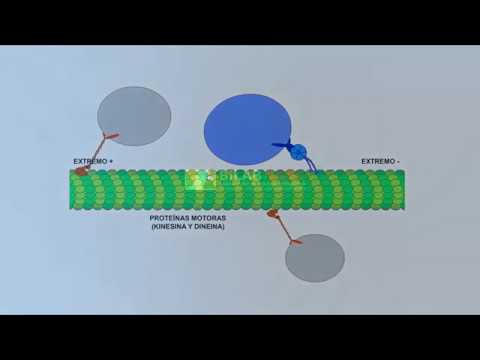
- Centrosomes in epithelial cells lack centrioles but function similarly to a centrosome, providing a base for organizing microtubules. The end of a microtubule that attaches to a microtubule organizing center is called the "minus" end, while the end that grows and shrinks is termed the "plus" end.
Dynamic Behavior of Microtubules
- Microtubules act as pathways for organelle movement within cells. The functional and structural unit of a microtubule is a dimer composed of α-tubulin and β-tubulin, activated when bound to GTP. These dimers elongate the microtubule by binding to its end.
- When GTP transforms into GDP, destabilizing the microtubule, tubulin dimers tend to dissociate, leading to shortening known as "microtubule catastrophe." Microtubules exhibit dynamic instability where they grow through polymerization.
Stabilization and Cellular Transport
- Proteins like tau stabilize microtubules by preventing dynamic instability. Tau plays a crucial role in organizing axonal microtubules. These microtubules act as tracks for vesicle transport within neurons.
- Vesicles must associate with microtubules via motor proteins like kinesin for movement. Kinesin moves towards the plus end away from the centrosome, while dynein moves towards the minus end.