El Sensor Inductivo y Capacitivo | Diferentes tipos y aplicaciones
Introduction to Industrial Sensors
Overview of Capacitive and Inductive Sensors
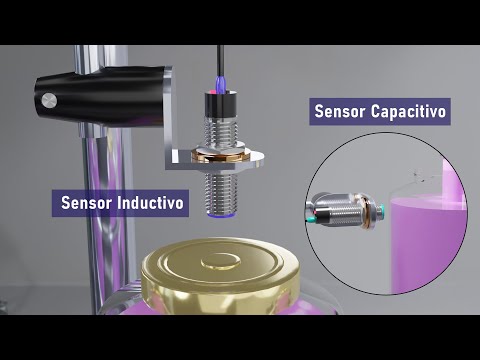
- Industrial processes utilize various sensors, including capacitive and inductive types. The capacitive sensor detects liquid levels, while the inductive sensor identifies whether containers are sealed.
Inductive Proximity Sensor Functionality
- An inductive proximity sensor is an electronic device that detects ferrous metal objects without physical contact.
- Some inductive sensors can also detect non-ferrous metals like brass, aluminum, and copper; however, detection range decreases for these materials. Maximum detection distance typically does not exceed 80 mm.
Internal Components of Inductive Sensors
- Key components include the sensor face, body, indicator light, and connector cables. Inside the body lies a circuit comprising a coil, oscillator, trigger circuit, and output circuit.
- The oscillator generates an electromagnetic field via the coil. When a metallic object enters this field, it induces a current in the object due to electromagnetic induction.
Detection Mechanism and Hysteresis
- As a metallic object approaches the sensor, induced current increases until it triggers oscillation changes detected by an amplitude detection circuit.
- Hysteresis is crucial as it prevents rapid switching between states when an object nears or moves away from the sensor. This interval helps maintain stable operation.
Types of Inductive Sensors
Shielded vs Unshielded Sensors
- Inductive sensors come in shielded (metallic shielding around the coil limits detection area to the front) or unshielded configurations (no shielding allows for greater sensing area).
Installation Considerations
- Shielded sensors should be flush-mounted with metal structures since they do not interfere with functionality; unshielded sensors must be mounted externally to avoid interference.
Sensor Configurations
Open vs Closed Configuration
- Normally open sensors close their contacts upon detecting metal objects; normally closed sensors open their contacts under similar conditions.
Power Supply Connections
- Typically powered by DC voltage with three wires: brown (positive), blue (negative), and black (signal output).
Capacitive Sensors Overview
Functionality of Capacitive Sensors
- Capacitive sensors resemble inductive ones but can detect various materials beyond metals—such as plastics and liquids—by reacting to electrostatic field changes.
Internal Structure of Capacitive Sensors
Understanding Capacitive and Inductive Sensors
Capacitive Sensor Functionality
- Changes in capacitance alter the electrostatic field of the sensor. The oscillator remains inactive when an object is outside this field, but activates at maximum frequency and amplitude when an object approaches.
- Detection distance varies based on several factors including the object's material, application environment, and detection range. Most sensors feature an adjustment screw to calibrate detection distance if necessary.
Types of Sensors: Capacitive vs. Inductive
- Both capacitive and inductive sensors come in various configurations such as normally open/closed, PNP, and NPN types. They can also be shielded or unshielded.
Characteristics of Inductive Sensors
- Inductive sensors detect only metallic objects with a relatively low range that depends on the alloy's nature. They are robust against harsh environments and resistant to impacts, vibrations, and dust.
- These sensors have a high switching frequency allowing for control over fast-moving parts even during rotation without moving parts subject to wear.
Characteristics of Capacitive Sensors