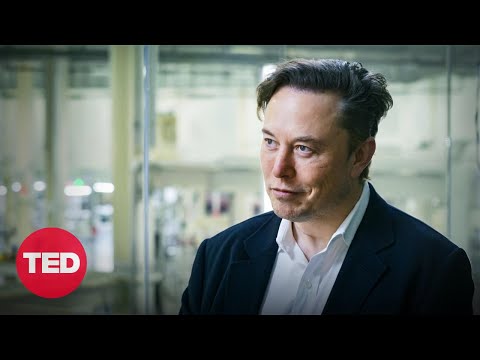
Elon Musk: A future worth getting excited about | Tesla Texas Gigafactory interview | TED
Elon Musk on Building a Sustainable Future
Introduction and Context
- Chris Anderson introduces Elon Musk at the Texas Gigafactory, highlighting the significance of the event as it opens the next day.
- The discussion aims to envision a future worth getting excited about, referencing Musk's previous TED talk.
Optimism vs. Pessimism About the Future
- Musk emphasizes that many people are pessimistic about the future, which is detrimental; he advocates for a hopeful outlook.
- He argues that life should not be merely about solving problems but rather looking forward to positive developments.
Climate Change and Pathways to Sustainability
- Musk acknowledges scientists' warnings regarding climate change by 2050 but expresses optimism about avoiding catastrophe.
- He stresses urgency in transitioning to a sustainable energy economy while cautioning against complacency.
Key Components of a Sustainable Energy Future
- Musk identifies three essential elements:
- Sustainable energy generation (primarily wind and solar).
- Battery storage systems for renewable energy.
- Electric transportation solutions (cars, planes, boats).
Challenges in Achieving Sustainability
- The production of battery cells is highlighted as a limiting factor in progress towards sustainability.
- Musk estimates that achieving sustainability requires approximately 300 terawatt hours of batteries globally.
Scaling Battery Production
- The Gigafactory aims to produce around 100 gigawatt hours annually, which is only one-hundredth of what is needed for global sustainability efforts.
- Tesla may contribute roughly 10% towards this goal by 2030 or 2040, emphasizing that these figures are speculative.
Vision for the Future Energy Landscape
- By 2050, Musk envisions an electric grid powered entirely by sustainable sources offering low-cost energy.
Energy and Carbon Sequestration
The Role of Sustainable Energy
- Sustainable energy from sources like wind and solar can be utilized for carbon sequestration, which requires significant energy to remove carbon from the atmosphere.
- This process could potentially reverse the increase of CO2 in both the atmosphere and oceans, contributing positively to climate change mitigation.
- Additionally, sustainable energy can provide an abundance of fresh water by converting seawater at low costs.
Environmental Benefits
- Transitioning to a non-fossil fuel world will lead to cleaner air as burning fossil fuels releases toxic gases and particulates harmful to health.
- A reduction in these pollutants will result in a cleaner sky and quieter environments, enhancing overall quality of life.
Artificial Intelligence Predictions
Predictive Accuracy in Sales
- The speaker reflects on their accurate prediction regarding Tesla's vehicle sales growth from 60,000 cars in 2014 to half a million by 2020.
- Despite skepticism at the time, this prediction was nearly spot-on with actual sales reaching approximately 510,000 vehicles.
Challenges with Full Self-Driving Predictions
- The speaker acknowledges past overconfidence about achieving full self-driving capabilities quickly but admits that predictions have not always been accurate.
- They highlight numerous "false dawns" in self-driving technology development where progress seemed promising but ultimately plateaued.
Understanding Progress Curves
Logarithmic Progression
- Progress in self-driving technology resembles a logarithmic curve; initial advancements may appear linear before hitting diminishing returns.
- Local maxima occur when developers mistakenly believe they have solved key issues only to encounter new challenges later on.
Real-world AI Requirements
- Achieving true full self-driving necessitates solving complex real-world AI problems since road networks are designed for human biological systems (neural nets and vision).
Current Developments in Self-Driving Technology
Confidence in Current Architecture
- The speaker expresses optimism about current technological architecture potentially overcoming previous limitations within this year.
High-quality Unified Vector Space
- Significant advancements include creating synchronized video inputs from multiple cameras for better data interpretation without ambiguity.
Labeling Techniques for Improvement
Surround Video Labeling Process
- To enhance accuracy, all camera frames must be labeled simultaneously by humans while also developing auto-labeling software for efficiency.
Scalability Challenges
Understanding AI and Autonomous Driving
The Challenge of Predicting Human Behavior
- The system must recognize surrounding objects and their movements, but predicting unpredictable human behaviors, like a child acting erratically while walking with an adult, is crucial for safety.
- Memory limitations in AI systems mean they cannot retain infinite data; occlusion scenarios (e.g., pedestrians hidden by vehicles) require the system to anticipate re-emergence without prior knowledge.
Progress in Full Self-Driving Technology
- Despite past predictions not materializing as expected, advancements in technology have led to increased confidence that autonomous vehicles will operate safely without human intervention in many urban areas by year-end.
- Current beta testing shows that Tesla's self-driving cars can navigate Austin with minimal interventions, indicating significant progress towards full autonomy.
Predictions and Timelines
- Elon Musk acknowledges skepticism regarding timelines but emphasizes the importance of setting aggressive goals to drive innovation and ambition within teams.
- He notes that media often highlights failed predictions while neglecting successful ones, leading to a skewed perception of his forecasting abilities.
Realizing the Potential of Robotics
- Musk reflects on how solving real-world AI challenges for self-driving cars can be applied to humanoid robots, suggesting a broader potential for robotics beyond current applications.
- He identifies two critical components missing from existing robotic technologies: sufficient intelligence for autonomous navigation and scalable manufacturing processes.
Future Directions for Tesla's Robotics Initiative
Humanoid Robots: The Future of Home Assistance?
The Potential of Humanoid Robots
- Discussion on the significance of humanoid robots, suggesting they could surpass the impact of cars in society.
- Comparison between humanoid robots and self-driving cars; humanoid robots operate at lower speeds, reducing risk during errors.
- Vision for future applications includes household tasks like tidying up, cooking, and caregiving.
Safety and Regulation Concerns
- Emphasis on safety features such as a localized ROM chip that cannot be updated remotely to prevent misuse.
- Call for a regulatory agency for AI to ensure public safety amidst advancements in robotics.
The Future Landscape of Robotics
- Speculation about widespread adoption of home robots by 2050, similar to early predictions about personal computers.
- Anticipation of various roles for robots, including companionship and potentially romantic relationships.
Economic Implications
- Initial focus on creating robots for dangerous or repetitive jobs with prototypes expected within two years.
- Predictions suggest that consumer models will be available within ten years at prices comparable to low-end cars.
Labor Market Transformation
- Discussion on the economic feasibility of replacing high-cost labor with one-time robot purchases leading to job displacement concerns.
- Argument against fears of unemployment due to labor shortages; instead, a vision of an abundance economy where goods are cheap and accessible.
Risks Associated with Advanced AI
- Exploration of potential risks if artificial general intelligence diverges from human interests or intentions.
Neuralink and the Future of Human-Machine Symbiosis
The Potential of Neuralink in Addressing Brain and Spinal Injuries
- Neuralink aims to alleviate brain and spinal injuries, even if it doesn't achieve its broader goals.
- The idea is to tightly couple human intelligence with digital intelligence, enhancing human capabilities while acknowledging potential risks.
Current Limitations and Future Aspirations
- Communication between humans and machines is currently limited by data transfer rates; humans communicate at a much slower pace than computers.
- While principles for reading neurons exist, effective consumer products are still in research phases without high-bandwidth solutions available.
Neuralink Device Design and Implementation Timeline
- The Neuralink device is compared to smartwatches but involves tiny wires that minimize brain damage during implantation.
- An FDA application has been submitted for the first human implant, focusing initially on neurological injuries.
Long-Term Vision for AI-Human Integration
- High-bandwidth neural interfaces for AI-human symbiosis are years away; initial focus will be on treating brain injuries over the next decade.
- Potential applications include addressing severe depression, memory restoration in older adults, and other significant health issues.
Addressing Civilizational Risks of AI
- Neuralink could help mitigate risks associated with advanced AI by integrating biological intelligence more closely with digital systems.
Exploring the Future of Space Travel and Human Potential
The Vision for Enhanced Human Capabilities
- The speaker discusses transforming a "tiny straw" into a "big highway," suggesting that while this initiative may not solve all problems, it could significantly address brain and spinal injuries.
- There is an optimistic view on potential discoveries such as telepathy, enhanced memory, and faster thought processing as possible outcomes of advancements in technology.
Introduction to Starship
- The conversation shifts to space exploration, highlighting the importance of reusability in rocketry. Starship represents a significant advancement in this area.
- Starship aims for full and rapid reusability, which has never been achieved before; Falcon 9 was a step towards this by recovering its first stage.
Design Goals and Cost Efficiency
- Unlike Falcon 9, which requires refurbishment after each flight, Starship is designed for immediate re-flight after refueling.
- Starship's capacity includes transporting over 100 people at once along with necessary cargo to Mars.
Timeline for Mars Missions
- The speaker outlines timelines for future missions: initial equipment-only flights to Mars followed by crewed missions.
- Notably, the cost of launching with Starship will be less than previous smaller rockets like Falcon 1 due to its efficient design using methane and oxygen.
Fuel Production on Mars
- A critical task on Mars will involve creating fuel plants primarily focused on producing oxygen for return trips; methane can also be synthesized from Martian resources.
- The design includes propulsive landing systems without parachutes, making it versatile enough for various destinations within the solar system.
Broader Applications Beyond Mars
- While SpaceX's main focus remains on Mars colonization, there are plans to use Starship for lunar missions in collaboration with NASA.
- Although primarily aimed at Mars transport, the technology offers generalized solutions for travel throughout the solar system.
Upcoming Launch Plans
- An orbital launch attempt is anticipated within months as preparations are underway; regulatory approval is pending.
- Early launches carry risks but promise excitement; timelines have shifted slightly regarding human landings on Mars now expected around 2029.
Production Scale Insights
- SpaceX plans to produce multiple ships and boosters rapidly—initially every couple of months—with hopes to reach monthly production rates by year-end.
Mars Colonization: A Vision for Humanity
The Concept of Mars as a New Frontier
- Elon Musk envisions a large-scale migration to Mars, likening it to the "Helen of Sparta" that launched 1,000 ships. He emphasizes the need for public awareness about this vision.
- Musk imagines an armada of Starships transporting humans to Mars every two years, comparing it to "Battlestar Galactica." He discusses funding through ticket sales priced around $100,000.
The Necessity of a Million People
- Musk believes that a million people is the critical mass needed on Mars for sustainability and survival. This includes those who can afford or secure sponsorship for their journey.
- He stresses that while moving to Mars will be accessible at around $100,000, initial conditions will be harsh and not luxurious—echoing historical expeditions like Shackleton's Antarctic journey.
Building a Sustainable City on Mars
- The goal is to establish a self-sustaining city on Mars over two decades with enough people to ensure survival if Earth supplies cease.
- Musk argues that humanity must become multi-planetary to avoid extinction from potential global catastrophes, viewing civilization as fragile in the vastness of space.
Governance and Society on Mars
- Discussions about governance should focus on how Martian society will function. Musk advocates for direct democracy and simpler laws that are easier to repeal than create.
- He expresses hope that future Martians will be more enlightened and cooperative compared to current societal conflicts on Earth.
Expanding Exploration Capabilities
- With advancements like Starship capable of carrying over 100 tons into orbit, new possibilities arise for scientific exploration beyond Earth.
Exploring the Future of Space Travel and Technology
The Excitement of Space Exploration
- CA expresses enthusiasm about the potential for a submarine to explore Europa, highlighting the joy of discovering extraterrestrial life.
- EM acknowledges the challenges ahead, emphasizing the need for successful orbital launches and rapid reusability in space travel.
Challenges in Rocket Science
- CA raises concerns about catastrophic failures like the Hindenburg incident; EM reassures that while rockets have exploded, no lives have been lost.
- EM discusses the complexities of escaping Earth's gravity compared to Mars' lower gravity and thinner atmosphere.
Synergies Between Technologies
- CA suggests that Tesla robots could assist on Mars, reducing human labor needs; he envisions a future where cities on Mars rely on both humans and robots.
- The idea of a partnership between Boring Company and Tesla is proposed to create efficient transportation networks using tunnels populated by robo-taxis.
Innovative Transportation Solutions
- EM agrees that creating underground tunnel systems is feasible today, even without fully autonomous driving capabilities.
- CA mentions Gwynne Shotwell's vision for intercity transport via rockets by 2028, with EM noting that rockets are indeed one of the fastest means for long-distance travel.
Corporate Structure and Future Prospects
- CA questions whether consolidating companies into one entity would be beneficial; EM explains challenges due to differing investor bases among his companies.
- EM reflects on how public investors may not support ambitious projects like colonizing Mars due to their long-term nature.
Public Access and Company Management
- CA argues that Tesla's financial strength could allow for public investment in SpaceX missions; EM acknowledges interest but highlights overhead issues with public companies.
- The burden of legal challenges faced by public companies is discussed as a significant concern affecting management time and resources.
Elon Musk on Wealth, Philanthropy, and the Future of Humanity
The Complexity of Wealth
- Elon Musk reflects on the excitement surrounding his mission to build a future worth getting excited about, acknowledging his status as one of the world's richest individuals.
- Discusses the volatility of his net worth, which can fluctuate by billions daily, and how he manages this psychologically.
- Emphasizes that every moment spent thinking about Tesla and SpaceX has significant financial implications for the companies.
Impactful Decision-Making
- Musk illustrates how a single brainstorming session can lead to substantial financial improvements for Tesla, highlighting the value of high-quality thinking.
- Addresses public criticism regarding billionaires' wealth compared to global poverty, suggesting flaws in these perceptions.
Personal Consumption vs. Philanthropy
- Musk clarifies that he does not indulge in extravagant personal consumption; he stays at friends' homes and lacks luxury items like yachts.
- He acknowledges owning a plane but justifies it as a necessity for maximizing work hours.
Philanthropic Intentions
- Discusses philanthropy's complexity and asserts that his ventures (SpaceX, Tesla, Neuralink, The Boring Company) embody philanthropic efforts aimed at improving humanity's future.
- Defines philanthropy as love for humanity and explains how each company contributes to this goal through various initiatives.
Concerns About Population Collapse
- Musk expresses indifference towards criticism about billionaire wealth; he views it as inconsequential ("water off a duck's back").
- Highlights concerns over declining birth rates leading to potential civilizational collapse and emphasizes its significance as a threat to human civilization.
Motivation and Optimism
- Shares his motivation rooted in curiosity about understanding life’s fundamental questions while ensuring a positive future for humanity.
Turn any video into a summary like this
YouTube links, meetings, lectures. With transcripts, search, and chat.