La hidráulica y la mecánica de fluidos: historia, ciencia y técnica | 1/49 | UPV
Introduction to Hydraulics and Fluid Mechanics
The introduction discusses the historical aspects of hydraulics and fluid mechanics, highlighting their evolution from separate disciplines to a unified field of study encompassing both science and technology.
Evolution of Hydraulics and Fluid Mechanics
- Hydraulics, known as the technical aspect, and fluid mechanics, referred to as the scientific aspect, have merged over time into a single discipline.
- Historical applications of hydraulic techniques date back to ancient civilizations like Mesopotamia and Egypt, showcasing advancements in water movement through channels, valves, pipes, and hydraulic energy utilization via mills and aqueducts.
- During the Enlightenment era, fluid mechanics transitioned from practical applications to a physics discipline encompassing various fluids beyond water such as air and oils.
Contributions of Scientists in History
- Leonardo Da Vinci focused on hydraulic aspects including water studies, wave motion analysis, pond dynamics, and early hydraulic machines.
- Galileo explored fluid properties like density and specific weight while Pascal and Torricelli delved into hydrostatics analyzing fluid rest and motion forces.
Advancements in Fluid Mechanics
- Isaac Newton introduced the concept of viscosity with the first viscosity equation leading to further analyses on fluid movements including streamlines by Euler.
- Venturi proposed flow studies in conduits defining motion quantities through measurements like the Venturi flow meter crucial for flow rate determination.
Development of Modern Fluid Mechanics
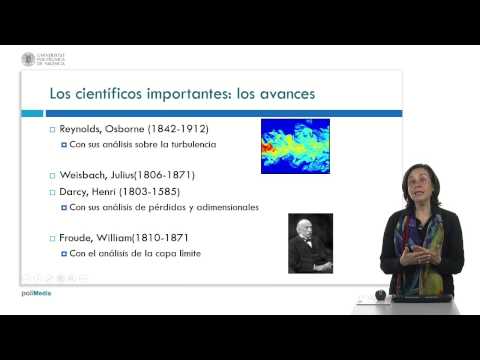
This section delves into advancements in modern fluid mechanics during the 19th century focusing on turbulence analysis by Reynolds along with pipe flow assessments by Darcy and Bisback.
Turbulence Analysis & Pipe Flow Studies
- Reynolds' work in the 19th century highlighted turbulence phenomena previously unexplored in classical fluid mechanics due to its intricate nature involving turbulent flows.
- Darcy's contributions provided insights into pipe flow dynamics using semi-empirical equations elucidating losses based on dimensional parameters.
Contemporary Applications of Fluid Mechanics
The discussion transitions towards contemporary applications emphasizing how modern fluid mechanics has evolved into a numerical analysis field essential for diverse sectors such as aeronautics, lubrication engineering, aerodynamics among others.
Numerical Analysis & Technological Applications
- Navier-Stokes equations formulating fundamental principles applied differentially or integrally marked a significant milestone shaping current computational fluid dynamics (CFD).