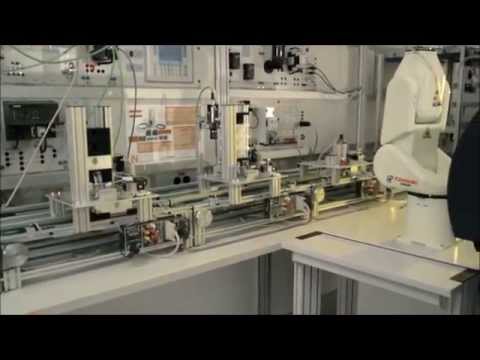
Manufactura Integrada por Computadora - CIM
New Section
This section introduces the concept of automation in the industry and its benefits.
The Role of Automation in Industry
- Automation has become an integral part of the industry, offering improved production results and optimization.
- Computer-integrated manufacturing (CIM) utilizes computer systems to automate and optimize various processes.
- CIM encompasses design, engineering, manufacturing, logistics, storage, and distribution of products.
- The goal of CIM is to increase manufacturing capacity by using flexible tools that can adapt to market requirements.
New Section
This section discusses the origins and definition of computer-integrated manufacturing.
Origins and Definition of Computer-Integrated Manufacturing
- Computer-integrated manufacturing was introduced in the 1970s by Carrington in England.
- It was later developed further by a research group at Purdue University in the United States.
- CIM is a hierarchical automation model aimed at increasing efficiency across all production-related components.
- John Bernard defines CIM as the integration of digital computers into all aspects of the manufacturing process.
New Section
This section explores the concept and importance of computerized control and integration in manufacturing.
Computerized Control and Integration in Manufacturing
- CIM involves computerized control and integration at all levels of the manufacturing process.
- It is not just about providing a definition but understanding it as a way of working towards organizational goals.
- Mansenc and Romeral highlight the rapid growth of automation in industry through networks and smart systems.
- Automated exercises involve multiple interconnected parts controlled by databases but lacking communication between them.
New Section
This section delves into different hierarchy levels within a computer-integrated manufacturing system.
Hierarchy Levels within Computer-Integrated Manufacturing
- Level of Process:
- Data of the manufacturing process is located in the tunnel and activated by actuators.
- Sensors transfer information to control systems at the station level for execution of control algorithms.
- Level of Station:
- Machines are controlled by electronic systems such as PLCs, CNS, robots, computers, DCS, etc.
- Control systems receive information from lower-level devices and monitor variables and alarms.
- Level of Cell:
- Coordination of machines is carried out by a factory cell phone.
- Areas within the factory are decomposed into simpler operations for efficient production.
- Level of Area:
- Different cells coordinate within an area or production line.
- This level may not be included in the design pyramid due to its complexity.
New Section
This section discusses coordination between different levels and areas in computer-integrated manufacturing.
Coordination Between Levels and Areas
- The coordination between different levels ensures communication between control systems and field devices.
- Machines at each level have specific control mechanisms such as PLCs, CNS, robots, computers, DCS, etc.
- The cell phone at the cell level coordinates machine operations within a factory cell.
- Areas are composed of multiple cells that form a production line with synchronized operations.
The transcript does not provide further sections beyond this point.
New Section
This section discusses the importance of management, machines, programs, and maintenance in the production process. It also highlights the role of global management and software tools in plant activities and production system implementation.
Importance of Management and Maintenance
- Management is necessary for the maintenance of the final product.
- It involves integrating lower levels within a company.
- Global management includes buying, selling, commercialization, investigation, strategic objectives, and long-term planning.
Software Tools for Plant Activities
- Auxiliary Engineer by Computer (Hokkae) is used to develop product specifications and manufacturing processes.
- Design Auxiliary by Computer (Hokkae) helps with drawings, material lists, graphic simulation, document editing, etc.
- Process Plan Auxiliared by Computer (CAPP) generates product flow through the production system.
- Parts are cataloged in families based on similar manufacturing characteristics.
- Auxiliary Manufacturing by Computer (CAM) develops control programs for numerical applications to machines, tools, robots, etc.
New Section
This section continues discussing software tools used in integrated manufacturing by computer. It covers CAM activities related to control program generation and control for various aspects of manufacturing systems.
CAM Activities
- CAM includes activities related to CAPP (Computer-Aided Process Planning), CATP (Computer-Aided Testing Program), CACU (Computer-Aided Control Unit), and auxiliary auxiliary by computer.
- CAM focuses on generating and controlling control programs for numerical applications to machines, tools, robots, manufacturing systems, materials inspection, and testing.
New Section
This section concludes with an overview of integrated manufacturing by computer as a philosophy that utilizes computers and technology to coordinate product development functions for better competitiveness.
Integrated Manufacturing by Computer
- Integrated manufacturing by computer is an administration philosophy that uses computers, communication, and information technology.
- It aims to coordinate product development, design, and manufacture for a better competitive position.
- The objective is to achieve a high-quality level of workmanship.
The transcript provided does not include specific timestamps for each bullet point. I have associated the bullet points with the given timestamps based on their order in the transcript.