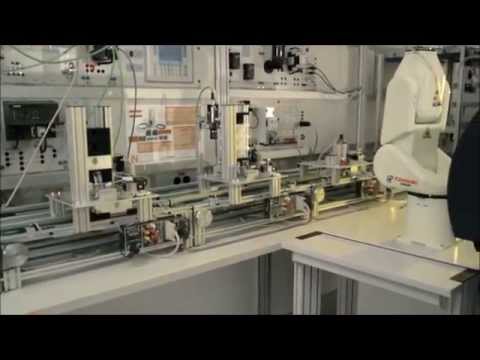
Manufactura Integrada por Computadora - CIM
Automation in Industry: The Role of SIM
Introduction to Automation
- Automation has become integral to modern industry, enhancing production efficiency through computer integration.
- The System for Integrated Manufacturing (SIM) leverages computational power for analysis and processing, impacting design, engineering, manufacturing, logistics, and distribution.
Historical Context and Development
- Computer-integrated manufacturing was pioneered in the 1970s by English innovator Carrington, who envisioned microprocessor-based applications.
- John Bernard defines SIM as a complex system integrating digital computers across all manufacturing processes to minimize costs and enhance wealth creation.
Understanding SIM's Functionality
- The essence of SIM lies not just in definitions but in its operational focus on aligning all components towards organizational goals.
- According to Mansenc and Romeral, automation has rapidly evolved with networks of smart systems creating automated exercises that lack communication between them.
Communication Systems in Automation
- Current trends emphasize communication systems that facilitate information flow among devices, enabling programmable automation and robotic stations.
- Within SIM's framework are various hierarchical levels: processing level, machine station level, cell phone level (factory), area level, factory level, and company level.
Hierarchical Levels Explained
- At the processing level, data is activated by actuators; sensors relay information to control systems at the station level for algorithm execution.
- Machine controllers like PLCs and robots operate at the station level while coordinating tasks across different fabrication lines at the cell phone level.
Factory Management Dynamics
- The factory-level focuses on resource management including planning production sequences and maintenance activities essential for product completion.
- Company-level management integrates lower levels while addressing global aspects such as purchasing strategies and long-term planning.
Software Tools Supporting SIM
- Various software tools support SIM operations:
- Computer-Aided Engineering (CAE): Develop specifications for products and processes.
- Computer-Aided Design (CAD): Create drawings and material lists along with graphic simulations.
Integrated Manufacturing and Computer-Aided Engineering
Overview of Integrated Manufacturing
- The discussion focuses on the generation and control of numerical control programs applied to various manufacturing elements, including machines, tools, robots, and inspection systems.
- Emphasizes the role of Computer-Aided Engineering (CAE) in facilitating production processes through computer assistance.
- CAE activities can be classified into two main categories: Computer-Aided Process Planning (CAPP) and pre-production oscillation by computer.
- Highlights that integrated manufacturing is a philosophy that leverages computers for effective administration within manufacturing environments.