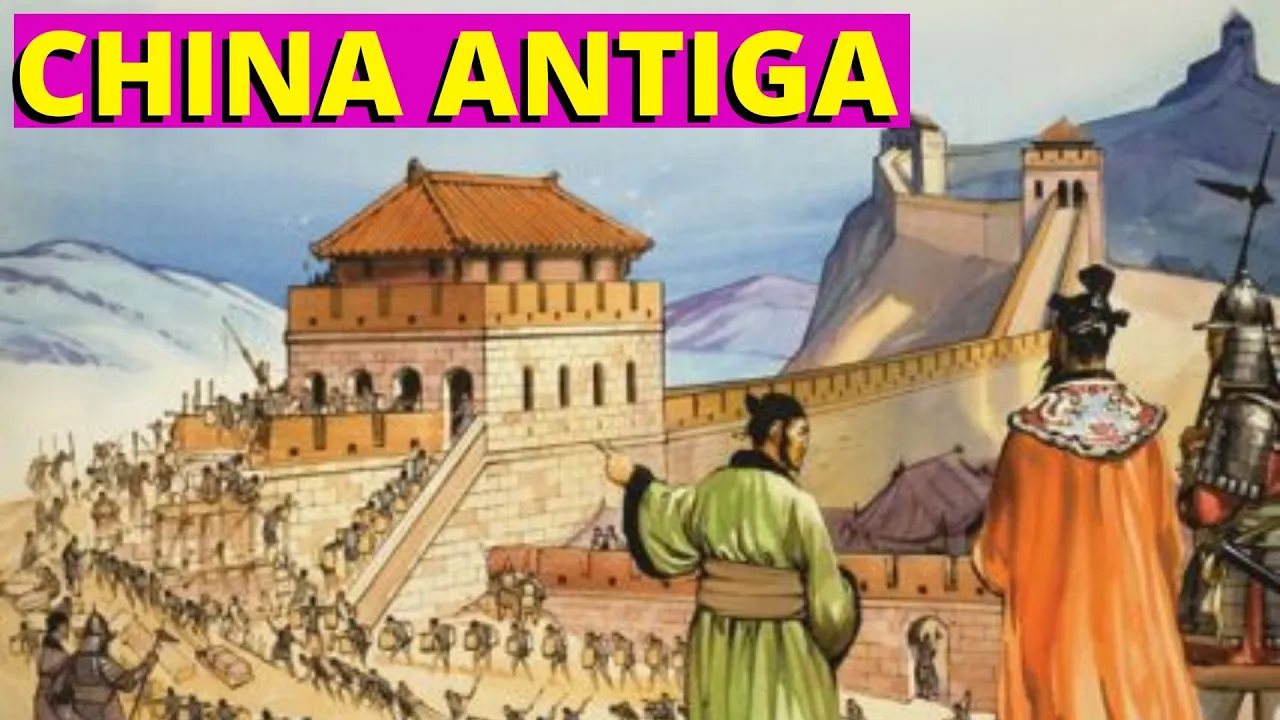
A civilização chinesa.
The Formation of Chinese Civilization
Early Development and Dynastic History
- At the beginning of the Modern Age, Europeans had limited and confusing information about South and East Asia, referring to these regions as the Indies or the Orient.
- Around 5000 BC, hunter-gatherer groups settled in the Yellow River valley, establishing early agricultural centers in eastern China.
- In the Yangtze River valley, rice cultivation began; by 2200 BC, these villages unified under Yu the Great, founding the Xia dynasty and marking the start of dynastic China.
- The Shang dynasty succeeded Xia around 1800 BC, introducing writing (Yinxu), a 365-day calendar, and silk-making techniques while engaging in extensive trade.
- The Zhou dynasty replaced Shang in 1027 BC; it expanded territory but faced challenges from nobles leading to a period known as the Warring States.
Philosophical Developments During Turmoil
- Key states during this period included Qin, Han, Zhao, Qi, Wei, Yan, and Chu; they expanded their territories amidst chaos.
- Confucius emphasized moral conduct for rulers and individuals alike. He stated that public income should not be misused for personal gain to ensure prosperity.
- Lao-tse focused on nature and spirituality through Taoism. His teachings promote harmony with nature and humility as central tenets of life.
The Imperial Phase of Chinese History
- Zheng became China's first emperor after unifying territories; he standardized currency and measurements while facing resistance from traditional nobility.
- After Zheng's death in 210 BC, Liu Pang emerged from a revolt to establish the Han dynasty in 206 BC which led to significant advancements in agriculture and commerce supported by Confucianism.
Innovations Under Han Dynasty
- The Han era saw remarkable inventions such as paper and movable type printing which later influenced European technology during the Renaissance.
- Following crises post-Han dynasty (220 AD), stability returned with Tang dynasty promoting trade; under Song dynasty (960–1279), innovations like paper money emerged.
Trade Routes: The Silk Road
The Historical Trade Routes: From Prehistoric Migrations to the Silk Road
The Origins of Trade Routes
- The trade route connecting present-day Syria to Xiang, China, follows a natural path across Asia, historically significant for prehistoric migrations from Africa to Asia.
- The Persians were the first to transform this route into a trade pathway, with caravans traveling it centuries before Christ; historian Frantz Genet notes that these paths led to the creation of the Silk Road.
- In the 2nd century BC, diplomat Zhang Qian initiated an expedition under the Han dynasty to establish alliances with Indo-European peoples, marking early Chinese engagement in international trade.
The Silk Road and Its Evolution
- The Silk Road became the primary exchange route between East and West until the 15th century when maritime travel emerged as a faster alternative.
- Kublai Khan's rise in 1260 marked a pivotal moment; he moved China's capital and facilitated trade during his reign while Marco Polo visited around 1275.
Ming Dynasty and Maritime Expansion
- Under Admiral Zheng He in the early 15th century, China undertook significant maritime expeditions that some researchers suggest may have reached America before Columbus.
- A ban on large ship construction by a Ming ruler in 1436 stemmed from internal conflicts within Chinese elite factions fearing European influence.
Japan's Ancient History
- Japan's ancient history is divided into three periods: pre-Jomon (30,000 - 10,000 years ago), Jomon (7500 BC - 300 BC), and Yayoi (300 BC - 300 AD), with significant cultural influences from China during Yayoi.
- By the 4th century AD, Japan unified under noble clans known as Yamato; society was structured hierarchically with emperors, shoguns, daimyo, and samurai.
Isolationist Policies in Japan
- Tokugawa Ieyasu became shogun in 1603 and began combating foreign influences; real power shifted towards shogunate governance despite an emperor still leading nominally.
History of China: From Opium Wars to Economic Growth
The Impact of the Opium Wars and Colonialism
- In the mid-19th century, English forces defeated China in the Opium Wars, leading to significant territorial and economic concessions.
- The Chinese government was compelled to open new ports for foreign trade, resulting in British control over Hong Kong.
- Following this period, China was divided into areas of influence dominated by foreign powers including Britain, France, and Russia.
The Rise of Republicanism and Communism
- In 1916, Sun Yat-sen led a rebellion that deposed the last emperor and established the Republic of China.
- After a prolonged civil war, Mao Tse-tung's communists took power in 1949, marking a significant shift in China's political landscape.
Economic Transformation Post-Mao
- After Mao's death in 1976, China adopted capitalist measures which spurred rapid economic growth at rates exceeding 9% annually.
- As of now, with a population of 1.4 billion, China is recognized as the fastest-growing economy globally and ranks as the second-largest economy after the United States.
Social Inequalities and Environmental Concerns
- Despite economic growth labeled as "market socialist," social inequalities are increasing; wealth disparity is evident with the rich getting richer while the poor face worsening conditions.
- Rapid industrialization has also led to significant environmental issues that pose challenges for sustainable development.
Engagement and Further Learning
- Viewers are encouraged to subscribe for more content on related topics and follow on social media for additional insights.