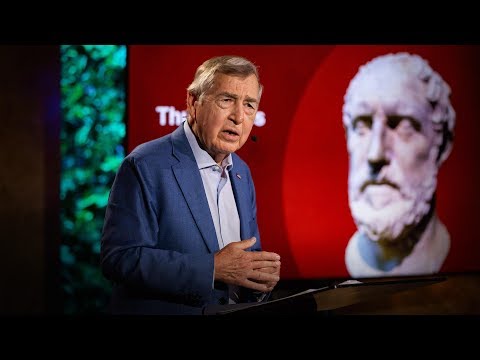
Is war between China and the US inevitable? | Graham Allison
The Rise of China and the Thucydides Trap
The speaker discusses the rise of China as a significant international story and the potential challenges it poses to the United States and the existing international order. The concept of Thucydides's Trap is introduced as a framework for understanding power shifts between rising and ruling nations.
The Rise of China
- Americans are accustomed to being at the top globally, making China's rise unsettling.
- History shows that when a rising power threatens an existing one, conflict often arises.
Impact of China's Rise
- In 1978, 90% of Chinese citizens lived on less than $2 a day; now fewer than 1 in 100 do.
- China has rapidly ascended to rival or surpass the United States in various areas.
Thucydides's Trap
- Thucydides is introduced as a historical figure who highlighted how power shifts can lead to conflict.
- Thucydides's Trap refers to tensions when a rising power challenges an established one, potentially leading to war.
Managing Rivalry
- The crucial question posed is whether nations can avoid war despite historical patterns.
The Rise of China and Its Implications
The speaker discusses the rapid development and ambitions of China under President Xi Jinping, highlighting the potential implications for global power dynamics.
The Speed of Infrastructure Development
- In 2015, China renovated the Sanyuan Bridge in just 43 hours, showcasing efficient execution.
Ambitious Goals Set by Xi Jinping
- Xi Jinping aims for China to dominate major markets in leading technologies by 2025.
- By 2035, China plans to lead in all advanced technologies.
- By 2049, on the People's Republic's 100th anniversary, China aims to be unequivocally number one.
Impact on Global Power Dynamics
- The rise of China will challenge American positions and prerogatives due to its growth in various aspects.
Historical Precedents and Potential Conflicts
- Reference to Thucydides's Trap where a rising power threatens a ruling power leading to conflict.
- Historical examples like World War I emphasize how conflicts can escalate unintentionally.
Leadership Challenges Between US and China
The speaker reflects on current leaders' roles in potentially shaping future conflicts or cooperation between the US and China.
Leaders' Roles in Global Dynamics
- Comparison between Donald J. Trump as a ruling power figure and Xi Jinping as a rising power leader.
Urgent Question for Future Relations
- Emphasis on avoiding catastrophic war between Americans and Chinese through shared leadership or new power relations.
Call for Innovative Solutions
The speaker urges creative thinking from diverse minds to address the challenges posed by shifting global dynamics.
Need for Unconventional Approaches
- Acknowledgment that conventional statecraft lacks feasible solutions; calls for out-of-the-box ideas from varied perspectives.
Historical Precedent of Collective Imagination
[Detailed Analysis of Transcript]
This transcript discusses the Marshall Plan post-World War II and the need for a similar initiative today to foster peace and prosperity.
The Marshall Plan and Its Impact
- The Marshall Plan was initially rejected as naive but proved crucial post-WWII. Americans, despite exhaustion, taxed themselves to aid Europe's reconstruction.
- Americans allocated 1.5% of GDP annually for four years to support European countries, including former enemies like Germany and Italy.
Creating an Order for Peace and Prosperity
- The Marshall Plan led to the creation of significant institutions like the United Nations, Universal Declaration of Human Rights, World Bank, and NATO.
- These entities formed a foundation for peace and prosperity globally.
Call for Action Today
- Emphasizes the need for a similar initiative in contemporary times.
Turn any video into a summary like this
YouTube links, meetings, lectures. With transcripts, search, and chat.