1.3. Orígenes. Galeno y su legado.
Galen of Pergamon: A Pioneer in Science and Medicine
This transcript discusses the life and work of Galen, a prominent figure in science and medicine during Antiquity. It covers his background, career, contributions to medical knowledge, and legacy.
Early Life and Career
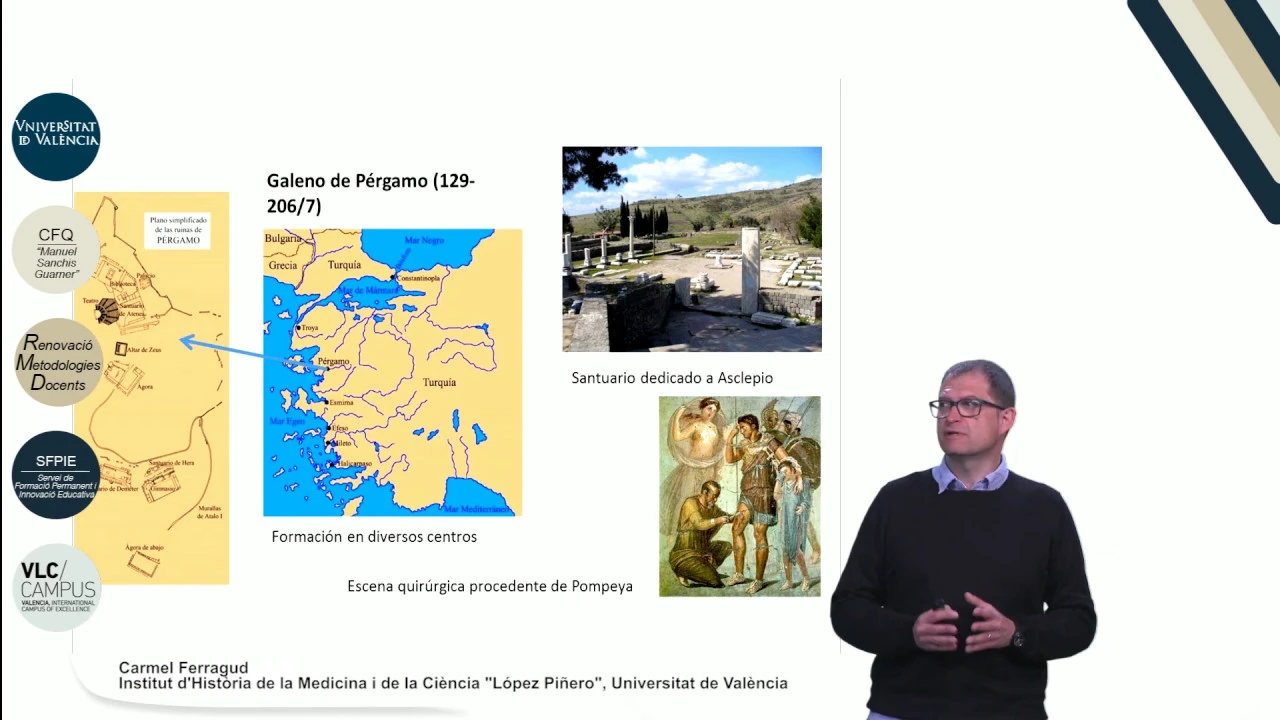
- Galen was born in 129 AD in Pergamon, an area occupied by the Roman Empire.
- He initially studied literature but later decided to pursue medicine at age 16.
- His decision was likely influenced by the presence of a sanctuary dedicated to Asclepius, the god of medicine, in his hometown.
Career Advancements
- Galen gained a reputation for successfully treating wealthy patrician patients who had been declared beyond recovery by other physicians.
- He became a physician to emperors such as Lucius Verus, Marcus Aurelius, Commodus, and Septimius Severus.
- Galen wrote about 300 titles on various topics related to medicine.
Contributions to Medical Knowledge
- Galen believed that anatomy was essential for medical knowledge and practiced dissections and vivisections on animals.
- He understood the body through three interconnected systems: the brain and nerves for sensation and thought; the heart and arteries for life energy transport; and the liver and veins for nutrition/growth.
- Galen believed that bodily fluids or "moods" (blood, yellow bile, black bile, phlegm) needed balance. Physicians should restore this balance when broken.
Legacy
- After his death, copies of Galen's works were made and spread throughout the Byzantine Empire, translated into Arabic and Syriac in Baghdad.
- Hunayin Ishaq prepared a large number of Galen's works. In the eleventh century, these works were translated into Latin and became foundational for medical studies at universities.
- Galen's work was eventually dismantled by Vesalian medicine, but his contributions to science during Antiquity remain significant.