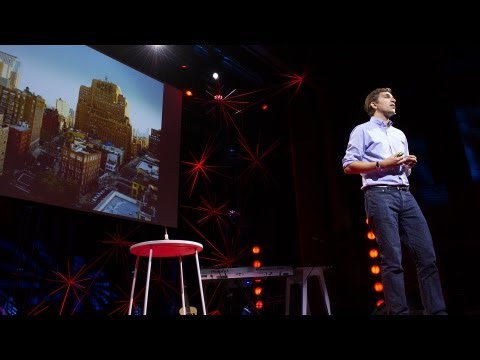
Andrew Blum: What is the Internet, really?
New Section
In this section, the speaker discusses their shift from writing about architecture to spending more time in front of a computer screen. They reflect on how their relationship with the physical world has changed due to constant online presence.
Shift in Focus
- The speaker used to primarily write about architecture and buildings.
- Writing about architecture was based on the assumption that buildings can be visited and experienced physically.
- However, over the years, the speaker found themselves spending more time in front of a computer screen instead of going out into the world.
Changing Relationship with the Physical World
- Since getting an iPhone in 2007, the speaker's relationship with the physical world has drastically changed.
- Constantly being online has divided their attention between looking at screens and observing their surroundings.
- The virtual world inside screens seems to lack physical reality, unlike the tangible experience of visiting real places.
The Internet as an Abstract Concept
- Images representing the Internet often depict it as an infinite expanse that is difficult to comprehend fully.
- This portrayal reminds the speaker of the Apollo image of Earth, emphasizing our smallness in comparison to its vastness.
- The Internet seemed intangible and separate from the physical world until a personal experience challenged this perception.
Discovering a Physical World within the Internet
- When experiencing internet connectivity issues, a cable technician discovered that a squirrel had chewed on the cables behind the speaker's couch.
- This incident sparked curiosity about where these cables led and whether there was a physical place associated with the Internet.
- Contrary to popular belief, there is indeed a real world connected to and supporting the digital realm.
Challenging Preconceived Notions
- The speaker embarked on a two-year journey to explore the physical spaces of the Internet.
- They visited large data centers and buildings like 60 Hudson Street in New York, where numerous networks connect.
- The physical connections between networks involve fiber optic cables and routers, highlighting the tangible nature of the Internet.
New Section
In this section, the speaker continues to discuss their exploration of physical spaces associated with the Internet. They highlight the significance of certain buildings and emphasize the intimate connection between physical infrastructure and digital connectivity.
Importance of Specific Buildings
- Buildings like 60 Hudson Street in New York play a crucial role in connecting various networks of the Internet.
- These buildings house important networks that serve undersea cables and facilitate global connectivity.
- The concentration of network connections within specific buildings makes them significant hubs for internet traffic.
Physicality of Internet Connections
- Network connections between different entities involve physical processes such as routing through fiber optic cables.
- The speaker emphasizes that these connections are not purely abstract or virtual but have a tangible presence.
- Buildings like 60 Hudson Street exemplify how physical infrastructure supports digital communication.
Intimacy in Connectivity
- Certain buildings, including 60 Hudson Street, have ten times more network connections than other similar structures.
- This high density of connections highlights an intimate relationship between physical spaces and digital connectivity.
- The speaker underscores that there is a real world associated with the Internet, contrary to common misconceptions.
Timestamps are approximate and may vary slightly depending on video playback.
New Section
This section provides an introduction to undersea cables and their capabilities.
Undersea Cables: Expansive Connections
- Undersea cables are like garden hoses in our hands, but in another dimension, they stretch across the ocean for thousands of miles.
- The basic physical process of undersea cables is simple: light enters on one end and comes out on the other.
- Landing stations, often inconspicuously located in seaside neighborhoods, serve as the starting point for transmitting light signals.
- Amplifiers resembling bluefin tuna sit on the ocean floor every 50 miles to amplify the signal.
- Each fiber optic cable can carry multiple wavelengths or colors of light, allowing for high-speed transmission.
- Multiple fibers are bundled together in a cable, connecting to the continent through manholes.
New Section
This section discusses the expansion of undersea cables and their importance for connectivity.
Expansion of Undersea Cables
- The landscape of undersea cables has been changing rapidly with more cables being laid down along coastlines.
- Countries realize that a single cable connection is not enough and seek permanent connections to support their industries.
- When a cable breaks, it requires physical intervention by sending a ship to repair and reconnect it.
- Simon Cooper from Tata Communications played a significant role in expanding undersea cable networks.
- Englishmen dominate the undersea cable industry, including Simon Cooper.
New Section
This section highlights Simon's geographic imagination and his involvement in building new undersea cables.
Geographic Imagination and Cable Building
- Simon Cooper possesses an incredible geographic imagination when it comes to expanding undersea cable networks.
- The speaker wanted to witness the process of building an undersea cable connection and approached Simon for this opportunity.
- Simon was working on the West Africa Cable System (WACS), which stretched from Lisbon to various countries in West Africa.
- The speaker received a short notice to meet Simon at a beach south of Lisbon to witness the cable being laid.
- The cable was pulled in from a specialized cable landing ship and floated on buoys until it reached the right position.
- English engineers supervised the process, and once in place, the buoys were cut off, allowing the cable to drop to the sea floor.
New Section
This section describes the process of connecting an undersea cable to land.
Connecting Undersea Cable to Land
- After reaching the ship, Simon Cooper swam back to shore and lit a cigarette as he prepared for the next step.
- The cable that had been brought down from the landing station was connected to the undersea cable onshore.
- The process involved preparing for connection and ensuring a seamless link between sea and land.
Timestamps are provided for each section based on available information.
New Section
In this section, the speaker reflects on the physicality of the internet and how it is not just a cloud-based concept. The speaker also highlights the connection between sophisticated technology and the physical process involved in internet connectivity.
Internet as a Physical Entity
- The speaker observes workers using a hacksaw to work on an internet cable, which emphasizes the physical nature of the internet.
- Despite being based on advanced technology, the physical process of connecting cables has been around for a long time.
- The culture surrounding this process remains consistent, with local laborers and English engineers working together.
- Classic port cities like Lisbon, Mombasa, Mumbai, Singapore, and New York are still connected by these cables.
New Section
This section focuses on the process of connecting cables onshore and highlights our tendency to relinquish responsibility when using cloud services.
Connecting Cables Onshore
- The process of connecting cables onshore takes approximately three or four days.
- Once completed, manhole covers are placed back on top and covered with sand.
- People tend to forget about these physical connections once they are buried underground.
Responsibility in Cloud Services
- While there is much talk about the cloud, every time something is stored in it, we give up some responsibility for its maintenance.
- We become less connected to our data and rely on others to take care of it.
New Section
This section emphasizes the importance of understanding where our internet comes from and physically connects us all.
Knowing About Wires
- A quote by Neal Stephenson suggests that people who use wired connections should have knowledge about wires themselves.
- It is crucial for us to know where our internet originates from and how we are physically connected through it.
Turn any video into a summary like this
YouTube links, meetings, lectures. With transcripts, search, and chat.