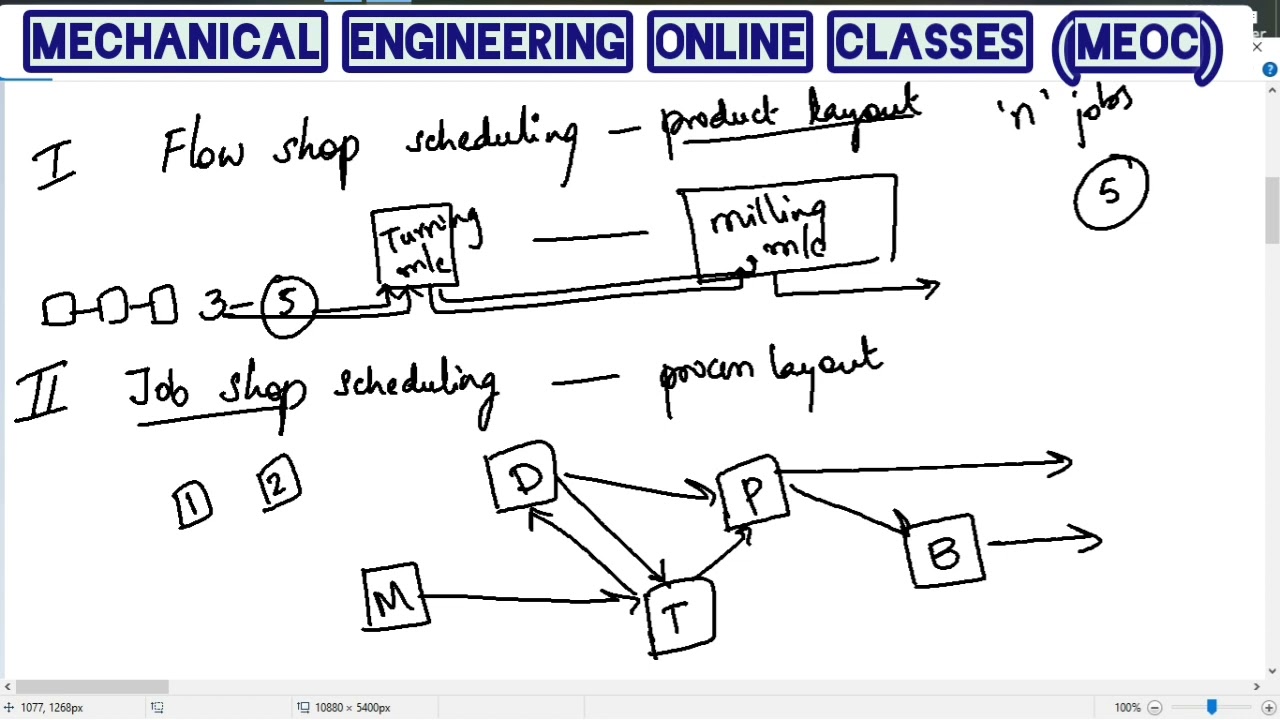
flow shop and job shop Sequencing and Scheduling definition, types & assumptions
Introduction
The lecture introduces the concept of scheduling problems in operations research, focusing on sequencing and the importance of determining the order in which jobs are to be done or customers served.
Understanding Sequencing in Operations Research
- Sequencing involves choosing the appropriate order for jobs or customer service.
- Effective measures such as time and cost play a crucial role in determining this order.
- Two types of sequencing problems exist: flow shop scheduling and job shop scheduling.
- Flow shop scheduling involves all jobs following the same processing order, typical in a product layout.
- Job shop scheduling entails each job having a unique processing order, common in a process layout.
Differentiating Flow Shop Scheduling and Job Shop Scheduling
- Flow shop scheduling:
- All jobs have the same processing order, leading to an optimal sequence with minimum time or cost.
- Job shop scheduling:
- Jobs have different processing orders, requiring finding an optimal sequence to minimize total time or cost.
Analytical Methods
Various analytical methods are discussed for solving sequencing problems, including models for end jobs processed on single or multiple machines under flow shop and job shop scheduling scenarios.
Analytical Methods for Sequencing Problems
- In jobs one machine:
- Finding the best sequence for end jobs processed on a single machine is one model.
- End jobs on two machines:
- Another model involves end jobs processed on two machines.
- N jobs on M machines:
- A general method where N jobs need to be processed on M machines falls under job shop scheduling.
Common Assumptions in Solving Sequencing Problems
- Only one operation per machine at a time:
- Each machine can handle only one job simultaneously.
- Completion of each operation before moving to the next:
- Ensuring that operations are completed sequentially without overlap is essential.
- Single machine type availability:
Sequencing Problems Assumptions
This section outlines eight crucial assumptions essential for solving sequencing problems efficiently.
Processing Order and Timing Assumptions
- The processing orders must be strictly followed, with job four coming after job five. Jobs should first go to milling and then to turning in a specific order without any violations.
- Processing times are independent of the order in which jobs move between machines. The time taken on each machine remains constant regardless of the sequence of operations.
Transportation Time and Cost Assumptions
- Transportation time between different machines is considered negligible and not factored into calculations. It is assumed that travel time does not impact overall processing efficiency.