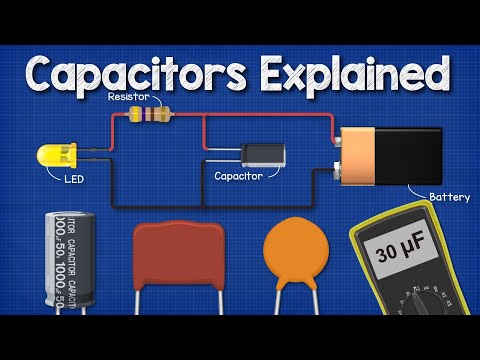
Capacitors Explained - The basics how capacitors work working principle
Understanding Capacitors: Function, Importance, and Applications
What is a Capacitor?
- Paul introduces the topic of capacitors, emphasizing their importance in electrical circuits and warning about the dangers of electricity.
- A capacitor is defined as a device that stores electric charge, functioning differently from a battery by charging and discharging energy more rapidly.
How Does a Capacitor Work?
- The analogy of a water pipe is used to explain how capacitors store energy; they act like tanks that smooth out interruptions in supply.
- When connected in a circuit, capacitors can maintain power during rapid on-off cycles, preventing lights from flashing.
Structure of a Capacitor
- Basic capacitors consist of two conductive plates (often aluminum) separated by an insulating dielectric material.
- The process of charging involves electrons building up on one plate while the other plate releases electrons due to voltage from a battery.
Voltage and Electric Field
- A voltage difference arises between the plates due to electron buildup, creating potential energy that can be measured with a multimeter.
- Voltage is likened to pressure in water pipes; it represents the difference between two points in an electrical circuit.
Behavior During Discharge
- When disconnected from power, capacitors still show voltage differences until they equalize; this allows them to discharge energy when needed.
- An electric field forms between the plates due to opposite charges attracting each other but not allowing direct flow because of insulation.
Practical Applications of Capacitors
- Capacitors are commonly found on circuit boards and come in various sizes for different applications such as motors and air conditioning units.
Understanding Capacitors and Their Applications
Basics of Capacitors
- Capacitors are electrical components that store energy in an electric field, characterized by their capacitance value (measured in farads) and maximum voltage rating (measured in volts). The voltage rating indicates the highest voltage the capacitor can safely handle.
Risks of Exceeding Voltage Ratings
- Exceeding a capacitor's voltage rating can lead to catastrophic failure, including explosions. This highlights the importance of adhering to specified limits when using capacitors.
Applications of Capacitors
Power Factor Correction
- In large buildings, capacitors are commonly used for power factor correction. They help synchronize current and voltage waveforms when inductive loads cause them to fall out of phase.
Smoothing AC to DC Conversion
- Capacitors play a crucial role in smoothing out peaks during AC to DC conversion. They release stored energy during gaps between peaks, resulting in a more stable DC output.
Measuring Capacitance and Voltage
Using a Multimeter
- To measure capacitance and stored voltage, one can use a multimeter. Not all multimeters have this function; it's important to select an appropriate model for accurate readings.
Safety Precautions
- When handling capacitors, safety is paramount due to their ability to hold high voltages even after disconnection from circuits. Proper discharge methods should be employed before handling.
Measurement Process