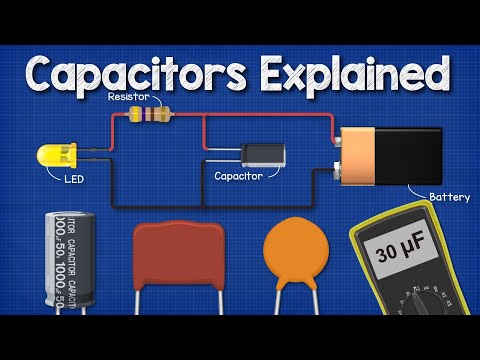
Capacitors Explained - The basics how capacitors work working principle
Understanding Capacitors: Function, Importance, and Applications
What is a Capacitor?
- A capacitor is defined as a device that stores electric charge, functioning similarly to a battery but with different energy storage capabilities.
- Unlike batteries, capacitors can charge and release energy much faster, making them essential components in nearly every circuit board.
How Does a Capacitor Work?
- The analogy of a water pipe is used to explain how capacitors store energy; they act like tanks that smooth out interruptions in the flow of electricity.
- When connected in a circuit, capacitors help maintain power supply during rapid on-off cycles by discharging stored energy to keep devices powered momentarily.
Structure of a Capacitor
- A basic capacitor consists of two conductive metal plates (often aluminum), separated by an insulating material known as dielectric.
- The connection of one plate to the positive terminal and the other to the negative terminal allows for electron buildup on one side while depleting it on the other.
Voltage and Electric Field
- The difference in electron accumulation creates a voltage difference between the plates, which can be measured using tools like multimeters.
- Voltage is compared to pressure; just as pressure gauges measure differences between two points, voltage measures potential differences across capacitor plates.
Practical Applications of Capacitors
- Capacitors are widely used in various applications including circuit boards, induction motors, ceiling fans, and air conditioning units.
Understanding Capacitors and Their Applications
Capacitor Basics
- A capacitor is represented by a symbol resembling a letter "U" with a tail, and its voltage rating is measured in volts (V). This rating indicates the maximum voltage the capacitor can handle.
- Exceeding this voltage can lead to catastrophic failure, such as an explosion of the capacitor. A slow-motion demonstration illustrates this risk.
Applications of Capacitors
- One primary use of capacitors in large buildings is for power factor correction. Inductive loads can cause current and voltage waveforms to become out of sync, leading to lagging current.
- Capacitor banks are employed to realign these waveforms, restoring synchronization. Previous discussions on power factor provide further insights into this topic.
Smoothing Power Supply
- Another common application involves smoothing peaks during AC to DC conversion. Full bridge rectifiers flip AC sine waves, but gaps between peaks can create issues.
- Capacitors release stored energy during these interruptions, resulting in a more stable DC output.
Measuring Capacitance and Voltage
- Not all multimeters have capacitance measurement functions; however, recommendations for specific models are provided. Caution is advised when handling capacitors due to their ability to store high voltages even when disconnected.
- To check voltage safely, connect the multimeter's red wire to the positive terminal and black wire to the negative terminal. If readings exceed several volts, discharge using a resistor before handling.
Practical Measurement Techniques