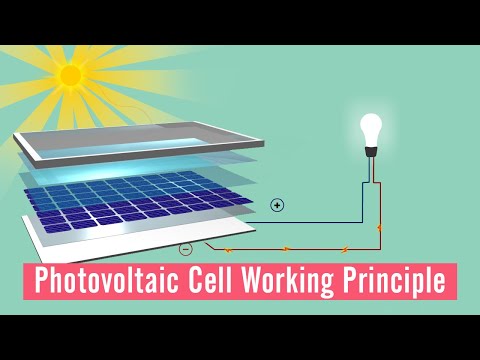
How do Solar cells work? | #PNjunction solar cell | #solarenergy Explain
How is Solar Energy Used to Generate Electricity?
Overview of Solar Energy
- The most commonly used renewable energy source is solar energy.
Photovoltaic Systems
- Solar energy is converted into electricity using a photovoltaic (PV) system.
- The basic component of a PV system is the solar cell, which produces about 0.5 volts of electricity.
- A solar panel consists of multiple solar cells connected in series to generate usable voltage; for example, 30 cells can produce 15 volts.
Functionality of Solar Cells
- The process by which sunlight generates electricity in solar cells is called the photovoltaic effect.
- Solar cells are made from semiconductors, primarily silicon, and consist of three layers: an n-type layer with high electron concentration and a p-type layer with high hole concentration.
Formation of APN Junction
- When the n-type and p-type materials are joined, they form an APN junction that creates negatively charged and positively charged layers due to electron and hole movement.
Depletion Region Dynamics
- Sunlight penetrates the top layer to reach the depletion region where neutral atoms are broken apart by photons, creating free charge carriers (electrons and holes).