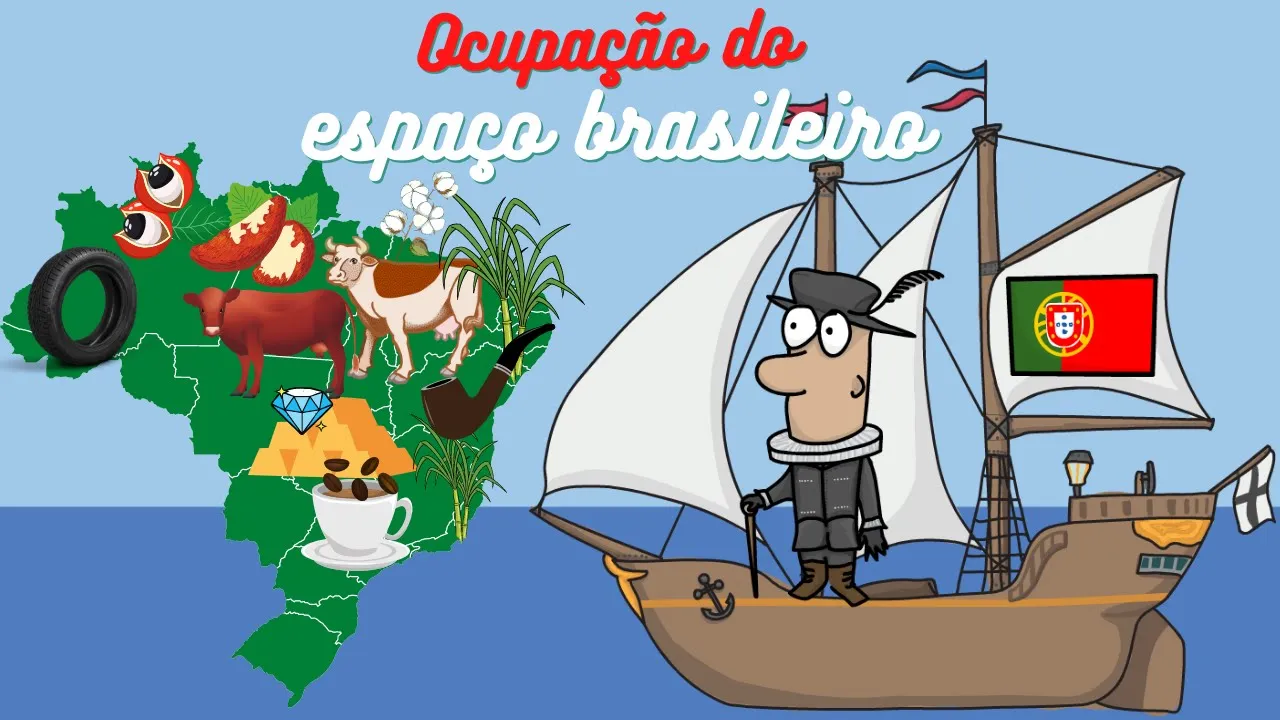
Ocupação do espaço brasileiro
Ocupação do Espaço Brasileiro
In this section, the speaker delves into the historical context of the Brazilian territory's occupation, exploring factors such as the Treaty of Tordesillas and key economic activities that shaped Brazil's development.
Portuguese and Spanish Exploration
- The Treaty of Tordesillas divided lands between Portugal and Spain.
- Portuguese received fewer territories compared to the Spanish.
- Initial exploration lacked technology for accurate territorial assessment.
- Spanish found gold and diamonds in Pacific and Caribbean regions.
- Portuguese focused on spice trade with India before colonizing Brazil.
Colonization Phases
- Sugar cultivation in Northeast initiated colonization in 1530.
- Lack of precious metals led to inland expeditions.
- Shift to cattle ranching and spice exploration in Amazonia by the 17th century.
- Expansion broke Treaty of Tordesillas boundaries.
Economic Shifts and Territorial Expansion
This segment discusses economic transitions from sugar to gold mining, rubber production, cotton cultivation, coffee farming, and their impacts on Brazil's territorial growth.
Economic Activities Evolution
- Bandeirantes discovered gold deposits in Minas Gerais, Goiás, Mato Grosso around 1700.
- Gold rush attracted settlers to Minas Gerais; capital shifted to Rio de Janeiro.
- Signing of the Treaty of Madrid in 1750 expanded Portugal's territorial rights significantly.
- Principle of Uti Possidetis solidified possession based on occupation.
Industrialization Impact
- Cotton became a significant export by the late 18th century due to English demand for textiles.
- Rubber extraction boosted urban development in Manaus during the rubber boom era (late 19th century).
- Acquisition of Acre from Bolivia for rubber production via Tratado de Petrópolis (1904).
Industrialization and Urbanization
This part explores how coffee cultivation spearheaded industrial growth, infrastructure development like railways, electricity supply establishment, emergence of banks, fostering industrialization and urbanization across Brazil.
Coffee Industry Dominance
- Coffee emerged as a pivotal economic activity between the 19th and early 20th centuries.