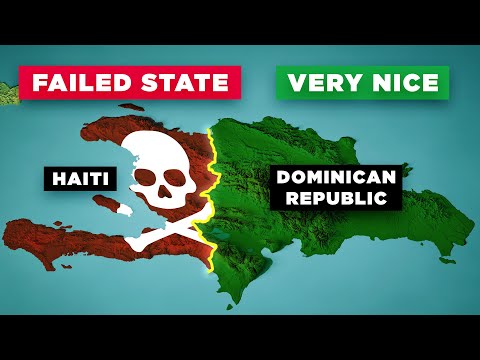
Why Haiti is Dying & the DR is Booming
Haiti's State Collapse Crisis
The transcript discusses the dire situation in Haiti, where armed gangs have taken control, leading to a collapse of the state.
Haiti's Political Turmoil
- Armed gangs control significant portions of Haiti, including 90% of the capital, Port-au-Prince.
- Lack of elected officials and delayed elections have left Haiti without a functioning government.
- President Moise's assassination in 2021 led to suspicions and accusations against Ariel Henry, who became Prime Minister under questionable circumstances.
Natural Disasters and Economic Impact
- Following Moise's assassination, a devastating earthquake struck Haiti in August 2021, causing significant loss of life and economic damage.
- The series of events in 2021 left Haiti with an unelected leader and widespread gang violence, exacerbating the country's instability.
Escalation of Violence and International Response
- Former police members turned gangsters exploit the power vacuum, leading to increased violence across Haiti.
- The Biden Administration advised American citizens to leave Haiti due to escalating violence and anarchy.
Refugee Crisis and Foreign Intervention
The transcript delves into the refugee crisis stemming from Haiti's turmoil and calls for foreign intervention.
Refugee Exodus
- Over 100,000 Haitians fled as refugees post-crisis through perilous routes towards South America or directly to US territories.
Pleas for Foreign Intervention
New Section
This section discusses the intervention in Haiti, detailing the involvement of various countries and the historical context of foreign interventions in the region.
Intervention in Haiti
- The United Nations Security Council authorized an armed intervention into Haiti, with the United States funding it with over $100 million. Kenya will lead the intervention.
- Kenya plans to deploy at least a thousand police officers and soldiers to destroy gang control in Haiti, supported by troops from Jamaica, the Bahamas, and Antigua and Barbuda.
- Foreign interventions in Haiti have a long history dating back centuries, with limited success in establishing lasting stability. Foreign troops have been present on Haitian soil for about 38% of the past 108 years.
- The current crisis in Haiti is considered one of its worst, potentially leading to it becoming a failed state. The United Nations intervention aims to restore order as Haiti faces escalating violence and anarchy.
New Section
This section delves into the construction of a wall along the border between Haiti and the Dominican Republic, highlighting economic disparities and contrasting living conditions between the two nations.
Border Wall Construction
- The Dominican Republic is constructing a wall along its entire border with Haiti to further separate both nations. The wall includes advanced security features like drones, cameras, radars, motion sensors, and fiber optic cables to prevent unauthorized crossings.
The History of Haiti and the Dominican Republic
This section delves into the historical background of Haiti and the Dominican Republic, focusing on the contrasting colonial experiences of the two nations under Spanish and French rule.
The Colonial Divide
- The island was divided into an eastern Spanish colony and a western French colony, with differing treatment by their respective colonizers.
- The Spanish pursued settler colonialism with limited slavery, while the French engaged in extensive exploitation, forcibly transporting around 800,000 Africans to Haiti.
- By 1789, Haiti's population exceeded that of the neighboring Dominican Republic significantly due to slavery practices.
Revolution and Independence
- In 1791, Haitian slaves revolted against their colonial masters in a violent revolution during the chaos of the French Revolution.
- After a brutal genocidal war lasting 13 years, Haiti gained independence from France in 1804 through violent means.
- Despite independence, Haiti faced international non-recognition for decades post-independence.
Haiti's Economic Struggles Post-Independence
This section explores Haiti's economic challenges following independence, focusing on the impact of the French Indemnity and subsequent financial burdens imposed on Haiti.
The French Indemnity
- In 1825, France demanded financial compensation from Haiti for recognizing its independence or face war.
- Forced to accept, Haiti agreed to pay France an indemnity known as the French Indemnity for its freedom already paid in blood.
- The indemnity economically crippled Haiti for over a century despite later reductions by France.
Economic Consequences
- To repay this debt, Haiti resorted to drastic measures like deforestation for timber sales contributing to environmental degradation.
- Lack of international recognition led to predatory loans from French banks exacerbating their financial burden.
Bank Control and Debt Imposition
This section discusses how a bank gained control over the Haitian Central Bank, leading to the imposition of predatory loans on Haiti to service its original 1825 French Indemnity debt.
Bank's Control Over Haitian Central Bank
- The bank acquired European shareholders in the Haitian Central Bank, redirecting Haiti's double debt repayments to Wall Street.
- City Bank utilized its influence over the Haitian Central Bank to enforce significant additional predatory loans on Haiti.
Impact of Double Debt on Haiti
This part delves into the repercussions of Haiti's double debt from the 1825 French Indemnity, portraying it as hindering Haiti's development and autonomy for an extended period.
Consequences of Double Debt
- The forced loans transformed Haiti into what American Communists termed an "American slave Colony."
- It took until 1935 for the Haitian Central Bank to gain independence from City Bank.
Economic Drain on Haiti
This segment explores how diverting funds to repay debts hindered Haiti's progress, depriving them of resources for self-investment in infrastructure, education, and healthcare services.
Economic Impact
- Over 122 years, Haiti paid a total of 112 million Franks on their double debt.
- The diversion of resources prevented investments in crucial sectors like infrastructure and healthcare.
Long-Term Financial Losses
Discusses a New York Times investigation highlighting the enduring impact of diverted funds due to debts imposed on Haiti by France.
Financial Analysis
- Retaining funds for internal development could have yielded approximately $21 billion today.
- Estimates suggest potential losses reaching as high as $115 billion due to diverted funds over two centuries.
Haiti-Dominican Republic Relations
Explores historical events that shaped divergent paths between Haiti and the Dominican Republic post-independence.
Post-Independence Events
- Dominican Republic avoided similar debt burdens faced by Haiti post-independence.
Haiti and the Dominican Republic: A Tale of Two Countries
This section delves into the contrasting political histories of Haiti and the Dominican Republic, focusing on the authoritarian rule in Haiti under François Duvalier and his son Jean-Claude Duvalier, juxtaposed with the Dominican Republic's shift towards democracy and economic growth.
Haiti under François Duvalier
- François Duvalier's authoritarian regime in Haiti lasted until his death in 1971, unlike Trujillo's regime in the Dominican Republic that collapsed post his demise.
US Support for Duvalier Regime
- The United States supported the Duvalier regime due to its anti-communist stance, which was crucial for countering communist Cuba's influence in the Caribbean.
Economic Divergence between Haiti and the Dominican Republic
- While both countries were impoverished and isolated due to dictatorships, the Dominican Republic began reforming itself in the late 1960s, leading to economic growth and stability.
Political Instability in Haiti
- Despite historical factors contributing to poverty, Haiti's economic decline compared to the Dominican Republic started after 1968 due to chronic instability deterring foreign investment.
Political Turmoil and Foreign Interventions in Haiti
This section explores political upheavals in Haiti post-Duvalier era, including Jean-Bertrand Aristide's presidency, military coups, US interventions, and demands for reparations from France.
Aristide Presidency & Coup
- Jean-Bertrand Aristide became Haiti's first democratically elected leader but faced a coup within seven months. The Clinton Administration imposed an economic blockade on Haiti following this event.
US Military Intervention
- In 1994, the United States intervened militarily to restore Aristide to power after a rebellion. Over 20,000 troops were sent during Operation Uphold Democracy.
Reparations Demand & Rebellion
- Aristide demanded $21 billion reparations from France. Subsequently, paramilitary rebels launched a successful rebellion allegedly with training from US Special Forces.
Aristide’s Controversial Exit from Power
This segment discusses Aristide's controversial departure from office amidst escalating rebel activities and alleged involvement of US security personnel.
Departure from Presidency
Life in Exile
This section discusses the events surrounding Jean Bertrand Aristide's exile from Haiti, highlighting conflicting accounts of his resignation and removal from power.
Events Leading to Exile
- Conflicting accounts exist regarding Aristide's resignation; he claimed American officials pressured him to resign immediately, citing threats to his life and family.
- Aristide was allegedly kidnapped by American forces at gunpoint, flown out without knowledge of his destination, and forced into exile against his will.
- Allegations of coercion during Aristide's removal are supported by the actions of the Americans and French, notably their involvement in rejecting appeals for peacekeeping forces before his resignation.
Aftermath of Aristide's Resignation
- Following Aristide's resignation, an armed intervention was authorized in Haiti with Boniface Alexandre succeeding him as interim president, withdrawing Haiti's demand for reparations from France.
- A report suggested that the events leading to Aristide's exile constituted a coup d'état sponsored by France and the United States to thwart Haiti's demands for reparations.
Haiti-Dominican Republic Comparison
Contrasting geographic features between Haiti and the Dominican Republic are discussed alongside demographic growth rates and population densities.
Geographic & Demographic Contrasts
- Despite similar rainfall levels on both sides of the island, Haiti faces unique geographic challenges contributing to continuous disasters compared to its neighbor.
- Both countries experienced comparable demographic growth rates since the 1950s, with significant population increases by 2001.
Worldwide Population Density and Vulnerabilities
This section discusses the population density of various countries, focusing on Haiti's unique vulnerabilities due to its high population density and deforestation issues.
Worldwide Population Density
- Half of the top 15 densest countries with over a million people are highly developed economies.
- Haiti faces frequent natural disasters due to its high population density and geographical location prone to hurricanes.
- Haiti's vulnerability to storms is exacerbated by deforestation, unlike the Dominican Republic.
Energy Sources and Infrastructure in Haiti vs. Dominican Republic
This part delves into the energy sources, infrastructure, and electricity access in Haiti compared to the Dominican Republic.
Energy Sources and Infrastructure
- Both countries heavily rely on imported fossil fuels for electricity and transportation.
- The Dominican Republic attracts more foreign investment, leading to a more developed electricity grid than Haiti.
Impact of Deforestation on Vulnerability to Natural Disasters
Examines how deforestation affects vulnerability to hurricanes in Haiti compared to the Dominican Republic.
Deforestation Impact
- Only 12% of Haiti's land remains forested due to reliance on charcoal as an energy source.
- Deforestation exacerbates flooding in Haiti during hurricanes, contrasting with forested areas in the Dominican Republic.
Geographic Factors Affecting Disaster Vulnerability
Discusses how geographic factors like tectonic fault lines contribute to disaster vulnerability in Haiti versus the Dominican Republic.
Geographic Factors
- Active tectonic fault lines increase earthquake risk in densely populated areas of Haiti.
Dormant Period and Catastrophic Events
This section discusses the dormant period in Haiti leading up to the catastrophic earthquake in 2010, detailing the impact on the population and infrastructure.
Dormant Period and Hurricane Resistance
- The Haitian people were dormant for over 240 years, focusing on hurricane resistance by building homes with concrete and cinder blocks.
- Homes built to resist hurricanes were not suitable for earthquakes, leading to devastating consequences during the 2010 earthquake.
Impact of 2010 Earthquake
- The catastrophic earthquake in 2010 near Port-au-Prince caused significant loss of life, with poorly constructed homes collapsing.
- The economic damage from the earthquake amounted to $8.5 billion, representing a substantial portion of Haiti's GDP at that time.
Aftermath of Natural Disasters
This section delves into the aftermath of the 2010 earthquake in Haiti, including foreign aid efforts and subsequent challenges faced by the country.
Cholera Outbreak and Hurricane Matthew
- Foreign aid workers arrived post-earthquake but inadvertently introduced cholera to Haiti, resulting in a deadly outbreak affecting hundreds of thousands.
- Hurricane Matthew in 2016 exacerbated existing issues, causing further loss of life, economic damages, and worsening the cholera epidemic.
Lasting Legacies and Political Turmoil
- The interventions by various countries left lasting negative legacies on Haiti's trust towards external assistance due to failures in establishing stability.
- President Moïse faced corruption allegations amid delays in parliamentary elections, leading to protests against his administration before his assassination in July 2021.
Current Challenges and International Intervention
This section explores recent events in Haiti post-natural disasters, including gang control escalation, failed governance structures, and international intervention discussions.
Gang Control and Failed Governance
- Following natural disasters and political turmoil, gangs gained control over a significant portion of Haiti's capital city.
- The United Nations considered another armed intervention due to Haiti's status as a failing state but faced challenges finding a lead country willing to intervene directly on the ground.
International Intervention Efforts
- The Biden Administration sought Kenya's leadership for an intervention into Haiti after previous unsuccessful attempts by other nations due to past failures in stabilizing the region.
Forces Deployed to Haiti
The discussion revolves around Kenya leading an intervention in Haiti by deploying police officers and soldiers to regain control of Port-au-Prince from gangs, aiming to restore authority to the Haitian government for conducting elections.
Kenya's Intervention Concerns
- Doubts exist regarding the success of Kenya's intervention due to historical corruption in both Kenyan and Haitian police forces.
- There are fears that Kenya's involvement may inadvertently strengthen a particular gang with ties to the Haitian government, potentially exacerbating dominance issues.
Economic Disparities: Haiti vs. Dominican Republic
Contrasting the economic situations of Haiti and the Dominican Republic, highlighting how natural disasters have significantly impacted Haiti's development compared to its neighbor.
Economic Disparities
- The Dominican Republic has been more resilient to natural disasters due to factors like lower deforestation rates, population density, and historical economic stability.
- Tourism plays a crucial role in the Dominican Republic's economy, surpassing Haiti significantly in tourist numbers and revenue generation.
Wealth Disparity and Resource Allocation
Discussing how economic disparities between Haiti and the Dominican Republic have widened over time due to differing resource allocations and wealth accumulation.
Wealth Gap Factors
- The Dominican Republic benefits from mineral wealth, notably having profitable gold mines that contribute substantially to its GDP.
- Contrarily, Haiti lacks significant mining operations, hindering its ability to generate tax revenues for reinvestment into critical sectors like education and infrastructure.
Proposed Solutions for Haiti's Development
Proposals for addressing Haiti's long-standing challenges by advocating for economic sovereignty restoration through reparations payments from historical entities that profited off past injustices.
Proposed Solutions
- Advocates suggest honoring reparations demands made by Jean Bertrand Aristy in 2003 as a means of empowering Haiti economically.
Refugees and International Interventions in Haiti
The discussion revolves around the implications of interventions in Haiti, particularly focusing on the potential consequences if economic aspects are not addressed alongside security concerns.
Refugees and Future Interventions
- Refugees fleeing towards the United States may continue to be a challenge for Washington if future interventions in Haiti only focus on restoring government sovereignty in a security sense without addressing economic reparations.
- Past demands for reparations by Haitian leaders resulted in adverse outcomes such as sponsored coups and foreign troop presence, highlighting the complexities surrounding addressing historical wrongs in Haiti.
- The uncertain future of Haiti contrasts with the Dominican Republic's promising trajectory towards becoming a fully developed country, emphasizing the divergent paths of these neighboring nations.
Historical Context and Complex Challenges
- Drawing parallels between Hispaniola and the Korean Peninsula underscores the potential for vastly different futures based on historical decisions and current circumstances.
- Addressing Haiti's multifaceted challenges is identified as one of the most daunting tasks facing the International Community amidst a myriad of global issues, ranging from macro-level crises to individual struggles.
Sponsorship Message: Henson Shaving Razor
The transcript transitions into a sponsorship message promoting Henson shaving razors, highlighting their quality, durability, and cost-effectiveness.
Features of Henson Shaving Razor
- Henson shaving razor boasts precision engineering that exposes blades minimally, offering a superior alternative to traditional disposable cartridges.
- Contrary to misconceptions about safety razors being outdated, Henson razors are likened to aerospace-grade products due to their design excellence derived from space station part manufacturing experience.
- The blade support system across its width ensures a gentle shave with minimal irritation, emphasizing longevity as users can retain one razor for decades by replacing only inexpensive blades.
Cost-Efficiency and Quality
- Despite initial investment costs, Henson razors promise long-term savings while providing a premium shaving experience compared to conventional grocery store options.