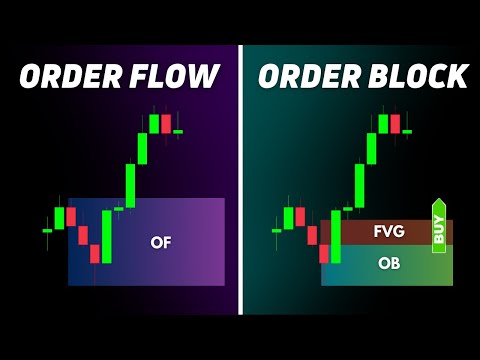
SECRETS of ORDER FLOWS and ORDER BLOCKS🔥 | Smart Money Concepts Course | Episode - 6 | SMC | ICT
Smart Money Concepts: Order Flow and Order Blocks
In this video, the focus is on understanding order flow and order blocks in Smart Money Concepts (SMC) trading. These concepts are crucial for identifying potential trade setups with minimal risk and high profit probabilities.
Understanding Order Flow
- Order flow and order blocks help identify potential trade entry points with minimal risk.
- Order flow reveals where smart money hides positions or initiates new ones.
- Two types of order flows exist: bullish in an upward market structure and bearish in a downward market structure.
- Validating order flow is essential; it can be mitigated, unmitigated, or failed.
Identifying Bullish Order Flow
- In a bullish market, higher highs and higher lows indicate a bullish structure.
- Spotting bullish order flow involves identifying bearish candles before price moves higher.
Recognizing Bearish Order Flow
- Lower highs and lower lows characterize a bearish market structure.
- Identifying bearish order flow entails recognizing bullish candles before price drops.
Order Flow Trading Strategies
In this section, the speaker discusses order flow trading strategies, distinguishing between mitigated and unmitigated order flows and their implications for future price movements.
Identifying Mitigated and Unmitigated Order Flows
- Mitigated Order Flows:
- The last selling move before a buy indicates an order flow.
- Price tapping into bullish order flow mitigates it, suggesting future ineffectiveness.
- Unmitigated Order Flows:
- Prices not testing or mitigating bearish/bullish order flows are significant.
- High probability of price returning to mitigate untested order flows.
Taking Trades Using Order Flow Concept
- Trade Entry Strategy:
- Shift to next untested order flow once current one is mitigated.
- Enter trade from order flow zone during pullback after structure break.
Applying Order Flow Concept in Market Structures
- Bullish Scenario:
- Identify bullish break of structure for trade entry above bullish order flow.
- Set stop-loss below the order flow zone with targets at recent swing highs.
- Bearish Scenario:
- Mark bearish break of structure for short trade below unmitigated bearish order flow.
- Stop-loss above the order flow zone with targets at recent swing lows.
Challenges and Considerations in Order Flow Trading
This part addresses drawbacks and considerations associated with utilizing order flows in trading strategies.
Drawbacks of Order Flow Trading
- Large Stop Losses:
- Stop losses need to be beyond the order flow zone, leading to reduced reward-to-risk ratio.
- Lack of Entry Criteria:
- No defined entry criteria; relies on intuition and risk assessment for trade positions from an order flow zone.
- Human Error in Identification:
Understanding Order Flow and Order Blocks
In this section, the speaker discusses the importance of correctly identifying order flow areas and introduces the concept of order blocks as a refinement of order flow.
Marking Order Flow Areas
- Incorrectly marking order flow can lead to price return or failure.
- A bullish order flow is not necessarily the last selling move before a buy; correct identification is crucial.
Identifying Real Order Flow
- The highlighted area may be an internal move or consolidation, not the actual order flow.
- True order flow involves moves that do not take out previous lows/highs.
Introduction to Auto Blocks
- Auto blocks refine order flows, offering high-quality trades with improved risk-reward ratios.
- Tight stop-loss settings in auto blocks can be vulnerable to volatile price swings.
Factors for Identifying Valid Order Blocks
This part delves into seven essential factors for recognizing and marking valid order blocks, enhancing trading precision and success rates.
Seven Key Factors
- Mark order blocks on higher time frames for better accuracy .
- Look for valid break of structure before identifying order blocks .
- Consider imbalance or fair value gap as a factor .
- Ensure proper inducement after structure break .
- Check for liquidity sweep of previous highs/lows .
Order Block Identification Strategies
Exploring strategies to identify and mark valid order blocks based on the seven key factors discussed earlier.
Maximum Number of Valid Blocks
- Within a swing move, there can only be a maximum of two valid auto blocks.
Understanding Order Blocks in Trading
In this section, the speaker delves into the concept of order blocks in trading, emphasizing the importance of identifying bullish and bearish order blocks based on market structure and character changes.
Identifying Bullish Order Blocks
- To identify a bullish order block, look for the last bearish candle before the buy.
- Check for a liquidity sweep where the last candle should take out the previous minor low.
- An imbalance should be formed after the last selling candle to confirm a bullish structure.
- Start checking for order blocks only after a valid break of structure or change of character.
Validating Bullish Order Blocks
- Shift the order block to a candle that has taken out liquidity if no liquidity sweep is present.
- The fair value gap between candles is crucial for marking a valid order block.
Internal Consolidations and Second Candle
- Candles within highs and lows of the first candle are internal consolidations; focus on the one breaking high as the second candle.
Marking Bearish Order Blocks
This part discusses how to mark bearish order blocks in a bearish market structure post-valid breakout, focusing on identifying key factors like liquidity sweeps and imbalances.
Bearish Breakout Structure
- Ensure there is a valid bearish breakout structure before marking bearish order blocks.
Identifying Bearish Order Blocks
- Look for the last buying candle before sell; it should have taken out the previous Minor High.
- Check for an imbalance or fair value gap between candles to validate an order block.
Validating Bearish Order Blocks
Understanding Order Blocks and Inducements
In this section, the speaker explains how to identify and mark bearish order blocks properly by considering various factors such as extreme order blocks and decisional POIs.
Identifying Bearish Order Blocks
- The extreme order block is crucial as it signifies a high probability of reversal due to liquidity and imbalance availability.
- Valid order blocks are limited to two due to either inducements or order flow mitigations.
- Inducement is the first pullback after a structure break, essential for identifying valid order blocks from smart money traps.
Filtering Order Blocks with Inducements
This part delves into shifting inducement levels based on price movements and the significance of confirming inducement before trading.
Shifting Inducement Levels
- Price movements dictate shifting inducement levels to identify valid order blocks accurately.
- Beware of marking low probability bullish order blocks that can lead to failed trades; confirm inducement before trading.
Utilizing Order Flow Mitigation Rule
Exploring how the order flow mitigation rule aids in filtering multiple order blocks for effective trading decisions.
Filtering Order Blocks
- Understanding inducements in bearish market structures helps in filtering multiple order blocks effectively.
Understanding Price Movements and Order Blocks
In this section, the speaker discusses how price movements in the market can indicate potential trading opportunities based on order blocks and inducement levels.
Analyzing Market Movements
- The market moves higher, forming a single candle pullback without sweeping the previous inducement. Inducement levels need to be adjusted to new minor lows.
- Price correction takes out the inducement level, indicating two things: the highest price before the inducement sweep becomes the higher high, and price can tap into liquidity zones for potential reversals.
- Identifying order blocks involves finding specific candles that sweep liquidity and exhibit imbalances or fair value gaps. Incorrectly marking order blocks can lead to false readings.
Establishing Order Blocks
- The candle absorbing minor liquidity becomes a bullish order block with a fair value gap, while another bearish candle creates a second order block with an imbalance.
- Emphasizing that color of candles is less significant compared to liquidity grabs and fair value gap criteria when marking order blocks.
Utilizing Order Blocks Strategically
- Drawing imbalances or fair value gaps associated with order blocks is crucial. Price reactions from decisional and extreme order blocks guide trading decisions.
- Opting for positions from extreme order blocks over decisional ones due to higher probability and discounted prices. Setting stop-loss below key areas ensures risk management.
Order Blocks and Order Flows Analysis
In this section, the speaker discusses the concept of order blocks and order flows in trading, emphasizing their significance in decision-making processes.
Understanding Order Blocks
- The green candle that surpasses previous minor highs signifies an imbalance, serving as a potential second-order block.
- Differentiate between extreme order blocks with higher success probability and decisional order blocks. Price movements indicate reactions to these blocks.
- Observing price actions within extreme order blocks reveals insights into liquidity absorption and manipulation strategies.
Trading Strategies with Order Blocks
- Validity of an order block is maintained if price closes below it after testing. Traders can consider short trades within the block with strategic stop-loss placements.
- Optimal selling locations within an order block are highlighted for premium valuation. Target levels include previous minor lows, with a major take-profit level set at a previous lower low.
Conclusion and Call to Action
Turn any video into a summary like this
YouTube links, meetings, lectures — with transcripts, search, and chat.