Search - Lecture 0 - CS50's Introduction to Artificial Intelligence with Python 2020
Introduction to Artificial Intelligence with Python
In this class, Brian Yu introduces the concepts and techniques of artificial intelligence (AI) using Python. The class covers various types of AI techniques, including search, knowledge representation, uncertainty, optimization, machine learning, and natural language processing.
Introduction to Artificial Intelligence
- AI encompasses computer systems that exhibit intelligent behavior.
- Examples of AI include facial recognition, game playing, and language understanding.
- The class will explore the foundational ideas behind AI.
Search
- Search is a fundamental problem in AI where an agent looks for solutions to a given problem.
- Examples of search problems include finding driving directions or making moves in a game like tic-tac-toe.
- The goal is to find an optimal or near-optimal solution.
Knowledge Representation
- AI should be able to represent information and draw inferences from it.
- Representing knowledge allows computers to reason and make decisions based on available information.
Uncertainty
- Dealing with uncertain events is crucial for AI systems.
- Probability theory helps computers handle uncertain facts and make informed decisions.
Optimization
- Optimization involves finding the best solution among multiple possibilities.
- Computers can optimize their actions based on specific goals or objectives.
Machine Learning
- Machine learning enables computers to improve their performance by learning from data and experiences.
- Algorithms are designed to learn patterns and make predictions based on available data.
Language Processing
- Natural language processing focuses on enabling computers to understand human languages.
- Challenges arise when trying to interpret natural language inputs accurately.
Search Problems
This section introduces search problems as a type of AI problem. It discusses different examples of search problems such as puzzle solving and maze navigation. The concept of an agent and state are also introduced.
Agent and State
- An agent is an entity that perceives its environment and acts upon it.
- In search problems, the agent aims to find a solution by taking actions in different states.
- States represent configurations of the agent in its environment.
Examples of Search Problems
- The 15 puzzle is an example of a search problem where tiles need to be moved to reach a specific configuration.
- Maze solving is another example where the agent navigates through a maze to reach a goal state.
- Real-world applications like driving directions can be framed as search problems.
Conclusion
This section concludes the introduction to AI with Python. It emphasizes the importance of understanding search problems and introduces key concepts such as agents, states, and different types of search problems.
Understanding Search Problems
- Search problems are fundamental in AI and involve finding solutions in various domains.
- Agents perceive their environment and take actions based on different states.
- Examples include puzzle solving, maze navigation, and real-world applications like driving directions.
By understanding these concepts, we can delve deeper into AI techniques such as knowledge representation, uncertainty handling, optimization, machine learning, and natural language processing.
The Initial State
In this section, the concept of the initial state in AI search algorithms is introduced. The initial state is the starting point for the search algorithm and determines where the agent begins its reasoning process.
- The initial state is the state from which the search algorithm starts.
- It serves as a starting point to reason about what actions can be applied to reach the goal.
- Actions are choices that can be made in any given state.
- Actions can be formalized as a function called "actions" that takes a state as input and returns a set of all possible actions that can be executed in that state.
Transitioning from Initial State to Goal
This section discusses how an AI agent makes its way from the initial position to the goal by taking actions. It introduces the concept of a transition model, which describes how states and actions are related to each other.
- Actions are essential for transitioning from one state to another.
- Actions can only be executed in certain states and not others.
- Examples include sliding tiles in different directions in a 15 puzzle game.
- AI programs need encodings of both states and actions, as well as their relationship.
- A transition model defines what state we get after performing an available action in another state.
Understanding Transition Models
This section delves deeper into transition models, explaining how they relate states and actions. It also introduces the concept of a state space, which encompasses all possible states reachable from the initial state through sequences of actions.
- A transition model is defined as a function called "result."
- The result function takes two inputs: a state (S) and an action (A).
- It outputs the new state obtained after performing action A on state S.
- Transition models describe how states and actions are related to each other.
- The state space is the set of all states reachable from the initial state through any sequence of actions.
- The state space can be represented as a graph, with nodes representing states and arrows representing actions.
Goal Test
This section discusses the importance of a goal test in AI. The AI agent needs a way to determine when it has reached the goal state and solved the problem.
- The AI agent needs to know when it has reached the goal state.
- A goal test determines whether a given state is a goal state.
- In driving directions, reaching the user's intended destination could indicate a goal state.
- In the 15 puzzle game, checking if numbers are in ascending order might serve as a goal test.
[t=0:11:13] Conclusion
This section concludes by summarizing key points discussed throughout the transcript, including initial states, transition models, and goal tests.
- The initial state is where an AI search algorithm begins its reasoning process.
- Actions are choices that can be made in any given state to transition towards the goal.
- Transition models describe how states and actions are related to each other.
- The state space encompasses all possible states reachable from the initial state through sequences of actions.
- A goal test determines whether a given state is a goal state, indicating that the problem has been solved.
New Section
In this section, we learn about search problems and the concept of path cost.
Search Problems and Path Cost
- A computer may need to find a goal in a problem, either any goal or one with low cost.
- Path cost is a term used to define the numerical cost associated with each path in a search problem.
- The goal is to find a solution that minimizes the path cost.
- Actions in a search problem have associated costs, which can vary for different actions.
- Some problems have simplified costs where all actions have the same cost.
- A search problem consists of an initial state, possible actions, transition model, goal test, and path cost function.
- The objective is to find an optimal solution with the lowest path cost among all possible solutions.
New Section
This section discusses how we represent data and solve search problems using nodes.
Representing Data and Solving Search Problems
- Nodes are data structures used to represent states in a search problem.
- Each node keeps track of the current state, parent state (previous node), action taken from parent to current state, and path cost from initial state to current state.
- The parent information helps us backtrack and determine the sequence of actions leading to the goal state.
New Section
This section explains the approach for solving search problems by exploring options from a given state.
Exploring Options in Search Problems
- The approach starts at an initial state and explores available options.
- Multiple options can be considered simultaneously during exploration.
- All unexplored options are stored in a data structure called the frontier.
- The frontier contains states that haven't been visited yet but can be explored next.
New Section
This section discusses the process of exploring and solving problems using AI algorithms.
Exploring and Solving Problems
- AI can explore problems and determine if there is a solution or not.
- If the frontier (set of unexplored nodes) is empty, it means there is no solution.
- Removing a node from the frontier allows for further exploration.
- If a removed node is a goal state, a solution has been found.
- Expanding a node means considering all possible actions from that node's state.
- The resulting nodes are added to the frontier for further exploration.
New Section
This section demonstrates an example search problem using the AI algorithm discussed earlier.
Example Search Problem
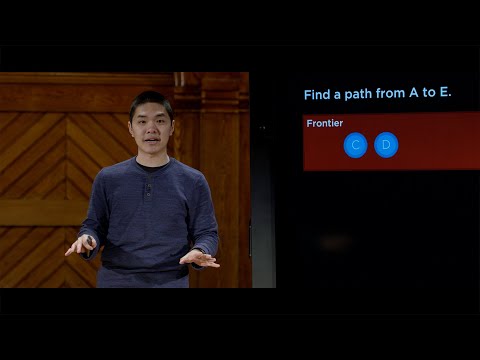
- A sample graph with connected nodes A, B, C, D, E, and F is presented.
- The goal is to find a path from A to E.
- Starting with the initial state A in the frontier, nodes are removed and explored until a solution is found or the frontier becomes empty.
New Section
This section concludes the example search problem by finding a path from A to E.
Finding Path from A to E
- Nodes are removed from the frontier and checked if they are goals. If not, they are expanded by adding their neighboring nodes to the frontier.
- After removing C and expanding it, E (the goal state) is added to the frontier.
- When E is removed from the frontier, it is identified as a goal state since we were trying to find a path from A to E. Thus, a solution has been found.
New Section
This section discusses potential problems that can arise with the search algorithm.
Potential Problems
- In some cases, bidirectional connections between nodes can cause issues.
- If there are bidirectional connections, the algorithm may get stuck in a loop or fail to find an optimal solution.
- The example of a graph with bidirectional arrows between A and B is given as an illustration.
New Section
This section concludes the discussion on potential problems and summarizes the search algorithm.
Conclusion
- The search algorithm follows a process of removing nodes from the frontier, checking if they are goals, and expanding them by adding neighboring nodes to the frontier.
- Bidirectional connections between nodes can lead to problems in finding optimal solutions.
- The search algorithm aims to find a solution by constantly exploring and expanding nodes until a goal state is reached.
New Section
In this section, the speaker discusses the problem of getting stuck in an infinite loop while searching for a solution. They introduce the concept of keeping track of explored states to avoid revisiting them.
Dealing with the Problem (0:23:37s)
- The speaker explains that constantly going back and forth between two already explored states can prevent progress.
- The solution is to keep track of what has already been explored.
- By maintaining a set of nodes that have been explored, unnecessary revisits can be avoided.
Revised Approach (0:23:55s)
- The revised approach involves using a frontier containing the initial state and an empty set for storing explored nodes.
- If a node has already been explored, it is not added to the frontier again.
- This approach ensures that previously visited states are not revisited unnecessarily.
Adding Nodes to Frontier (0:24:10s)
- Initially, the explored set is empty.
- If the frontier is empty, there is no solution.
- When removing a node from the frontier, if it's not the goal state, it is added to the explored set.
- The node expansion step involves adding resulting nodes to the frontier but only if they are not already in either the frontier or explored set.
Importance of Frontier Structure (0:25:00s)
- The choice of how elements are added and removed from the frontier is crucial.
- A stack data structure, where elements are last in, first out (LIFO), can be used for adding and removing nodes efficiently.
Depth First Search (DFS) (0:26:11s)
- DFS treats the frontier as a stack, exploring the deepest node first and backtracking when necessary.
- An example path from A to E demonstrates how DFS works by going deep into one branch before exploring other options.
Breadth First Search (BFS) (0:28:36s)
- BFS explores the shallowest node in the frontier, unlike DFS.
- It uses a queue data structure, where elements are first in, first out (FIFO), to determine the order of exploration.
The summary is based on the provided transcript and may not include all details from the video.
New Section
This section discusses the concepts of breadth-first search (BFS) and depth-first search (DFS) algorithms and their application in problem-solving, specifically maze solving.
BFS vs DFS
- BFS explores nodes that are closer to the initial state first, while DFS goes as deep as possible into the search tree.
- BFS looks at shallower nodes first, while DFS follows one path until it hits a dead end.
- BFS explores all possible paths simultaneously, while DFS exhaustively explores one path before backtracking.
- Unlike DFS, BFS guarantees finding a solution in finite mazes.
- However, BFS does not always find the optimal solution.
Maze Solving with DFS
- DFS chooses one path at decision points and continues until it reaches a dead end.
- It then backtracks to the last decision point and tries another path.
- DFS may not find the best solution if an alternative path is more optimal.
Maze Solving with BFS
- BFS explores nodes based on their distance from the initial state.
- It starts by looking at nodes one step away from the initial state, then two steps away, and so on.
- By exploring shallower nodes first, BFS can find the optimal solution in terms of minimum steps.
New Section
This section further discusses the differences between BFS and DFS algorithms in terms of finding solutions in mazes. It also addresses questions about whether these algorithms always work and if they guarantee optimal solutions.
Guaranteeing Solutions
- Both BFS and DFS will find a solution in finite mazes since they eventually explore all possible paths.
- If there is an infinite state space or an infinite number of spaces to travel, the algorithms may not find a solution.
Optimal Solutions
- DFS may not always find the optimal solution since it follows one path until it reaches a dead end.
- BFS, on the other hand, explores all possible paths simultaneously and guarantees finding the shortest path to the goal.
New Section
This section explains how BFS explores nodes in a maze and compares it with DFS. It highlights how BFS prioritizes shallower nodes and explores multiple paths simultaneously.
Exploring Nodes in BFS
- BFS explores nodes based on their distance from the initial state.
- It first looks at nodes one step away, then two steps away, and so on.
- Unlike DFS, which follows one path at a time, BFS explores all possible paths simultaneously.
- It bounces back between different paths while ensuring that shallower nodes are explored earlier.
Optimal Solution with BFS
- Although BFS may explore some states that don't lead to the goal, it guarantees finding the optimal path.
- By exploring shallower nodes first, BFS finds the shortest way to reach the goal in terms of minimum steps.
New Section
This section discusses how breadth-first search (BFS) behaves in larger mazes and emphasizes its ability to find optimal solutions.
Behavior of BFS in Larger Mazes
- In larger mazes, BFS continues exploring states until it reaches decision points.
- At decision points, it can choose between different paths by going left or right.
- While depth-first search (DFS) picks one path and follows it exclusively, BFS explores all possible paths simultaneously.
Optimal Solutions with BFS
- Despite exploring some states that don't lead to the goal, BFS guarantees finding the optimal path.
- It prioritizes exploring shallower nodes first, ensuring that the shortest way to reach the goal is found.
The transcript provided does not include any timestamps beyond 2100 seconds.
Depth First Search vs Breadth First Search
In this section, the speaker discusses the trade-offs between depth first search (DFS) and breadth first search (BFS) algorithms. They explain how DFS may save memory but requires exploring a lot of states, while BFS explores more states but guarantees finding a solution.
Trade-offs between DFS and BFS
- DFS explores deeper into the search space before backtracking, while BFS explores all neighboring nodes at each level before moving to the next level.
- DFS may save memory compared to BFS as it does not need to store all explored states. However, BFS explores more states in order to find a solution.
- The choice between DFS and BFS depends on the specific problem and its constraints.
Implementing Depth First Search and Breadth First Search
In this section, the speaker demonstrates how to implement depth first search (DFS) and breadth first search (BFS) algorithms using Python code. They introduce classes for nodes, frontiers, and mazes.
Node Class
- The node class keeps track of the state, parent state, and action taken to reach that state.
- Path cost is not stored in the node class as it can be calculated later.
Frontier Classes
Stack Frontier
- The stack frontier class represents a stack data structure for storing frontier data.
- It has functions for adding nodes to the frontier (by appending them to a list), checking if a state is in the frontier, checking if the frontier is empty, and removing nodes from the end of the list.
Queue Frontier
- The queue frontier class inherits from the stack frontier class but removes nodes from the beginning of the list instead of the end, making it a queue data structure.
Maze Class
- The maze class handles the process of solving a maze by taking a text file as input.
- The solve function uses either DFS or BFS based on the chosen frontier class and explores states until reaching the goal state.
Solving a Maze using Depth First Search
In this section, the speaker explains how to solve a maze using depth first search (DFS) algorithm. They demonstrate an implementation in Python code.
DFS Algorithm
- The DFS algorithm starts with a stack frontier containing only the start state.
- It repeatedly removes a node from the frontier, checks if it is the goal state, and explores its neighboring states.
- The algorithm continues until finding a solution or determining that there is no solution.
Handling No Solution in Depth First Search
In this section, the speaker discusses how to handle cases where depth first search (DFS) does not find a solution for a given problem.
Checking for Empty Frontier
- Before removing a node from the frontier in DFS, we check if the frontier is empty.
- If the frontier is empty, it means there is no solution to the problem, and an exception or error can be raised.
Conclusion
In this lecture, we explored depth first search (DFS) and breadth first search (BFS) algorithms. We discussed their trade-offs and saw how to implement them in Python for solving mazes. Additionally, we learned about handling cases where DFS does not find a solution.
Backtracking and Building the Solution
In this section, the speaker explains how to backtrack and figure out the actions taken to reach a goal in a search problem. The process involves looking at the parent nodes and their corresponding actions.
Backtracking Process
- To determine the actions taken to reach a goal, we need to backtrack from the current node.
- Each node stores its parent node and the action used to get there.
- By continuously looking at the parent nodes, we can build a sequence of actions leading to the initial state.
- This loop repeats until we reach the initial state with no parent.
Building Up Actions and Solution
- While backtracking, we also build up a list of all actions followed and cells that are part of the solution.
- The sequence of actions is reversed because it is built from goal to initial state.
- Reversing them gives us the sequence of actions from initial state to goal, which is ultimately our solution.
Exploring States and Adding Neighbors
- If the current state is equal to the goal, all previous steps were successful in reaching it.
- Otherwise, if it's not yet the goal, we add this state to an explored set so that we don't revisit it later.
- We then implement adding neighbors by checking if they are already in either frontier or explored set.
- If not, we add these new child nodes (states) to explore further.
Depth-first Search vs Breadth-first Search
In this section, depth-first search (DFS) and breadth-first search (BFS) algorithms are compared using two different mazes as examples. The number of states explored by each algorithm is highlighted.
Depth-first Search (DFS)
- DFS explores paths deeply before backtracking when necessary.
- It may find an optimal solution but can explore more states than necessary.
- In the example maze, DFS explored 399 different states to find a path from initial state to goal.
Breadth-first Search (BFS)
- BFS explores all neighboring nodes before moving deeper into the search space.
- It guarantees finding the shortest path but may take longer in some cases.
- In the same maze example, BFS only needed to explore 77 states to find the optimal solution.
Visualizing Maze Solutions
This section focuses on visual representations of maze solutions and how they help understand the exploration process of search algorithms.
Maze Visualization
- The program generates graphical representations of mazes and their solutions.
- Opening "maze.png" shows a visual representation of the maze with walls, initial state, goal state, and the path followed.
- Different colors are used to highlight walls, initial state, goal state, and the path taken.
Depth-first Search Exploration
- By enabling "show explored" in the program, all explored states are highlighted in red on "maze.png".
- DFS explores paths extensively before backtracking when reaching dead ends.
- Inefficient exploration can lead to exploring unnecessary parts of the graph.
Comparing DFS and BFS on a Maze
This section continues comparing depth-first search (DFS) and breadth-first search (BFS) algorithms using another maze example. The number of states explored by each algorithm is compared again.
Algorithm Differences
- The main difference between DFS and BFS lies in their frontier data structure: stack for DFS (last in, first out) vs. queue for BFS (first in, first out).
- Both algorithms follow similar steps but differ in how they prioritize exploring neighboring nodes.
Efficiency Comparison
- Running both DFS and BFS on the same maze reveals significant differences in efficiency.
- DFS took around 400 states to find the optimal solution, while BFS only required exploring 77 states.
- DFS explores deeply before backtracking, potentially leading to unnecessary exploration.
- BFS explores all neighboring nodes first, ensuring the shortest path but taking longer in some cases.
Visualizing BFS Exploration
This section focuses on visualizing the exploration process of breadth-first search (BFS) algorithm using a maze example.
Maze Visualization with BFS
- Running the program with "maze2.txt" and BFS shows a graphical representation of the maze and its solution.
- Opening "maze.png" highlights the path from initial state to goal state in yellow.
Efficient Exploration with BFS
- By enabling "show explored," all explored states are highlighted in red on "maze.png".
- Unlike DFS, BFS explores neighboring nodes systematically before moving deeper into the search space.
- The number of states explored by BFS is significantly lower compared to DFS for this particular maze.
Breadth-First Search vs Depth-First Search
This section compares the effectiveness of breadth-first search (BFS) and depth-first search (DFS) algorithms in solving mazes.
BFS on a Simple Maze
- BFS explores states close to the initial state before exploring further away.
- If the goal is not too far away, BFS can be effective.
- In a simple maze, both BFS and DFS find the same solution.
BFS and DFS on a Complex Maze
- In a more complex maze with multiple paths from A to B, BFS and DFS may find different solutions.
- Using BFS on maze3.txt finds an optimal solution with four steps.
- Using DFS on maze3.txt finds a non-optimal solution.
Trade-offs between BFS and DFS
- DFS may not always find the optimal solution.
- Breadth-first search is generally good at finding optimal solutions.
- However, there are situations where depth-first search might find longer routes to the goal.
Intelligent Algorithms: Informed Search
- Uninformed search algorithms like DFS and BFS do not use problem-specific knowledge.
- Informed search strategies use problem-specific knowledge to improve finding solutions.
- In a maze, being closer geographically to the goal is considered better.
Improving Search Algorithms with Problem-Specific Knowledge
This section discusses how problem-specific knowledge can improve search algorithms.
Human Intuition in Solving Mazes
- Humans may make different decisions than uninformed search algorithms when solving mazes.
- The first decision point in this example maze is where humans might consider progress towards the goal when choosing between left or right paths.
Distinction Between Uninformed and Informed Search
- Uninformed search algorithms like DFS and BFS do not use problem-specific knowledge.
- Informed search strategies use problem-specific knowledge to better find solutions.
- In a maze, being closer geographically to the goal is considered better.
Importance of Progress Towards the Goal
- An algorithm that makes progress towards the goal is desired.
- Moving in the coordinate direction of the goal is usually a good strategy in mazes.
- Informed search algorithms take into account problem-specific knowledge to make more intelligent decisions.
Greedy Best-First Search
In this section, we learn about Greedy Best-First Search (GBFS), a search algorithm that prioritizes expanding the node closest to the goal based on a heuristic function.
Introduction to GBFS
- GBFS is a search algorithm that expands the node it believes is closest to the goal.
- It uses a heuristic function, denoted as h(n), to estimate how close a state is to the goal.
- The heuristic function provides an estimate of proximity to the goal and helps in decision-making.
Heuristic Function and Maze-solving
- The heuristic function, such as Manhattan distance, estimates how many steps are needed to reach the goal from a given state.
- In maze-solving algorithms, the heuristic function helps determine which cell is better or closer to the goal.
- The Manhattan distance calculates steps vertically and horizontally without diagonal movement.
Estimating Proximity with Heuristics
- The heuristic function provides an estimate of proximity but may not guarantee the exact number of steps required.
- It approximates and tries to determine which squares are closer based on their values for the heuristic function.
- Squares that appear closer generally have smaller values for the heuristic function.
Applying GBFS Algorithm
- GBFS selects nodes from its frontier based on their heuristic value, choosing those with smaller values first.
- At each stage of exploration, GBFS removes nodes from its frontier based on their proximity estimation using the heuristic function.
Making Informed Decisions with GBFS
This section explains how Greedy Best-First Search allows informed decision-making by considering proximity estimations provided by the heuristic function.
Making Decisions in GBFS
- GBFS allows informed decisions by comparing proximity estimations provided by the heuristic function for different nodes.
- When faced with multiple options, GBFS selects the node with the smallest heuristic value as it is considered closer to the goal.
Example Decision Points
- In a maze-solving scenario, GBFS evaluates different nodes and their proximity estimations.
- It chooses the node with the smallest heuristic value to explore next, indicating it is closer to the goal.
Importance of Heuristic Function
- The heuristic function helps in making informed decisions even if they may not always be optimal.
- It provides an estimate of proximity to the goal and guides the search algorithm towards potentially better paths.
Conclusion
This section concludes our understanding of Greedy Best-First Search and its ability to make informed decisions based on proximity estimations provided by a heuristic function.
Key Takeaways
- Greedy Best-First Search (GBFS) prioritizes expanding nodes closest to the goal based on a heuristic function.
- The heuristic function estimates proximity to the goal and helps in decision-making.
- GBFS allows informed decisions by selecting nodes with smaller heuristic values, indicating closer proximity to the goal.
By using Greedy Best-First Search and its ability to make informed decisions based on proximity estimations, we can efficiently navigate through search spaces towards our desired goals.
Greedy Best-First Search
In this section, the concept of greedy best-first search is introduced as an approach to solving problems. The algorithm selects nodes with the smallest heuristic value and explores them first.
Greedy Best-First Search Approach
- Greedy best-first search chooses nodes to explore based on their heuristic value, which estimates the distance to the goal.
- It aims to find a route that leads to the goal by selecting nodes with the smallest heuristic value.
- Compared to breadth-first search (BFS), greedy best-first search can often explore fewer states.
Considerations for Greedy Best-First Search
- The effectiveness of greedy best-first search depends on the quality of the chosen heuristic function.
- Coming up with a good heuristic can be challenging.
- It is important to determine if greedy best-first search is an optimal algorithm, meaning it always finds the shortest path from the initial state to the goal.
Optimality of Greedy Best-First Search
This section discusses whether or not greedy best-first search guarantees finding the optimal solution in all cases.
Example Analysis
- An example scenario is presented where greedy best-first search is used to find a path from point A to point B.
- Nodes are labeled with their Manhattan distance from the goal as a heuristic estimate.
- At a decision point, where two options are available, greedy best-first search selects the node with a smaller heuristic value.
Shortest Path vs. Greedy Solution
- In some cases, choosing nodes solely based on their smallest heuristic value may lead to suboptimal solutions.
- The example demonstrates that even though greedy best-first search found a path, it was not optimal compared to another shorter path available.
A* Search Algorithm
This section introduces the A* search algorithm as an improvement over greedy best-first search to achieve optimality.
Improving Greedy Best-First Search
- A* search is a modified version of greedy best-first search that considers both the heuristic value and the cost to reach a particular state.
- It expands nodes based on the sum of g(n) (the cost to reach the node) and h(n) (the heuristic estimate).
A* Search in Practice
- The example maze is revisited, with nodes labeled with their Manhattan distance as before.
- In addition to the heuristic value, A* search also takes into account the number of steps taken to reach each node.
- The algorithm sums up g(n) and h(n) values to determine which node to explore next.
Combining Heuristic and Cost in A* Search
This section further explains how A* search combines heuristic estimates and costs for more informed decision-making.
Considering Both Heuristic and Cost
- A* search evaluates nodes based on both their heuristic value (h(n)) and cost (g(n)).
- By considering how far a node is from the goal (heuristic estimate) as well as how many steps it took to reach that node, better decisions can be made during exploration.
Summing Heuristic and Cost Values
- The algorithm expands nodes by selecting those with the lowest sum of g(n) and h(n).
- This approach allows for more intelligent decision-making, favoring paths that may have slightly higher heuristic values but require fewer steps overall.
These notes provide an overview of greedy best-first search, its limitations in terms of optimality, and how it can be improved using the A* search algorithm.
A* Search Algorithm
In this section, the speaker discusses the A* search algorithm and its decision-making process based on heuristic values.
Decision Making with Heuristic Values
- When estimating the distance to a goal, different steps are taken into consideration.
- The speaker presents two options: being six steps away from the goal with a heuristic of 13 for a total of 19, or being six steps away from the goal with a heuristic of 11 for an estimate of 17.
- The option with the lower total value is chosen, indicating that fewer steps are preferred even if it means a higher heuristic value.
Evaluating Heuristic Values
- Another scenario is presented where there are two possibilities: being 15 steps away from the goal with an estimated distance of 6 (total value of 21), or being six steps away from the goal with an estimate of 13 (total value of 19).
- The intuition is to choose the option with the lower total value (19), as it implies taking fewer steps to reach a lower heuristic value.
Admissible and Consistent Heuristics
- The speaker explains that for A* search to find an optimal solution, the heuristic function needs to be admissible and consistent.
- An admissible heuristic never overestimates the true cost and can either be exact or underestimate.
- Consistency requires that for every node and its successor, the heuristic value should be less than or equal to the successor's heuristic plus the cost to move between them.
Optimality and Choosing Heuristics
- As long as these conditions hold true, A* search will find an optimal solution.
- Choosing an appropriate heuristic can be challenging but crucial in solving search problems effectively.
Adversarial Search in Games
This section introduces the concept of adversarial search in games, where an agent makes intelligent decisions while facing an opponent with opposing objectives.
Adversarial Situations and Game Examples
- Adversarial situations arise when there is an agent trying to make intelligent decisions while facing an opponent who wants them to fail.
- Games like tic-tac-toe are used as examples, where players take turns placing X or O on a 3x3 grid to achieve their objective.
- Computers have become proficient at playing games, including more complex ones.
Intelligent Decision Making in Games
- The speaker discusses what constitutes an intelligent move in a game like tic-tac-toe.
- Players aim to achieve their objective (three X's or three O's in a row), while opponents try to prevent it.
- Optimal moves involve strategies that consider both achieving the objective and blocking the opponent's progress.
Alternative Search Algorithms
This section mentions alternative search algorithms that can be used instead of A* search, particularly when memory usage needs to be optimized.
Memory Usage of A* Search
- A* search has a tendency to use significant memory resources.
- Alternative approaches exist that utilize less memory than the traditional version of A* search.
Optimized Search Algorithms for Different Cases
- Various search algorithms are optimized for specific scenarios beyond A* search.
- These alternatives cater to different requirements and constraints encountered during problem-solving tasks.
Conclusion
The transcript covers the A* search algorithm, decision-making based on heuristic values, admissible and consistent heuristics, adversarial search in games, and alternative search algorithms. It emphasizes the importance of choosing appropriate heuristics and explores various aspects of solving problems using different search techniques.
[t=1:13:43s] Understanding Adversarial Search and the Minimax Algorithm
In this section, we will explore the concept of adversarial search and how it differs from classical search problems. We will also introduce the Minimax algorithm, which is used to solve deterministic games with two players.
Adversarial Search and the Need for an Algorithm
- Adversarial search involves a game where one player tries to find the best moves while being opposed by an adversary.
- The Minimax algorithm is designed to handle adversarial search situations in deterministic games.
- In these games, both players aim to win, but one player wants to maximize their score while the other wants to minimize it.
Translating Game Concepts into Numbers
- To make a game understandable for a computer, we need to translate concepts like winning and losing into numerical values.
- The computer understands numbers better than abstract notions of victory or defeat.
- Each possible outcome of a game can be assigned a value or utility. For example, in tic-tac-toe, O wins (-1), nobody wins (0), X wins (1).
Max Player vs. Min Player
- In the Minimax algorithm, one player is designated as the max player (X) and aims to maximize the score.
- The other player is called the min player (O) and aims to minimize the score.
- The max player wants a higher score, while the min player wants a lower score.
Components of Game Encoding for AI
- To encode a game like tic-tac-toe for AI play, several components are needed:
- Initial state (S0): Represents how the game begins, such as an empty game board.
- Player function: Determines whose turn it is based on the current state.
- Actions function: Provides a set of possible actions for a given state.
- Transition model: Defines the consequences of taking an action in a specific state.
- Terminal test: Checks if a state is a terminal state, indicating the end of the game.
- Utility function: Assigns a numerical value to each terminal state.
Summary
- Adversarial search involves games where one player tries to find the best moves while being opposed by an adversary.
- The Minimax algorithm is used to solve deterministic games with two players, aiming to maximize or minimize scores.
- Game concepts like winning and losing are translated into numerical values for computer understanding.
- Components such as initial state, player function, actions function, transition model, terminal test, and utility function are needed to encode a game for AI play.
Transition Model and Result Function
In this section, the speaker discusses the transition model and result function in the context of playing tic-tac-toe.
Transition Model
- The transition model defines what new state is reached when an action is taken in a given state.
- It is necessary to encode the rules of tic-tac-toe into the AI so that it knows how to play.
- The result function takes a state and an action as input and returns the resulting state after applying the action.
Result Function
- The result function allows us to tell the AI how actions affect the outcome of the game.
- By applying the result function to a state and an action, we can determine what new state is obtained.
- Understanding how actions impact states is crucial for teaching the AI how to play tic-tac-toe effectively.
Terminal Function
In this section, the speaker explains the terminal function, which determines when a game is over.
Terminal Function
- The terminal function takes a state as input and determines if a game is over or not.
- If a non-terminal game state is passed into the terminal function, it will return false.
- If a terminal game state (i.e., one where someone has won) is passed into the terminal function, it will return true.
Utility Function
This section focuses on defining the utility function, which assigns scores or values to different states in tic-tac-toe.
Utility Function
- The utility function takes a state as input and provides us with information about its score or utility.
- For example, if X wins, then that particular state has a utility value of 1.
- The AI needs to know the utility of each terminal state in order to make informed decisions during gameplay.
Minimax Algorithm and Calculating Values
Here, the speaker introduces the Minimax algorithm and explains how values are calculated for game states.
Minimax Algorithm
- The Minimax algorithm is used to determine the best move for a player in a game with perfect information.
- X aims to maximize the score, while O aims to minimize it.
- The algorithm considers possible actions and their resulting states to calculate values.
Calculating Values
- To calculate values, we consider what actions can be taken from a given state and what states they lead to.
- In some cases, there may be multiple open squares or possible moves.
- The algorithm recursively applies itself from the opposite perspective (e.g., O considering X's moves) to determine optimal choices.
Maximizing and Minimizing Scores
This section delves into maximizing and minimizing scores in the context of the Minimax algorithm.
Maximizing Scores
- X, as the maximizing player, seeks to find the maximum possible value for their moves.
- From a particular board position, X will choose an action that leads to a state with a higher value if available.
Minimizing Scores
- O, as the minimizing player, aims to minimize the total value at the end of the game.
- When faced with multiple choices, O selects an option with a lower value since it wants to minimize its opponent's score.
The Logic of Minimax
In this section, the speaker explains the logic behind the Minimax algorithm and how it considers all possible options and actions to make decisions.
Understanding Minimax Logic
- The Minimax algorithm considers all possible options and actions.
- It puts itself in the opponent's shoes to make decisions.
- The player decides their move by considering what move the opponent will make on the next turn.
- This process continues recursively until reaching a terminal state at the end of the game.
Decision-Making Process for X Player
This section focuses on decision-making for the X player using the Minimax algorithm.
Decision Tree Analysis
- The X player needs to pick between multiple options.
- The tree becomes deeper as it represents each move or action taken by both players.
- Each level in the tree corresponds to one move or action made by either player.
Evaluating Different Outcomes
Here, we explore how different outcomes are evaluated based on optimal play.
Determining Optimal Moves
- By recursively applying logic, certain moves lead to specific outcomes.
- Some moves result in a tie, while others lead to a win or loss.
- Players aim to maximize their score by choosing moves with higher values.
Application Beyond Tic-Tac-Toe
This section discusses how the Minimax algorithm can be applied to various games with adversarial objectives.
Generalizing Minimax Algorithm
- The Minimax algorithm is not limited to tic-tac-toe but can be used in other games with similar objectives.
- A simplified diagram represents maximizing and minimizing states.
- The maximizing player aims for the highest score, while the minimizing player tries to minimize the score.
Minimax Algorithm Pseudocode
This section provides pseudocode to formalize the Minimax algorithm.
Pseudocode Explanation
- Given a state, S, the max player selects an action, A, that maximizes the value of min value of result of S and A.
- The min player does the opposite by selecting an action that minimizes the value based on what the max player would do.
- Both players make decisions based on estimating their opponent's moves.
Calculating State Values
Here, we delve into how state values are calculated in the Minimax algorithm.
Determining State Value
- The max player calculates the highest possible score among available actions.
- The min player calculates the smallest possible score among available actions.
- Players consider what their opponent would do to estimate scores accurately.
Maximizing the Value of the State
In this section, the speaker discusses how to maximize the value of a state in a game. They explain that if the game is over, it is easy to determine the value using a utility function. However, if the game is not over, recursive reasoning is required to calculate the value based on future opponent moves.
Calculating the Maximum Value
- If the game is not over, recursive reasoning is needed.
- The value of the state should be as high as possible.
- Initialize a variable called v with an initial value as low as possible (negative infinity).
- Consider each possible action and update v with the maximum value obtained by considering opponent moves.
- Return v as the value of that particular state.
Calculating the Minimum Value
- For calculating minimum values, follow similar logic but reverse it.
- Check if it's a terminal state and return its utility if true.
- Initialize v with an initial value as high as possible (infinity).
- Consider each possible action and update v with the minimum value obtained by considering opponent moves.
- Return v as the minimum value of that particular state.
Optimizations for Minimax Algorithm
In this section, optimizations for improving space and time efficiency in solving games using Minimax algorithm are discussed.
Example Game Analysis
- Analyzing states one at a time can lead to redundant calculations.
- Explore states in an optimal order to minimize unnecessary calculations.
Possible Optimizations
- Look for opportunities to prune branches or avoid exploring certain paths that are guaranteed to have suboptimal outcomes.
Conclusion
The transcript provides insights into maximizing and minimizing values in game states using Minimax algorithm. It also highlights potential optimizations for improving efficiency.
The Optimal Move
In this section, the speaker discusses the decision-making process in a game and how to determine the optimal move.
Evaluating Options
- The speaker prefers taking option 4 because it guarantees a score of 4.
- Choosing other options may result in a score of 3 or 2.
- Although there is a higher score of 9 available, choosing that option would leave the speaker with a score of only 3 if the opponent plays optimally.
Intelligent Decision Making
This section explores the importance of intelligent decision making in games and how it affects the outcome.
Considering Opponent's Moves
- If the opponent plays intelligently, they will choose option 4 to minimize the speaker's score.
- By considering all possible moves and their consequences, the speaker realizes that choosing option 4 is still the best strategy for maximizing their own score.
Computation and Optimization
The speaker reflects on the computational effort required to make optimal decisions in simple games and introduces the idea of optimization.
Simplifying Decision Making
- The current approach requires extensive computation to determine optimal moves.
- The speaker aims to find a more efficient way to reach conclusions without performing all calculations.
- Optimization can help streamline decision making by eliminating unnecessary calculations.
A Smarter Approach
In this section, an alternative approach to decision making is introduced, focusing on being more intelligent and efficient.
Initial Considerations
- Initially, one option is considered while anticipating what moves the opponent might make.
- The opponent has three options: 4, 8, and 5.
Analyzing Opponent's Moves
This section explores the process of analyzing the opponent's moves and its impact on decision making.
Min Player's Options
- The min player considers options 9 and 3 from their current state.
- The speaker recognizes that seeing a 3 is a red flag, indicating that the maximum value for that state is at most 3.
- The min player aims to minimize the speaker's score.
Making Informed Decisions
This section emphasizes the importance of making informed decisions based on available information.
Optimal Decision Making
- If the speaker chooses an action resulting in a score of 3, it cannot be better than choosing an action with a guaranteed score of 4.
- By considering future states and their potential values, the speaker concludes that certain paths will always yield better results than others.
Alpha-Beta Pruning
This section introduces alpha-beta pruning as an optimization technique in decision making.
Pruning Unnecessary Nodes
- Alpha-beta pruning allows for more efficient searching by removing unnecessary nodes from consideration.
- By keeping track of the best and worst scores encountered so far (alpha and beta), certain branches can be pruned without affecting the final decision.
Efficiency in Search Process
This section discusses how alpha-beta pruning can save time during search processes by optimizing searches.
Benefits of Alpha-Beta Pruning
- Alpha-beta pruning makes searches more efficient by reducing the number of nodes to explore.
- It improves search efficiency by eliminating unnecessary calculations and focusing on promising paths.
Complexity of Games
This section highlights the complexity of games and the vast number of possible game scenarios.
Tic-Tac-Toe vs. Chess
- Tic-tac-toe has approximately 255,000 possible game variations.
- In contrast, even after just four moves each in chess, there are already 288 billion possible game scenarios.
The transcript is already in English.
Adversarial Search and Depth-Limited Minimax
In this section, the speaker discusses the challenges of searching through all possible states in a game and introduces the concept of depth-limited Minimax as a solution.
Introduction to Adversarial Search
- The algorithm starts with an initial state and considers all possible actions until the end of the game.
- However, searching through all these states is computationally intractable for a computer.
Depth-Limited Minimax
- Depth-limited Minimax is an approach that limits the search depth to a certain number of moves.
- After reaching the specified depth, additional moves are not considered due to computational limitations.
- An evaluation function is used to assign a score to game boards or states when they are not yet over.
Evaluation Function
- An evaluation function estimates the expected utility of a game from a given state.
- It helps determine how good or bad a particular game state is.
- The quality of the evaluation function determines the performance of AI in playing games.
Variants and Techniques
- Different variants of Minimax incorporate additional features to improve performance under complex situations.
- Evaluation functions based on factors like piece count can be used in games like chess.
- Other techniques are employed to handle larger and more computationally challenging games.
Applications of Adversarial Search
This section explores various applications where adversarial search algorithms can be useful.
Decision Making and Rationality
- Adversarial search algorithms help AI make rational decisions in various scenarios.
- They assist in determining optimal moves or actions based on intelligent analysis.
Tic-Tac-Toe vs. Chess
- Tic-tac-toe has simple solutions due to its small size, while larger games like chess pose computational challenges.
- XKCD's webcomic provides optimal moves for tic-tac-toe, but such solutions are not feasible for complex games.
Importance of Intelligent Algorithms
- Adversarial search algorithms play a crucial role in AI decision-making processes.
- They enable AI to navigate and search through environments effectively to find optimal solutions.
Turn any video into a summary like this
YouTube links, meetings, lectures — with transcripts, search, and chat.