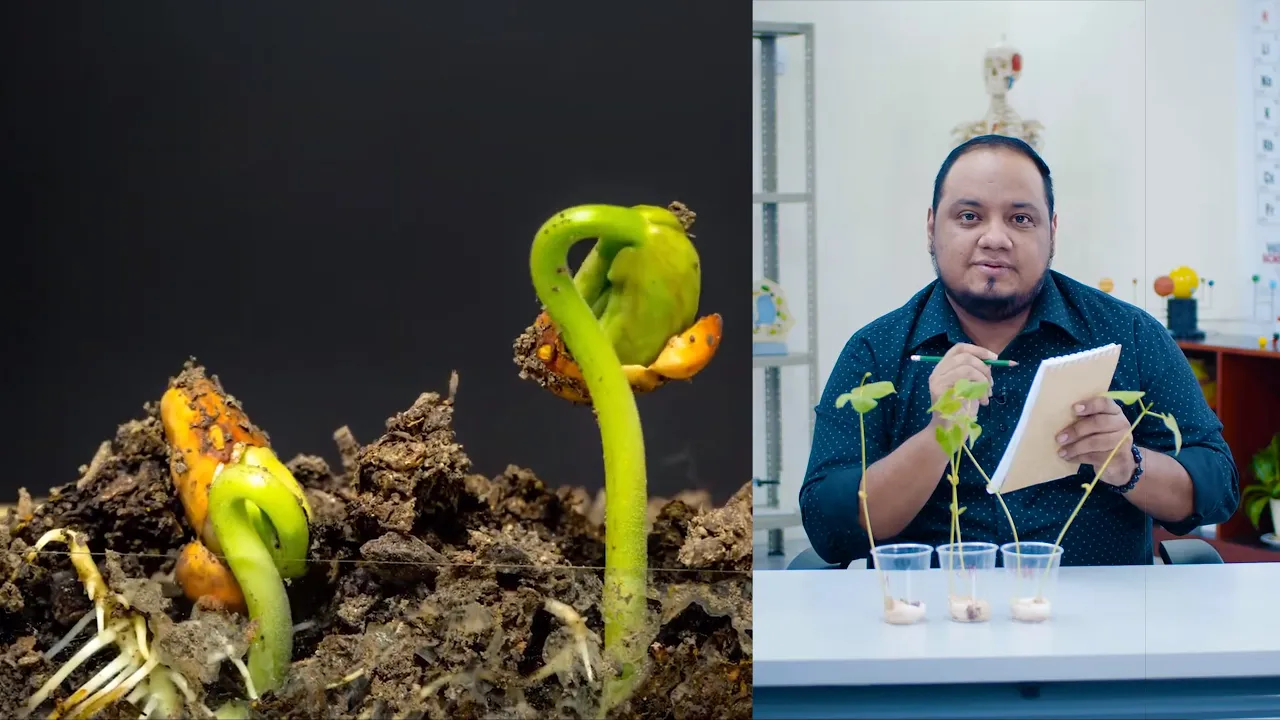
La Germinación y Crecimiento en Plantas
Germination Process in Plants
In this section, Orlando discusses the germination process in plants, focusing on concepts such as fruit, seed, and the phases of germination.
Understanding Concepts
- Orlando explains that a fruit is the fibrous or fleshy part surrounding a seed. He also defines a seed as the hard part containing the embryo.
- Germination is described as the growth process from seed to new plant. It involves phases like hydration, germination, and growth.
Phases of Germination
- Hydration Phase: Seeds swell, the shell breaks, and a primary root emerges.
- Germination Phase: Roots continue growing, the shell fully breaks, and initial leaves appear above the seed.
- Growth Phase: Roots enlarge, stems develop, leaves grow larger, and water absorption increases.
Observing Plant Growth
Orlando examines the growth of bean plants from last week's experiment and highlights key characteristics observed during their development.
Plant Growth Observations
- Bean plants show significant root growth and elongated stems. Primary leaves have emerged along with secondary ones for continued growth.
- The removal of bean seed shells reveals cotyledons (seed leaves). These structures aid in identifying dicotyledonous plants like beans.
Experiment Reflection & Future Exploration
Orlando reflects on the completed experiment with bean plants and suggests further exploration with different seeds while emphasizing patience and observation skills.
Experiment Reflection
- Encourages transferring grown plants to soil for ongoing care. Noting that detailed observations over time reveal hidden plant developments.
- Asks students to record data on seed growth rates for analysis. Identifying differences in growth speed among various seeds planted.
Future Exploration
- Suggest exploring other seeds' germination processes. Orlando demonstrates planting a corn seed (monocotyledonous), cautioning about fungal invasion risks.
Germination Process and Importance of Understanding It
The section discusses the germination process of plants, highlighting the importance of understanding this process for observing changes not visible to the naked eye and comprehending growth stages in plants.
Germination Process Insights
- Knowing about germination helps in understanding plant growth stages and how plants, like all living beings, undergo changes in size and shape.
- Understanding germination aids in recognizing edible seeds and plants globally dispersed, fostering a connection between germination knowledge and identifying edible plants.
- Historical significance of knowing edible plants led to agricultural practices where farmers nurture seeds for plant growth, emphasizing the vital role of agriculture in ensuring food supply for communities.
Significance of Note-Taking in Experiments
This part emphasizes the importance of note-taking during experiments to comprehend phenomena better and highlights how scientists globally document observations through notes, drawings, maps, or graphics.
Note-Taking Importance
- Effective experiment result interpretation is facilitated by meticulous note-taking practices.
- Scientists worldwide engage in noting observations during experiments, creating visual aids like drawings or models to enhance understanding of phenomena.
- Comprehensive documentation post-experiment enables a deeper grasp of phenomena's underlying reasons, showcasing the essence of scientific methodology.
Recap on Germination Experiment & Key Learnings
This segment revisits the three main stages of germination - hydration, germination, and growth. It also prompts viewers to recall these stages through questions testing their comprehension.
Recap & Comprehension Check
- Reviewing key phases: seed swelling and shell breaking; differentiation of roots, stem, and leaves.