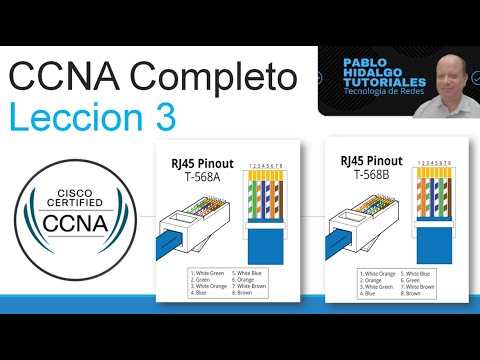
CCNA Completo | Leccion 3 | Capa física | Cobre
Introduction to Physical Layer and Copper Transmission
Overview of the Lesson
- The tutorial continues with CCNA training, focusing on Lesson 3 about the Physical Layer and copper transmission media.
- A hybrid model of five layers is introduced, combining TCP/IP application and transport layers with OSI's network, data link, and physical layers.
Functions of the Physical Layer
- The Physical Layer is responsible for transporting bits by encoding complete frames into signals transmitted through a medium.
- It involves creating electrical, optical, or radio signals that represent frame bits for transmission.
Standards Organizations Involved in Physical Layer
Key Organizations
- Various international and national organizations set standards for the Physical Layer including ISO, TIA/EIA, ITU, ANSI.
- Regulatory authorities like FCC (USA) and ETSI (EU) also play significant roles in establishing these standards.
Understanding Bandwidth
Definition and Measurement
- Bandwidth refers to a medium's capacity to transport data; it measures how much data can flow from source to destination over time.
- Common units include kilobits per second (kbps), megabits per second (Mbps), or gigabits per second (Gbps).
Common Misconceptions
- There is confusion between bandwidth and bit travel speed; they are not synonymous.
Copper Cabling in Networking
Characteristics of UTP Cables
- Copper cabling is prevalent in networks today; data travels as electrical impulses over twisted pairs of wires.
- UTP cables consist of four color-coded twisted pairs designed to reduce interference known as crosstalk.
Noise Interference Issues
- Any unwanted electrical signal in cables is considered noise which threatens information integrity.
- External sources like electromagnetic interference (EMI) and radio frequency interference (RFI), along with internal noise sources can distort signals.
Crosstalk Phenomenon
Explanation of Crosstalk
- Crosstalk occurs when an electric field induces voltage in nearby wire pairs during signal transmission.
- Twisting wire pairs helps cancel out this electric field effect significantly reducing crosstalk impact.
Cable Categories and Standards
IEEE Classification System
- IEEE defines cable characteristics based on performance; higher category cables support greater bandwidth capacities.
Minimum Cable Standards
- Category 5e: Minimum acceptable standard for existing buildings at 1 Gbps over 100 meters.
- Category 6: Recommended minimum for new installations.
- Category 6a: Supports up to 10 Gbps over the same distance typically used for server connections.
Correct Wiring Practices
Pin Configuration Importance
- Hosts transmit on pins 1 & 2 while receiving on pins 3 & 6. Switches do the opposite.
- Straight-through cables connect corresponding pins directly ensuring proper communication between devices.
Cross-over Cable Usage
Crossover Cables and Their Relevance
Uso de cables crossover
- Ejemplos de uso de cables crossover incluyen la conexión directa entre dos PCs y la conexión entre routers.
- Actualmente, los cables crossover se consideran obsoletos debido a que muchos dispositivos pueden detectar automáticamente el tipo de conexión necesaria.
- Esta capacidad de detección automática se denomina Auto-MDIX, lo que permite una mayor flexibilidad en las conexiones.
- Se proporciona un enlace a una lista de reproducción con vídeos relacionados al curso CCNA Completo para aquellos interesados en profundizar más en el tema.
Turn any video into a summary like this
YouTube links, meetings, lectures — with transcripts, search, and chat.