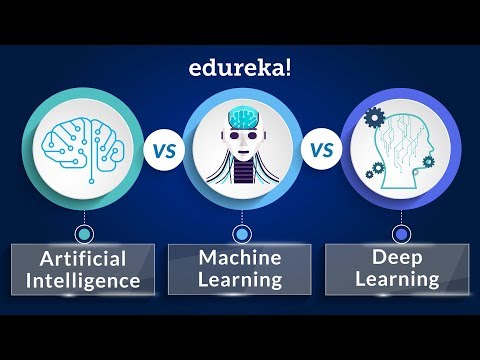
AI vs Machine Learning vs Deep Learning | AI vs ML vs DL - Differences Explained | Edureka
Introduction
In this section, the speaker introduces himself and welcomes the audience to the topic of discussion on AI vs Machine Learning vs Deep Learning.
Atul's Introduction
- Atul from Edureka welcomes everyone to today's topic of discussion on AI vs Machine Learning vs Deep Learning.
- Artificial Intelligence is a broader umbrella under which machine learning and deep learning come.
- All three are subsets of each other.
Understanding AI, ML, and DL
In this section, the speaker explains what artificial intelligence is and how it has gained popularity recently due to an increase in data volume and advanced algorithms. The speaker also discusses how machine learning came into existence as a subset of AI that enables computers to make data-driven decisions.
Artificial Intelligence
- Artificial intelligence is a technique that enables machines to act like humans by replicating their behavior and nature.
- Machines can learn from experience and respond based on new input.
- With AI, machines can be trained to accomplish specific tasks by processing large amounts of data and recognizing patterns in them.
- Examples of AI in our daily lives include Apple Siri, Tesla self-driving cars, etc.
Machine Learning
- Machine learning is a subset of AI that enables computers to make data-driven decisions.
- Programs or algorithms are designed in a way that they can learn and improve over time when exposed to new data.
- An example given was creating a system that tells the expected weight of a person based on their height using collected data points.
Issues with Symbolic Approaches
In this section, the speaker discusses some issues faced by researchers in statistics, computer science, and neuroscience that led to the existence of machine learning as an alternative approach.
Issues Faced by Researchers
- In statistics: efficiently training large complex models.
- In computer science and AI: training more robust versions of AI systems.
- In neuroscience: designing operational models of the brain.
Conclusion
In this section, the speaker concludes by summarizing what was discussed in the previous sections.
Summary
- Artificial intelligence is a technique that enables machines to act like humans by replicating their behavior and nature.
- Machine learning is a subset of AI that enables computers to make data-driven decisions.
- Researchers faced issues with symbolic approaches in statistics, computer science, and neuroscience that led to the existence of machine learning as an alternative approach.
Introduction to Deep Learning
In this section, the speaker introduces deep learning as a particular kind of machine learning that is inspired by the functionality of our brain cells called neurons which led to the concept of artificial neural network. The speaker explains how it works and gives examples to help understand it better.
What is Deep Learning?
- Deep learning is a particular kind of machine learning that is inspired by the functionality of our brain cells called neurons.
- It takes data connection between all the artificial neurons and adjusts them according to the data pattern.
- No one actually knows what happens inside a neural network and why it works so well, so currently you can call it as a black box.
Example of Deep Learning
- Let us try and understand how you recognize a square from other shapes.
- This deep learning also does the same thing but at a larger scale, let's take an example of machine which recognizes whether the given image is of a cat or a dog.
- Deep learning automatically finds out the feature which are most important for classification compared to machine learning where we had to manually give out those features.
Machine Learning vs. Deep Learning
In this section, the speaker discusses some important parameters and compares machine learning with deep learning. The speaker explains how they differ in terms of data dependencies, hardware dependencies, feature engineering, and problem-solving approach.
Data Dependencies
- The most important difference between deep learning and machine learning is its performance as the volume of the data gets increased.
- Deep learning algorithm needs a large amount of data to understand it perfectly on the other hand, the machine learning algorithm can easily work with smaller datasets.
Hardware Dependencies
- Deep learning algorithms are heavily dependent on high-end machines while the machine learning algorithm can work on low-end machines as well.
- The deep learning algorithm requires GPUs as they do a large amount of matrix multiplication operations, and these operations can only be efficiently optimized using a GPU as it is built for this purpose.
Feature Engineering
- Feature engineering is a process of putting domain knowledge to reduce the complexity of the data and make patterns more visible to learning algorithms.
- In case of deep learning algorithms, it tries to learn high-level features from the data. This is a very distinctive part of deep learning which makes it way ahead of traditional machine learning.
Problem Solving Approach
- When we are solving a problem using traditional machine learning algorithm, it is generally recommended that we first break down the problem.
Object Detection and Recognition using Machine Learning and Deep Learning
In this section, the speaker discusses how to identify objects in an image using machine learning and deep learning. They compare the two approaches based on various parameters such as accuracy, training time, execution time, and interpretability.
Machine Learning Approach
- The problem is divided into two steps - object detection and object recognition.
- A bounding box detection algorithm like GrabCut is used to find all possible objects in the image.
- An object recognition algorithm like SVM with HOG is used to recognize relevant objects.
Deep Learning Approach
- End-to-end processing is done using a deep learning algorithm like YOLO net.
- The algorithm passes an image and gives out the location along with the name of the object.
Execution Time
- Deep learning algorithms take longer to train due to many parameters, while machine learning algorithms take relatively less time ranging from a few weeks to a few months.
- During testing, deep learning algorithms take much less time than machine learning algorithms like KNN.
Interpretability
- Interpreting results is difficult in deep learning since it does not reveal why a score was given. Algorithms like decision tree are primarily used for interpretability in industry.
Summary
In this section, the speaker summarizes the key points discussed in the video regarding machine learning and deep learning approaches for object detection and recognition.
- Machine learning uses algorithms to parse data, learn from it, and make informed decisions based on what it has learned.
- Deep learning structures algorithms in layers to create artificial neural networks that can learn and make intelligent decisions on their own.
- Deep learning is a subfield of machine learning, while both fall under the broad category of artificial intelligence.
- Deep learning is usually what's behind the most human-like artificial intelligence.
Turn any video into a summary like this
YouTube links, meetings, lectures. With transcripts, search, and chat.