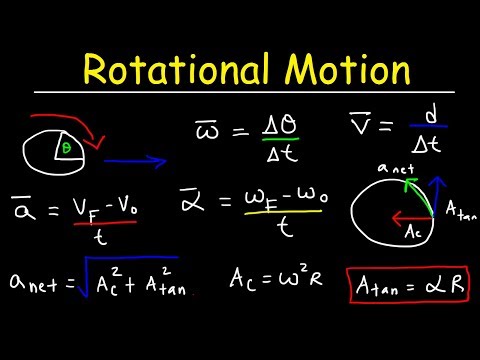
Rotational Motion Physics, Basic Introduction, Angular Velocity & Tangential Acceleration
What is Rotational Motion?
Introduction to Rotational Motion
- Rotational motion refers to any object that can rotate or spin, distinguishing it from linear motion, where an object moves forward.
- Linear motion and translational motion are essentially the same concepts.
Key Terms in Rotational Motion
- In linear motion, key terms include position (a point in space) and displacement (the change in position).
- For rotational motion, analogous terms are angular position (a point on a circle) and angular displacement (the difference between two angular positions).
Understanding Angular Displacement and Velocity
Angular Displacement
- The standard unit for angular displacement is radians; degrees can also be used but radians are more common.
Angular Velocity
- Angular velocity indicates how fast an object spins around a circle, represented by the symbol omega (ω).
- Average angular velocity is calculated as angular displacement divided by time, with units of radians per second.
Relationship Between Linear and Angular Quantities
Connecting Linear and Angular Velocity
- The equation linking linear velocity (v) to angular velocity is v = ω * r.
- While all points on a spinning wheel have the same angular velocity, their linear velocities differ based on their distance from the center.
Example of Linear vs. Angular Velocity
- Point B travels a longer distance than Point A during rotation; thus, its linear speed must be greater despite having the same angular speed.
Period and Frequency in Rotational Motion
Definitions of Period and Frequency
- The period is the time taken to complete one cycle or rotation; frequency is its reciprocal—number of cycles per second.
- Units: Period is measured in seconds per cycle; frequency in hertz (Hz).
Calculating Angular Velocity from Period/Frequency
- Angular velocity can be calculated using ω = 2πf or ω = 2π/T.
Angular Acceleration vs. Linear Acceleration
Understanding Accelerations
- Average linear acceleration measures change in velocity over time; average angular acceleration measures change in angular velocity over time.
Units of Measurement for Acceleration
- Standard units: meters per second squared for linear acceleration; radians per second squared for angular acceleration.
Centripetal Acceleration
Concept of Centripetal Acceleration
- Any object moving around a circle experiences centripetal acceleration due to its circular path.
Understanding Centripetal and Tangential Acceleration
Centripetal Acceleration
- Centripetal acceleration is directed towards the center of a circular path and is calculated using the formula a_c = v^2/r . Here, v represents linear speed and r is the radius of the circle.
- By substituting v with omega r , where omega is angular velocity, we derive that centripetal acceleration can also be expressed as a_c = omega^2 r . This indicates that it solely depends on angular velocity and radius.
- For an object moving at constant speed in a circle, its only form of acceleration is centripetal (or radial) acceleration. Thus, if speed remains constant, net acceleration equals centripetal acceleration.
Tangential Acceleration
- When an object accelerates while moving in a circular path (not maintaining constant speed), it experiences tangential acceleration. This type of acceleration can be defined as a_t = alpha r, where alpha represents angular acceleration.
- The relationship between centripetal and tangential accelerations reveals that they are perpendicular to each other. Therefore, when combined, they create a resultant net acceleration that points in a direction determined by their vector sum.