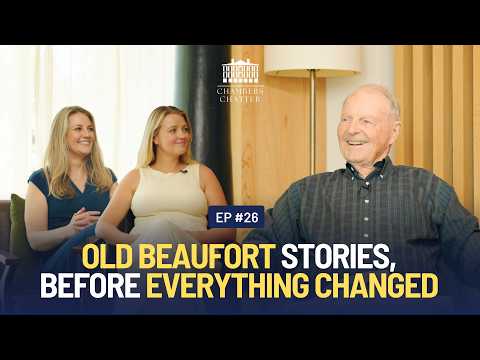
Chambers Chat Ep 26
Introduction to Walter Lubkin
Welcoming Walter Lubkin
- Laura Chambers Babis and Shay Chambers Helms introduce Walter Lubkin, a long-time resident of Beaufort.
- Walter shares that he is commonly known as "Spanky," a nickname given by his mother when he was six years old.
Origin of the Nickname "Spanky"
- The nickname originated during a shoe fitting at Lips department store, where it was suggested by a friend due to its rhyme with "Frankie."
- Walter expresses hope that people will still call him Spanky in the future.
Growing Up in Beaufort
Childhood Memories
- Walter reflects on growing up in Beaufort, noting its small population of around 20,040 in 1940.
- He describes life without modern conveniences like TV, video games, or air conditioning; pets were kept outside due to flea concerns.
Changes Over Time
- He recalls the infrastructure of Beaufort, mentioning sand streets and crushed oyster shell roads.
- The first streetlight was installed at Charles and Bay Street due to increased traffic from a grocery store.
Early Driving Experiences
First Accident
- Walter recounts getting his driver's license at age 14 and having his first accident shortly after while fiddling with the radio.
- He humorously notes how parents would instinctively put their arm out to protect children before seat belts were common.
Family Business Background
Seafood Industry Involvement
- Walter discusses his father's work for Blue Channel and their move to Belhaven for three years before returning to Beaufort.
- His father started a seafood business picking crabs and oysters in 1950; land prices were significantly lower back then.
Growth of the Business
- By 1962, their family business became one of the largest employers in the county.
- Although they did not sell internationally initially, this changed later when Walter transitioned into import business after closing the family operation.
The Evolution of Crab Meat Business and Local History
Transition in the Crab Meat Industry
- The speaker discusses the growth of their crab meat business, primarily focusing on pasteurized crab meat. They faced competition from imported crab meat from Indonesia, Thailand, and China, leading to the closure of their original business.
- After closing the initial business, they began importing fresh and pasteurized crab meat from Venezuela and Mexico, as well as pasteurized products from Indonesia and Thailand.
Unique Historical Insights about Buford
- The speaker shares a personal anecdote about their father's fishing experiences near Bay Point, where a hotel once existed. This hotel was significant enough for his parents to have honeymooned there.
- The hotel was described as a two-story establishment resembling a bed-and-breakfast that was ultimately destroyed by a hurricane in 1940. The speaker reflects on how few people know about this hotel's existence.
Personal Memories of Growing Up in Buford
- The speaker recounts growing up behind Gford High School and living near Albagardi Creek due to their father's passion for fishing. They emphasize that spending time on the river was central to local entertainment.
- A memorable trip to Pritchards with their father is shared; it highlights community interactions at local grocery stores like Mom Millers, where beer purchases were notably high compared to food.
Camping Adventures and Local Culture
- The speaker describes early camping experiences before any structures were built at Pritchards. They recall using a buried box for storing camping gear while sleeping under the stars or in tents.
- Anecdotes include dealing with mosquitoes during camping trips and how alcohol consumption may have been used as a means to cope with discomfort during these outdoor adventures.
Hunting for Food: A Different Era
- Fishing off the land was common during these trips; however, one night they resorted to hunting raccoons when fishing proved unsuccessful. This illustrates resourcefulness in food sourcing.
- Meals often consisted of whatever could be caught or gathered rather than pre-packed supplies, showcasing an adventurous spirit among campers who relied heavily on nature for sustenance.
Bufort's Community and Traditions
The Importance of Community Connections
- The speaker reflects on the close relationship between family members, specifically mentioning Uncle Buddy Lepkin and Zuvon Harton, who were inseparable during work hours.
- Acknowledges that while the community grew around local events like the jelly festival, personal involvement varied; for instance, the speaker's father worked long hours and rarely attended such gatherings.
Fishing Culture in Bufort
- During drumfish season, many locals would prioritize fishing over church attendance, highlighting a cultural norm where fishing was a communal activity with numerous boats participating.
- The speaker reminisces about the past when Bufort had fewer boats and discusses how they used to catch crabs using large runboats before modern conveniences became available.
Evolution of Fishing Practices
- Describes early fishing methods before bridges and outboard motors were common; emphasizes how these practices shaped local traditions.
- Shares an anecdote about using a Briggs and Stratton engine to power a boat for crab catching, illustrating resourcefulness in adapting technology for fishing.
Reflections on Change in Bufort
- When asked about advice for younger generations in Bufort, the speaker suggests that knowing more people enriches life experiences, hinting at changes in community dynamics over time.