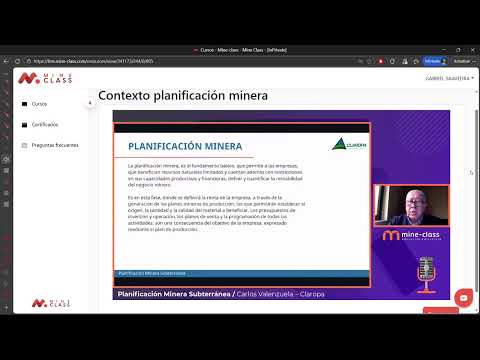
Planificación Minera Subterránea
Introduction to Underground Mining Planning
Speaker Background
- Carlos Valenzuela introduces himself and shares his extensive experience of 40 years in mining, starting at COELCI Salvador and later working with Metela (now Tetatech) for 17 years as a partner and director.
Agenda Overview
- The presentation will cover six main points:
- General concepts of underground mining planning.
- Selection of exploitation methods, focusing solely on underground mining.
- Discussion on various underground exploitation methods and their distinct designs.
- Key operational units in mining operations such as drilling, blasting, material handling, and ventilation.
- Phases of a mining project from discovery to exploitation.
Understanding Exploitation Methods
Types of Mining Exploitation
- Emphasis is placed on analyzing the entire deposit for potential reserves before deciding on the method:
- Open-pit mining.
- Pure underground mining.
- A combination of both (over 90% common).
- Transitioning from open-pit to underground operations is highlighted as a significant topic. The Chui underground case study is mentioned as a recent example that began in May this year.
Underground Mining Methods
Methodologies Discussed
- Different methods have unique designs and planning requirements:
- Block caving is noted for its high productivity and low cost, making it competitive with open-pit methods.
- Importance of understanding operational phases including drilling, blasting, material handling, ventilation etc., which are crucial for effective planning.
Definition of Mining Planning
Core Concept
- Mining planning is defined as the fundamental basis allowing companies to manage limited natural resources effectively:
- It involves defining profitability under constraints like production capacity and financial limits (e.g., Codelco's investment cap).
- The goal is to maximize what’s known mathematically as Net Present Value (NPV).
Profitability Insights
Financial Considerations
- In projects lasting between 20 to 25 years:
- The first ten years account for approximately 75% of profitability; the first five years alone contribute about half.
- This highlights the importance of exploiting higher quality reserves early in the project lifecycle.
- Codelco's long-term perspective emphasizes sustainability alongside profitability—balancing immediate gains with future operational viability.
Challenges in Mine Closure
Economic Implications
- Closing mines involves significant costs beyond just locking up facilities; it requires environmental considerations such as removing fortifications to prevent contamination.
- Example: Salvador mine faced closure discussions due to ongoing losses versus high closure costs ($50 million estimated).
- Long-term monitoring post-closure can extend up to fifty years at substantial expense. This reflects ongoing economic evaluations regarding mine viability versus closure costs over time.
Considerations in Mining Project Planning
Defining Mining Exploitation
- The initial analysis for defining a mining operation requires identifying relevant aspects embedded within the project, such as the definition and selection of exploitation options.
- Emphasis is placed on strategic planning to maximize resource consumption over time, particularly from a long-term perspective in projects like Celco.
Engineering Stages and Risk Analysis
- Projects undergo various engineering stages: conceptual, basic, and detailed. Post-construction, risk analysis is conducted iteratively to adapt to changing market conditions.
Data Requirements for Production Planning
- The quality of data available at different project stages influences production planning; initial profiles may have limited data but improve as plans progress.
- Proven reserves must be included in production plans, requiring a model that details tonnage and grades of minerals like copper, silver, gold, and molybdenum.
Geological Considerations
- A comprehensive geological model includes structural anomalies (faults, fractures), topography of deposits, and geomechanical characteristics essential for method selection.
Factors Influencing Method Selection
Endogenous Factors
- Different depths and shapes of deposits necessitate systematic reviews of endogenous factors such as geometry (e.g., whether a vein is massive or layered).
Geomechanical Stability
- Structural geology impacts stability; understanding rock competence and potential risks (like rock bursts) is crucial for design criteria.
Spatial Location
- The spatial location affects initial planning decisions regarding whether an open-pit or underground approach is suitable based on depth and surrounding rock quality.
Environmental Conditions
- External factors like water presence or contamination significantly influence open-pit operations while also affecting underground methods.
Operational Flexibility
- Operational flexibility allows quick responses to issues within the mine; this adaptability can dictate overall efficiency during unforeseen challenges.
Cost Implications of Different Methods
Operational Costs
- Different mining methods incur varying operational costs per ton; for instance, sublevel stopping versus block caving shows significant cost differences impacting decision-making.
Infrastructure Investments
- Large infrastructure investments are necessary for tunneling; understanding these costs helps determine feasible exploitation methods based on recovery rates.
Preparation Times
- Some methods allow immediate mineral extraction post-development while others require extensive preparatory work that may yield non-mineralized material initially.
This structured overview captures key insights from the transcript related to mining project considerations while providing timestamps for easy reference.
Mining Method Selection and Safety Considerations
Quality Separation in Mining Methods
- Discusses the importance of selecting mining methods that allow for the separation of high-quality minerals from lower-quality ones, contrasting this with block caving which extracts everything indiscriminately.
- Highlights that certain methods yield higher productivity and safety, emphasizing the need for careful selection based on these factors.
Safety Standards in Mining
- Notes that current safety standards in mining are at their lowest, with an accident rate of approximately one per million hours worked.
- Stresses the necessity for zero accidents as a goal during project projections, indicating a strong focus on safety despite existing challenges.
Circular Analysis of Mining Parameters
- Introduces a circular analysis approach to evaluate various parameters such as rock type, mineral grades, recovery rates, and exploitation methods.
- Emphasizes the role of geologists in providing updated reserve models annually to inform ongoing assessments of recovery and exploitation methods.
Methodology for Selecting Exploitation Methods
- Outlines a methodology for selecting mining exploitation methods starting with defining actions within project subsectors.
- Describes constructing a matrix to analyze different alternatives based on technical-economic factors when at conceptual or pre-feasibility stages.
Expert Judgement in Method Evaluation
- Details how expert judgment is used to assign weights to various factors influencing method selection, including geological structures and operational costs.
- Explains how experts assess each parameter's impact on different mining methods using subjective scoring from one (poor) to five (excellent).
Comparative Analysis of Mining Methods
- Concludes that after evaluating weighted factors, block caving emerges as the most recommended method but suggests further analysis is necessary before finalizing decisions.
Types of Mining Methods
Classification of Exploitation Techniques
- Mentions various mining methods categorized into three main groups based on support types: pillar-supported, artificially supported, and unsupported techniques.
Pillar-Supported Methods
- Describes pillar-supported techniques where natural pillars are left intact during extraction leading to lower recovery rates compared to other methods.
Artificially Supported Techniques
- Discusses artificially supported techniques involving backfilling with extracted material or cement post-extraction to maintain structural integrity.
Unsupported Techniques
- Highlights unsupported techniques like sublevel caving and block panel caving as highly productive due to their reliance on gravity-driven extraction processes.
Technical Requirements for Sublevel Caving
- Specifies technical requirements for sublevel caving including drill diameter and depth which directly influence operational efficiency.
Development of Mining Techniques
Introduction to Mining Operations
- The mining body begins operations by extracting minerals defined within mineralized contours, as demonstrated in an accompanying video.
- A trench is excavated to collect minerals from upper levels, utilizing specialized mechanized equipment for drilling and development.
Modern Equipment and Methods
- Current mining practices involve advanced machinery for drilling, fortification, and explosive loading, with some processes being remotely operated.
- Low-tonnage LHD (Load-Haul-Dump) machines are used; modern mines employ electric, autonomous, semi-remote-controlled, and fully automated equipment.
Drilling Techniques and Safety Improvements
- The initial pilot hole is drilled using specialized machines that allow for efficient blasting without the need for manual methods previously deemed dangerous.
- This selective method requires competent rock conditions; ideally softer inner rock surrounded by harder outer rock enhances safety and efficiency.
Exploitation Levels and Infrastructure
- The second important method discussed involves sublevel caving without support, allowing simultaneous exploitation of multiple levels based on drilling quality.
- Each level must maintain a balance between development, drilling, blasting, and extraction; infrastructure such as access points must be established beforehand.
Production Control and Efficiency
- Effective production control is crucial to prevent dilution of materials during extraction; various jumbos operate at different levels to manage this process.
- Sublevel toping methods are noted for higher productivity compared to traditional methods; examples include a high-output iron mine producing 70,000 tons daily.
Comparison of Mining Methods
- Transitioning from open-pit to underground mining can be viable if geomechanical connections allow it; however, underground methods generally yield lower productivity than open-pit operations.
- Infrastructure management includes ventilation systems developed in competent rock formations essential for safe operations.
Blood Panel Caving Methodology
Understanding Blood Panel Caving
- Blood panel caving involves massive bodies with sufficient area projection to induce subsidence through hydraulic radius calculations.
Mechanisms of Mineral Extraction
- During exploitation in caving methods, the lower section is mined while the remaining mineral falls due to gravity through fractures created by preconditioning techniques.
Mining Techniques and Infrastructure Overview
Mining Operations and Ventilation Systems
- The speaker discusses the need to exploit mineralized areas to establish ventilation, production, sinking, and preconditioning levels necessary for gravity-based mineral extraction.
- Introduction of different mesh types used in mining; specifically mentioning the Henderson mesh as a reference point for flexibility and construction efficiency.
Equipment and Automation in Mining
- Modern jumbos are highlighted as nearly autonomous machines that develop various galleries for transport and extraction points.
- Emphasis on the importance of infrastructure such as shafts (piques) that facilitate mineral transport to the surface or processing facilities.
Tunnel Development Insights
- The extensive tunnel systems developed over years are noted, with examples like Teniente's 3000 km of tunnels compared to Chucki's projected 1000 km.
- Discussion on investment focus in mining projects, highlighting equipment costs versus development costs; larger trucks cost significantly more than smaller equipment.
Extraction Techniques and Geomechanics
- Explanation of radial drilling techniques being employed to create trenches for receiving mined minerals.
- Introduction of "esponjamiento" (sponging), which refers to the fracturing process that occurs during extraction, affecting internal rock tensions.
Production Costs and Method Comparisons
- Details on how cavin affects internal rock pressures, allowing for safer gallery operations during extraction processes.
- A comparative analysis of production methods is presented, showing cost structures across top-down mining (red), caving (green), and block caving (blue).
Capacity Analysis Across Mining Methods
- Examination of production capacities across various methods; sublevel caving can reach up to 70,000 tons while block caving can achieve up to 150,000 tons per day.
- Notable mention that no single sector globally exceeds a daily output of 50,000 tons currently; exceptions include specific projects in Australia and Indonesia.
Economic Factors Influencing Mining Decisions
- Cost comparisons reveal that lower tonnage operations incur higher costs per ton due to treatment needs; current market prices for gold ($1950/oz.) favor certain mining strategies over others.
- Summary table comparing key mining methods indicates significant differences in operational costs based on method selection.
Mining Planning and Economic Considerations
Internal and External Factors in Mining
- Codelco's financial sensitivity: For every cent increase in copper prices, Codelco gains an additional $120 million, highlighting the importance of careful planning.
- Internal factors include geological interpretation, geomechanical design parameters, and processing models. External factors often involve environmental regulations that can delay projects significantly.
Quality Assessment of Mining Bodies
- The classification of mining bodies based on quality affects operational decisions; lower quality requires more space for extraction compared to higher quality rock.
- The spacing required for equipment varies with rock quality; high-quality rocks allow for larger equipment due to better density.
Dilution and Interaction Heights
- Understanding interaction heights is crucial for estimating dilution points where waste mixes with ore during extraction processes.
- Example calculations show how to determine dilution percentages based on height and fragmentation characteristics, which are essential for effective resource estimation.
Software Utilization in Resource Estimation
- Data from previous analyses is input into software to create a diluted block model that helps estimate economic viability through various parameters.
- The economic delineation of mining areas involves assessing technical criteria like geomechanics alongside production capacity metrics.
Operational Phases in Mining Projects
- Key unit operations include conventional construction methods versus mechanized approaches, impacting efficiency and cost.
- A typical mining project spans about ten years from engineering phases through construction to ramp-up periods, as evidenced by the Chui Sutterráneo project timeline.
Defining Business Options in Engineering Profiles
- During the engineering phase, multiple business options must be defined including alternative exploitation methods and material handling systems.
- Decisions regarding metallurgical processes—whether to concentrate minerals or refine them—are critical for determining overall project feasibility.
Economic Indicators and Mining Project Disciplines
Overview of Economic Estimators in Mining Projects
- The discussion begins with the use of unit estimators for economic evaluations, indicating a lack of detailed cost information.
- A basic model is introduced that focuses on a single exploitation method and material handling, emphasizing production planning and economic indicators.
Importance of Engineering Disciplines
- It is noted that only 8 to 10% of mining disciplines are utilized in a mining project, with the remainder being various other engineering fields.
- As engineering depth increases, the number of disciplines involved also rises; this includes different levels of consultants from junior to senior roles.
Cost Estimation Techniques
- In early project stages (profile and conceptual), unit values and market studies are used for cost estimation; however, firm quotes are required during detailed engineering phases.
- The typical formula for economic evaluation is presented: income minus costs, where income is derived from price multiplied by ore grade, tonnage, and conversion factors.
Conclusion on Economic Evaluation
- The speaker emphasizes the importance of understanding cash flows over time as part of the overall financial assessment in mining projects.