How To Trade Consolidation - Phases Of Price
What is Consolidation in Trading?
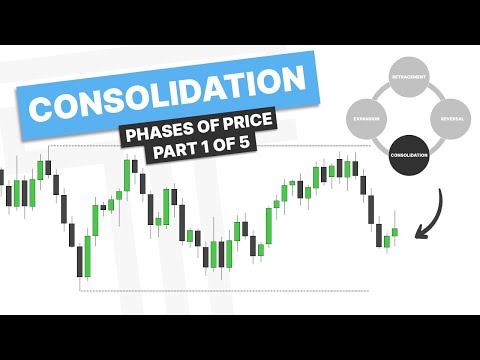
Definition of Consolidation
- A consolidation occurs when price remains between a defined high and low, not breaking either for a period of time.
- This phase typically follows a large price range or when the price reaches a higher timeframe level.
Interaction with Consolidation
- Traders should avoid trading within the consolidation range to prevent guessing whether the price will break higher or lower. Instead, patience is key.
- The ideal scenario for bullish traders is to see the price run out the low before looking to trade higher, following the classic power of three: accumulation, manipulation, and distribution.
Types of Consolidations: Continuation vs Reversal
Continuation Patterns
- In continuation consolidations, after an expansion leads to a smaller range, traders anticipate that prices will continue moving in the same direction if they have not yet hit a higher timeframe level.
- Manipulation occurs when prices run out a low before continuing upward; this can be confirmed by waiting for closure through significant levels.
Reversal Patterns
- Reversals occur after an expansion into consolidation at a higher timeframe objective where traders expect prices to change direction. They look for highs to be taken out before trading lower.
- Understanding PDR (Price Delivery Range) concepts like discount and premium helps in identifying potential reversals during consolidations.
Practical Examples of Consolidation
Analyzing Price Action
- In practical examples, observing how price behaves post-expansion can indicate whether it is consolidating or preparing for another move; lack of confirmed action suggests ongoing consolidation rather than continuation or reversal.
Market Analysis and Trading Strategies
Understanding Price Levels and Continuations
- The speaker discusses the importance of protecting a low price level, indicating that a closure above this level is crucial for potential upward movement.
- A lesson on fair value gaps highlights the absence of significant levels in the current market context, suggesting reliance on opposing candle analysis for trading decisions.
- The continuation of price movement is confirmed as it reaches back to an important level, with emphasis on closing above down close candles to protect lows while trending higher.
Manipulation and Market Behavior
- The concept of combining protected swings with consolidation is introduced, emphasizing that manipulation precedes trend movements.
- Observations from daily charts indicate a bearish change in delivery state after taking out highs, prompting expectations for lower price movements while respecting equilibrium (EQ).
Analyzing Price Phases
- The speaker notes conflicting signals in price phases—expansion followed by retracement—and suggests waiting for further developments before making trading decisions.
- Consolidation patterns are identified where prices remain internal without breaking previous highs or lows, indicating indecision in the market.
Trading Bias and Confirmation Signals
- Traders should look for runs of lows or highs based on their bias; however, the speaker expresses uncertainty about their current bias.
- A confirmation signal through closures over down close candles is necessary before considering trades towards higher targets.
Patterns of Expansion and Retracement
- The ideal scenario involves either consolidation or retracement rather than aggressive moves back into ranges after breakouts.
- Another consolidation phase emerges as prices fail to reach significant levels, reinforcing the need to wait for confirmations before entering trades.
Fair Value Gaps and Liquidity Draw
- Discussion around fair value gaps indicates potential inducements; if expecting continuation upwards, traders should watch for low formations at EQ levels.
Fractal Model Approach to Trading
- Emphasizing a fractal model approach, the speaker advocates waiting for manipulations before engaging in expansions rather than attempting to catch lows prematurely.
Reversal Day Strategy
- Transitioning into reversal strategies from bullish trends involves identifying relevant levels such as previous day’s highs/lows.
- In preparation for reversals off previous day lows, traders must recognize consolidations within defined high/low boundaries.
Understanding Price Consolidation and Trading Strategies
Analyzing Market Reactions
- The speaker discusses the importance of observing price consolidation, indicating a desire to see manipulation of lows before trading higher.
- A confirmed closure through a specific level allows for anticipation of price movement, particularly regarding wick confirmations.
- The concept of expansion days is introduced, characterized by small wicks and large bodies, suggesting potential for New York continuation after a London reversal.
Identifying Key Levels and Patterns
- The presence of a fair value gap is noted as an important level where traders should look for swing formations or continuation entries.
- If price fails to close above certain levels during consolidation, it indicates internal market behavior that may lead to further analysis on reversals or continuations.
Observing Market Behavior
- The speaker emphasizes the significance of consolidations forming reversals and continuations, highlighting the need for closures over key levels.
- A successful example is provided where previous day lows are respected, leading to expansions towards equal highs.
Daily Chart Analysis: USD JPY
- The daily chart shows a sweep out of highs with expectations set for lower trading in subsequent days due to changes in delivery state.
- Price behavior is described as lethargic within a range without significant movements above highs or below lows over 18 hours.
Trading Continuations and Fair Value Gaps
- A reaction off high points leads to discussions about fair value gaps; closures through up-close candles signal potential downward trades.
- Successful trade examples illustrate achieving target returns (2R), emphasizing the effectiveness of recognizing multiple continuation opportunities in these scenarios.
Conclusion on Price Phases