The Wilson Cycle and Plate Boundaries
Introduction to Plate Tectonics
In this section, we will discuss the Wilson Cycle, which is a global-scale model for the formation and destruction of supercontinents. We will start with the embryonic stage of the Wilson Cycle.
Embryonic Stage of the Wilson Cycle
- The embryonic stage begins with the initiation of rifting on the supercontinent.
- Pangea was a supercontinent that existed for over 100 million years before it succumbed to the Wilson Cycle.
- Rifting is poorly understood and can be explained by active or passive rifting mechanisms.
- Active rifting is caused by a convection-driven mantle plume beneath the supercontinent, while passive rifting is caused by tensional forces.
- Rifting continents typically break apart along three-line segments in a Y-shape, with the center of the Y lying beneath the mantle plume, which is called a triple junction.
- The Red Sea and East African Rift are modern examples of triple junctions.
Juvenile Stage of the Wilson Cycle
- As rifting continues, large volumes of molten asthenosphere flow upward to form fissure volcanoes or linear volcanic vents.
- Eventually, as lithosphere thins and fractures so much that it separates into three pieces about the triple junction creating three new tectonic plates.
- Above rift surface elevation drops as crust thins and deep elongated lakes begin to form widening and deepening with time.
- Lake Victoria, Lake Malawi, and Lake Tanganyika are all examples of rift valley lakes in the East African Rift System.
- The mature stage of the Wilson Cycle is distinguished by the formation of a vast ocean basin, such as the Atlantic Ocean.
Conclusion
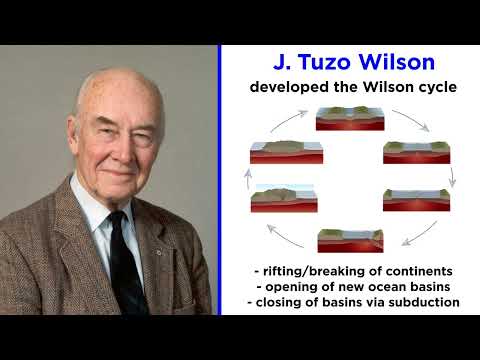
The Wilson Cycle describes the rifting, opening of new ocean basins, and eventual closing of these basins via subduction. It is named after Canadian geologist J. Tuzo Wilson and has been used to explain the formation and destruction of supercontinents throughout Earth's history.
Plate Tectonics and the Wilson Cycle
This video explains the process of plate tectonics and the Wilson cycle, which describes how continents move and change over time.
Plate Tectonics
- Oceanic lithosphere forms hot with a thin lithospheric mantle. As it cools and thickens, it becomes more dense and sinks into the ductile asthenosphere below.
- Subduction occurs when old and cold oceanic crust sinks into the mantle at convergent plate boundaries. This results in volcanic island arcs or continental arcs depending on whether it is an ocean-ocean or ocean-continent boundary.
- At an ocean-ocean convergent boundary, old dense oceanic crust subducts underneath younger buoyant oceanic crust resulting in volcanic island arcs such as Aleutian Islands. During subduction, water is delivered to the mantle via dehydration of hydroxyl-bearing minerals within subducted oceanic lithosphere causing widespread volcanism.
- At an ocean-continent boundary, dense oceanic crust subducts beneath continental crust from overlying tectonic plate creating accretionary wedge while subduction-related magmatism creates a chain of volcanoes called a continental arc such as Cascade Range of Pacific Northwest.
The Wilson Cycle
- After several hundred million years, subduction has nearly consumed all oceanic crust as fragments of rifted supercontinent move closer together to eventually be joined once again. The collision marks the terminal stage of the Wilson Cycle during which a new massive continental craton forms.
- During end-stage subduction, last piece of subducting lithosphere acts as ramp leading one continent to be thrust up and over other marking the final stage of Wilson Cycle: suturing stage. During this stage, a new massive continental craton forms and the Wilson cycle resets.
- At continent-continent convergent boundary, neither plate subducts due to buoyancy of continental crust. Both plates continue to collide forcing crust upward into dramatic mountain ranges such as Himalayas.
Overall, this video provides an overview of plate tectonics and the Wilson cycle, including how oceanic lithosphere forms and subducts at convergent boundaries, resulting in volcanic island arcs or continental arcs. The video also explains how the Wilson cycle marks the formation and eventual collision of supercontinents, leading to the creation of massive continental cratons and dramatic mountain ranges.
Turn any video into a summary like this
YouTube links, meetings, lectures. With transcripts, search, and chat.