Rotational Inertia
Understanding Rotational Inertia and Angular Momentum
Introduction to Rotational Inertia
- Mr. Andersen introduces the concept of rotational inertia, explaining its significance in rotating objects like flywheels.
- The amount of angular momentum is influenced by both angular velocity (spin speed) and the object's rotational inertia, which depends on its mass distribution.
Conservation of Angular Momentum
- Angular momentum is determined by the position of all objects (rotational inertia) and their velocities; changing positions does not create new momentum but alters velocities.
- The formula for linear momentum p = mv translates to angular momentum as L = I omega , where I is rotational inertia and omega is angular velocity.
Calculating Rotational Inertia
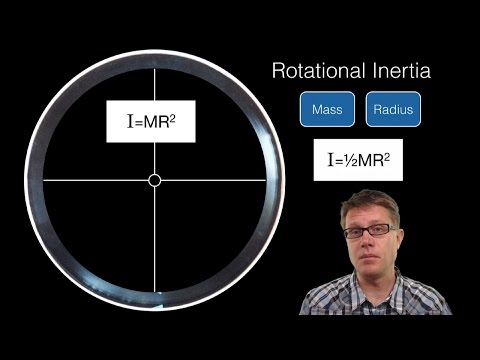
- Rotational inertia consists of mass and radius from the center point; it can be calculated using the formula I = 1/2 m r^2 .
- An example calculation shows a record with a mass of 0.10 kg and a radius of 0.15 m results in a rotational inertia of approximately 1.1 times 10^-3 kgcdot m^2 .
Variations in Mass Distribution
- If mass is concentrated at the edge rather than evenly distributed, the formula changes to I = mr^2 , effectively doubling the rotational inertia.
- This increased rotational inertia leads to greater angular momentum when spinning at the same speed, illustrating why flywheels have mass distributed outward.
Practical Applications and Observations
- Leonardo da Vinci's design for a variable flywheel demonstrates how moving mass outward increases rotational inertia while cranking.
- As friction slows down this system, decreasing angular velocity causes spheres to drop inward, reducing rotational inertia—an innovative mechanism for maintaining constant motion.
Orbital Dynamics and Angular Momentum
- Objects in orbit exhibit similar principles; satellites take about 90 minutes to orbit Earth while moons take around 28 days due to their distances.
- If Earth's position were altered while conserving angular momentum, its orbital speed would increase significantly, demonstrating how distance affects velocity in celestial mechanics.
Conclusion: Key Takeaways on Angular Momentum
- Understanding how to calculate angular momentum involves recognizing that it relies on both speed and rotational inertia—shaped by mass distribution, radius, and object geometry.