What is a Safety Instrumented System?
What is a Safety Instrumented System?
Introduction to Safety Instrumented Systems
- The video introduces the concept of a Safety Instrumented System (SIS), explaining its construction and significance in ensuring safety within chemical, refining, and manufacturing plants.
Importance of Safety in Industrial Settings
- Many industrial facilities, such as chemical and petrochemical plants, pose significant risks including fire, explosion, and chemical exposure. Eliminating these risks entirely is impractical due to the essential products they create.
- High-pressure processes can lead to hazardous situations; thus, process control systems are crucial for maintaining safe operations alongside trained personnel.
Layers of Protection
- The first layers of protection include process design, basic control systems, alarms, and operator intervention. Each layer offers approximately tenfold protection compared to the one below it.
- Despite these measures, accidents can still occur if risks are not adequately managed or anticipated.
Historical Accidents Highlighting Risks
- Notable incidents like the Flixborough explosion (1974), Bhopal gas leak (1984), and Texas City refinery explosion (2005) illustrate that even with existing safety measures in place, catastrophic failures can happen due to unaddressed risks.
Development of Functional Safety Standards
- To address these issues comprehensively, OSHA and industry groups developed standards focusing on functional safety rather than isolated risk management.
- The harmonization of ISA 84 and IEC 61508 into ISA-84/IEC-61511 established guidelines for implementing SIS as an additional protective layer.
Understanding the Structure of a Safety Instrumented System
Components of a Safety Instrumented System
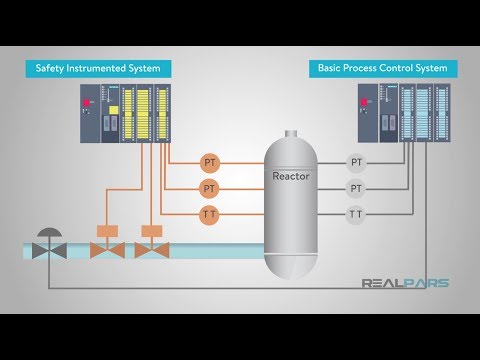
- An SIS consists of sensors, logic solvers, and final control elements designed specifically to bring processes to a safe state when predetermined conditions are violated.
Independence from Basic Control Systems
- For effective risk reduction exceeding tenfold, an SIS must operate independently from basic process control systems to avoid inheriting their shortcomings.
Functionality Within Plants
- Logic solvers within an SIS determine output states based on inputs related to specific functions known as Safety Instrumented Functions (SIF). This ensures controlled responses during critical operational scenarios.
Safety Instrumented Systems Overview
Reactor Overpressure Protection
- The flow is controlled by shutting the control valve to prevent over-pressurization of a closed tank. This function is defined as "reactor overpressure protection."
- A pressure sensor, logic solver, and positive shutoff valve are added to create an independent layer of protection against reactor overpressure, enhancing overall safety.
Risk Analysis in Safety Instrumented Systems
- A detailed risk analysis is essential for designing a Safety Instrumented System (SIS), identifying potential risks that necessitate defining a Safety Instrumented Function (SIF).
- A risk matrix can qualitatively or quantitatively assess tolerable risk levels and determine when a SIF should be established.
Probability of Failure on Demand (PFD)
- Every component in an SIS has a probability of failure; for example, pressure regulators have about a 1 in 10 chance of failing within a year. Understanding PFD is crucial for system reliability.
- Isolation valves have approximately a 1 in 100 failure rate, with these values obtainable from vendor data or industry databases. Overall PFD must be calculated for each SIF during design.
Safety Integrity Levels (SIL)
- If the desired PFD is less than 0.01, the SIF must meet Safety Integrity Level (SIL) 2 requirements; lower PFD thresholds correspond to higher SIL requirements up to SIL 4.
- Higher SIL levels indicate greater reliability but may not always be practical or economically feasible; redundancy can help mitigate risks further.
Redundancy and Design Principles
- Implementing redundancy increases system reliability and safety response but also raises costs; different configurations like 1 out of 2 or 2 out of 3 systems offer varying levels of safety response effectiveness.
- The ISA-84/IEC-61511 standards provide guidelines for developing and documenting SIS designs, emphasizing principles such as avoiding online changes to logic solvers and establishing change management processes post-design approval.
Layers of Protection
- The goal of implementing SIS is to reduce accident risks significantly while providing multiple layers of protection for processes, equipment, personnel, and communities within processing plants. Proper implementation can greatly enhance overall risk profiles.
- An SIS consists of sensors, logic solvers, and final control elements that operate independently from basic process control systems to ensure safe states during abnormal situations.