Equilibrio químico y constante de equilibrio, Kc (Introducción)
What is Chemical Equilibrium?
Introduction to Chemical Equilibrium
- The video introduces the concept of chemical equilibrium, starting from basic principles and progressing to more complex ideas.
- It emphasizes understanding the law of mass action, a formula crucial for solving equilibrium problems, rather than just applying it without comprehension.
Understanding Irreversible Reactions
- A generic equation is presented: Reactants A and B yield Products C and D, with lowercase letters representing stoichiometric coefficients.
- The reaction is initially described as irreversible due to the direction indicated by an arrow; products C and D cannot revert back to reactants A and B without a change in conditions.
Formation of Products and Dynamic Equilibrium
- As reactants A and B are added, they begin to form products C and D. Initially, only reactants are present.
- Over time, as more C and D are produced, they start reacting back into A and B. This leads to a balance where the rate of formation equals the rate of consumption.
- This state is defined as dynamic equilibrium—where reactions continue at a molecular level but appear static on a macroscopic scale.
Deriving the Law of Mass Action
Reaction Rates
- The speaker sets up two reactions that can be combined: one forming products from reactants (A + B → C + D), another reversing this process (C + D → A + B).
- Each reaction's speed can be expressed through rate equations involving concentrations raised to certain powers (partial orders).
Importance of Elementary Reactions
- For simplicity in deriving equilibrium expressions, all considered reactions are assumed to be elementary—meaning their rates directly correlate with stoichiometric coefficients.
Constant Rates at Equilibrium
- Distinctions between direct (forward) and inverse (backward) reaction rates are made; each has its own constant associated with it.
- At equilibrium, both forward and reverse reaction rates become equal; thus establishing a stable concentration ratio among reactants and products.
Visualizing Reaction Rates Over Time
Rate Changes During Reaction Progression
- The initial high speed of the forward reaction decreases over time as reactants are consumed while product formation increases until reaching an asymptote.
Achieving Equilibrium
Understanding Equilibrium Constants in Chemical Reactions
The Concept of Direct and Inverse Rates
- The speaker discusses equating direct and inverse reaction rates, indicating a mathematical approach to understanding chemical equilibria.
- The relationship between the direct constant and the inverse constant is introduced, leading to the equilibrium constant expression based on product and reactant concentrations.
Defining Equilibrium Concentrations
- Emphasis is placed on using equilibrium concentrations for calculations; initial concentrations do not yield accurate results for equilibrium constants.
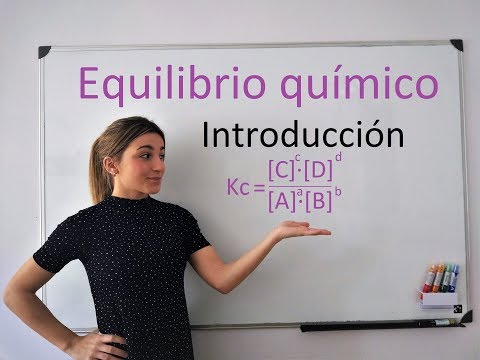
- The formula for the equilibrium constant (K) is defined as the ratio of products' concentrations raised to their stoichiometric coefficients over reactants' concentrations raised similarly.
Important Considerations for Using Equilibrium Constants
- Key considerations include that K is dimensionless but requires molar concentration inputs; only gaseous or dissolved species are included in calculations.
- Solid or liquid states are excluded from the equilibrium expression due to their unchanging concentration, which simplifies calculations by treating them as constants.
Implications of State on Equilibrium Calculations
Turn any video into a summary like this
YouTube links, meetings, lectures — with transcripts, search, and chat.