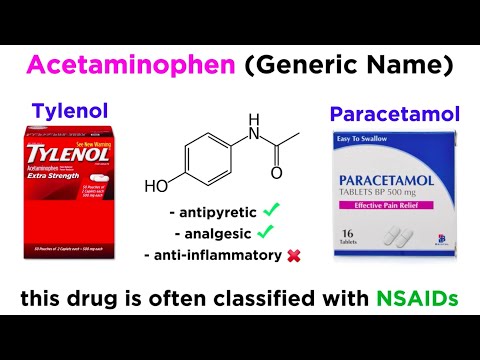
Acetaminophen/Paracetamol (Tylenol)
Acetaminophen: History and Mechanism
Introduction to Acetaminophen
- Acetaminophen was first produced in 1877 by Harmon Northrop Morse at Johns Hopkins University, but clinical testing began only in 1893.
- Joseph von Mering compared acetaminophen with phenacetin, noting that phenacetin could lead to methemoglobinemia, limiting oxygen transport in the body.
Transition from Phenacetin to Acetaminophen
- By 1949, biochemists David Lester and Leon Greenberg established that acetaminophen is as effective as phenacetin without causing methemoglobinemia or being carcinogenic.
- Acetaminophen became widely used and is now a common ingredient in over 600 medicines in the U.S., known as Tylenol or paracetamol outside the U.S.
Classification and Effects of Acetaminophen
- Although often classified with NSAIDs (nonsteroidal anti-inflammatory drugs), acetaminophen has little to no anti-inflammatory activity.
- It effectively reduces fever and increases pain threshold but weakly inhibits cyclooxygenase enzymes responsible for producing prostaglandins related to pain and inflammation.
Mechanism of Action
- The exact mechanism of acetaminophen's effects is not well understood; it may inhibit cyclooxygenase enzymes more effectively in the brain due to lower peroxide concentrations.
- Some suggest it might inhibit a third cyclooxygenase enzyme (COX-3), though its expression/function in humans remains unproven.
Safety Profile and Risks
- Due to its weak inhibition of cyclooxygenase enzymes, acetaminophen has fewer blood-thinning or gastric side effects than other NSAIDs, making it suitable for children and certain adults like asthmatics.
- However, high doses can cause liver toxicity. Acetaminophen is metabolized primarily through conjugation pathways which can become saturated at high doses.
Metabolism Pathways
- At safe doses, acetaminophen undergoes conjugation with sulfate or glucuronide for excretion. Excessive intake leads to overload on this pathway.