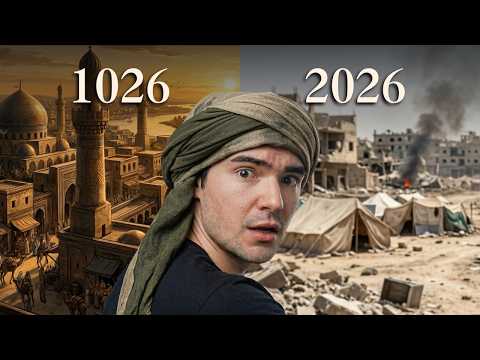
POR QUE O ORIENTE MÉDIO PAROU NO TEMPO?
The Rise and Fall of Islamic Civilization
Introduction to Historical Context
- 1200 years ago, the Islamic world was a center of knowledge in medicine, philosophy, and mathematics, far ahead of Europe.
- At its peak, the Islamic civilization had vast libraries with hundreds of thousands of books compared to Europe's mere hundreds.
Causes for Decline
- The transition from a hub of innovation to a region plagued by conflict is attributed to three recurring causes seen in civilizational collapse.
- The first cause relates to political dissatisfaction within the Umayyad Caliphate due to favoritism towards Arab Muslims over non-Arabs.
The Abbasid Revolution
- A revolutionary group led to the establishment of the Abbasid Empire after discontent grew against Umayyad corruption.
- In 751 AD, Abbasids captured Chinese artisans who introduced paper-making technology, revolutionizing information dissemination.
Impact of Paper on Knowledge Dissemination
- Paper was cheaper and easier to produce than parchment or papyrus, leading to mass production and accessibility of written works.
- The Abbasids moved their capital from Damascus to Baghdad, strategically located at trade crossroads which facilitated cultural exchange.
Cultural Flourishing Under Al-Ma'mun
- Al-Ma'mun's reign marked an era where he prioritized knowledge acquisition by demanding books as tribute during diplomatic missions.
- His dream encounter with Aristotle emphasized reason as paramount for understanding good and faith.
Establishment of the House of Wisdom
- Inspired by Alexandria’s lost library, Al-Ma'mun initiated a massive translation project at Bait al-Hikma (House of Wisdom).
- Scholars from diverse backgrounds collaborated here; knowledge became highly valued above material wealth.
Contributions to Science and Mathematics
- Persian mathematician Al-Khwarizmi developed algebra; his work laid foundations for modern algorithms used in technology today.
- Ibn al-Haytham pioneered the scientific method emphasizing hypothesis testing—a precursor for future scientific inquiry.
Shift in Intellectual Climate: Al-Ghazali's Influence
- In 1095, theologian Al-Ghazali published "The Incoherence of Philosophers," arguing that reason has limits when it contradicts divine will.
- This shift led many scholars away from philosophical inquiry towards strict adherence to religious doctrine.
Consequences on Knowledge Pursuit
- Curiosity diminished as questioning became associated with heresy; this stifled intellectual growth within Islamic society.
Averroes' Opposition and Legacy
- Averroes emerged as a prominent philosopher opposing Al-Ghazali’s views but faced persecution leading to book burnings and exile.
Impact on European Thought
- Despite his exile, Averroes’ works influenced European thinkers like Thomas Aquinas who sought harmony between faith and reason.
Reflection on Knowledge Transfer
Irony in Historical Progression
- The advancements that propelled Europe were rooted in knowledge produced by previously colonized civilizations.
Destruction During Mongol Invasion
Fall of Baghdad
- In 1258, Mongols destroyed Baghdad's cultural institutions including the House of Wisdom; countless texts were lost forever.
Analyzing Civilizational Collapse
Identifying Key Factors
- Three main causes contributed: concentration of knowledge among elites, acceptance over curiosity replacing critical thinking, and punishment for dissenting ideas.
Parallels with Brazil Today
Current State Analysis
- Brazil shows similar patterns: increased scientific output without corresponding technological advancement or public access due to elitism in academia.
The Necessity of Educational Content
Importance of Core Knowledge
- The educational curriculum mandated by the government includes essential knowledge for societal coexistence, such as Portuguese language, history, and geography.
- These subjects provide a worldview that enables students to function effectively in society, with mathematics being crucial for practical application in life.
Relevance of Advanced Topics
- Certain advanced topics taught in schools may not be relevant for all students, particularly those nearing graduation who may not pursue these areas further.
- While concepts like oxidation numbers and biological classifications are vital for science, their opportunity cost during formative years is high compared to more applicable life skills.
Impact of AI on Future Employment
Transition to an AI-driven World
- Students graduating now will face significant challenges as they enter a job market increasingly dominated by artificial intelligence (AI).
- Current education fails to equip students with entrepreneurial skills or financial literacy necessary for creating economic value in this new landscape.
Consequences of Inadequate Preparation
- Graduates may find themselves outperformed by AI systems capable of executing tasks more efficiently than humans.
- The government's outdated educational content does not address modern needs or prepare students adequately for future challenges.
Critical Thinking and Innovation
Lack of Critical Skills
- The current system does not foster critical thinking or self-directed learning among students, which are essential traits for success.
- There is a punitive environment against innovative thinkers within Brazil's educational framework, stifling creativity and progress.
Challenges Facing Brazilian Education
Hostile Environment for Intellectual Growth
- Brazil's scientific community faces obstacles due to high taxes on businesses that could fund research and innovation.
- This creates an environment where intellectual talent feels compelled to leave the country rather than thrive within it.
Initiatives for Change: Programa Lidere
Fostering Proactive Learning
- The speaker introduces "Programa Lidere," aimed at developing problem-solving skills and critical questioning among students.
- Key focus areas include financial education, entrepreneurship, and socio-emotional intelligence—skills vital for navigating today's world.
Real-world Experience Opportunities
- Winners from the Lider challenge were taken to Silicon Valley to learn from leading innovators, emphasizing the importance of exposure to real-world applications.
Turn any video into a summary like this
YouTube links, meetings, lectures. With transcripts, search, and chat.