Introduction to Tangential Flow Filtration (TFF)
Understanding Tangential Flow Filtration (TFF)
Overview of TFF Process
- Tangential flow filtration (TFF), also known as cross flow, is a technique that utilizes membranes to separate biomolecules based on size.
- Unlike dead-end filtration, TFF allows material to pass across the membrane rather than through it, enhancing separation efficiency.
Components of TFF System
- A typical TFF setup includes:
- Feed reservoir
- Feed pump
- Filter
- Retentate and permeate lines
- Pressure gauges for monitoring system pressure
- Collection vessel for permeate
Membrane Types in TFF
- Two primary types of membranes used in TFF are:
- Holofiber Membranes: Composed of embedded fibers within a cylinder; fluid filtration occurs between fibers.
- Cassette Membranes: Layers stacked inside housing with small screens separating them; filtration happens through adjacent membrane pores.
Pore Size and Filtration Mechanism
- Membranes are distinguished by pore size, categorized into:
- Microfiltration: Pores ≥0.1 micron; separates cells and macromolecules from proteins.
- Ultrafiltration: Pores <0.1 micron; retains larger proteins while allowing smaller molecules like water to pass.
Applications of TFF
- TFF is utilized in various operations such as:
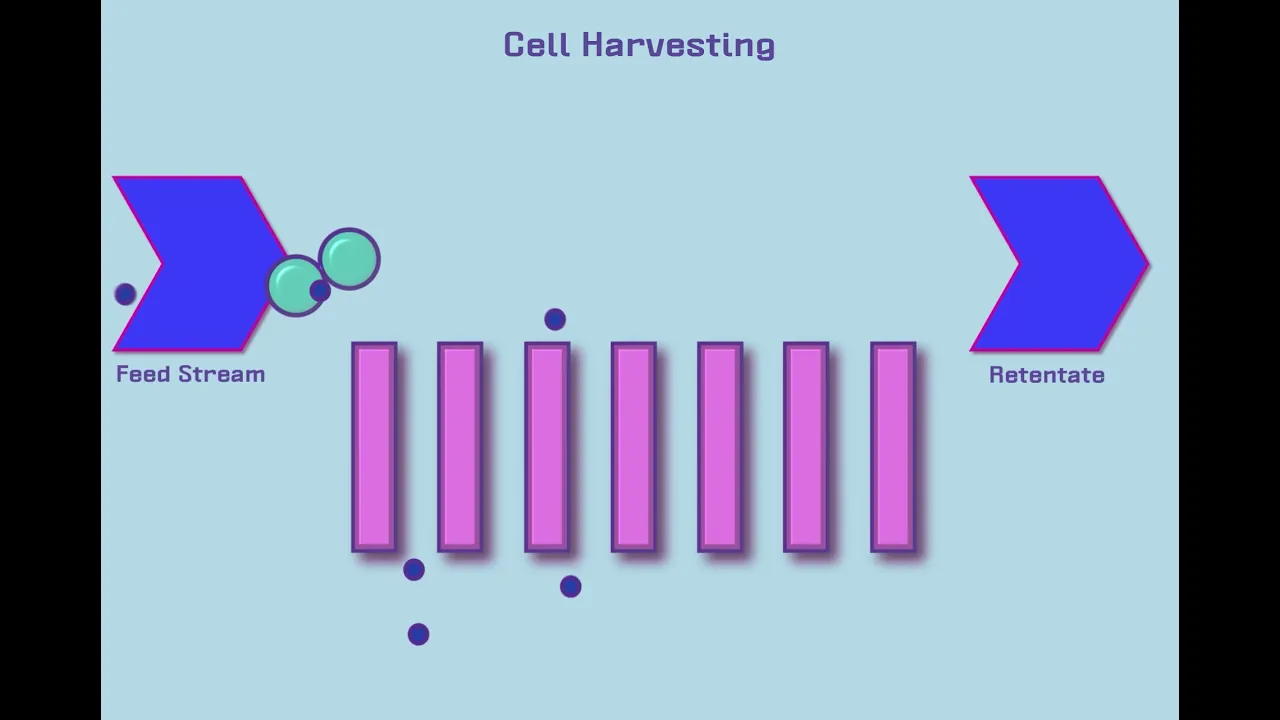
- Cell harvesting when centrifugation isn't feasible.
- Lysate clarification and product fractionation.
- Protein concentration and die filtration processes.
Key Steps in Performing TFF
Procedure Checklist for Effective Operation
- Follow these steps during the TFF process:
- Collect a pre-filtration sample for comparison later.
- Identify necessary components of the TFF system.
- Additional procedural steps include:
- Insert inlet tubing into the material to be concentrated.
- Ensure filtrate line enters a clean container while retentate returns to the reservoir.
- Operational checks involve:
- Turn on the system and record pump flow rate.
- Regularly check pressure settings to avoid exceeding limits.