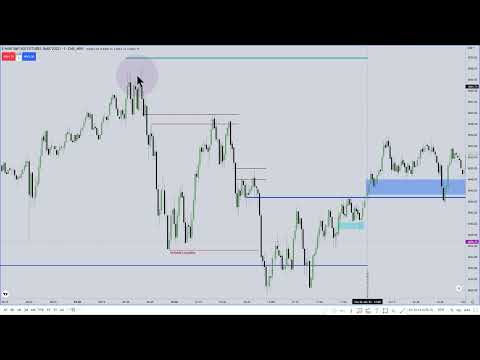
ICT Mentorship ES Market Review \ January 26, 2023
Market Analysis and Trading Strategy Overview
Overview of Current Market Conditions
- The speaker provides a brief review of the day's price action, indicating that they will not be trading tomorrow due to a three-day weekend.
- They mention their approach to identifying liquidity draws in the market, focusing on fair value gaps or order blocks that are significant at the time.
Focus on Stock Index Futures
- The speaker contrasts Forex market conditions with stock index futures, noting that Forex is currently "sloppy" and less favorable for trading.
- Emphasizes their focus on stock index futures (specifically E-mini S&P), as it offers cleaner price action compared to Forex markets.
Technical Analysis Insights
- Discusses the importance of using lower time frames (15-minute charts) for trade ideas while considering higher time frame analysis for context.
- Highlights the significance of understanding where liquidity draws are located based on daily and weekly trends before making trades.
Trading Strategy and Execution
- Advises new traders to concentrate on one market (E-mini S&P), rather than switching between different assets, to reduce confusion and improve focus.
- Explains that experienced traders may switch between markets but emphasizes that beginners should stick to one asset class until they gain more experience.
Key Price Levels and Market Triggers
- Introduces key price levels such as the midnight opening price for December 26, 2023, which is marked at 40.36.75.
- Describes how smart money traders can capitalize on long positions by targeting specific high levels after observing market behavior around these key prices.
Conclusion of Market Review
- Stresses the importance of recording observations during trading sessions and being aware of potential catalysts affecting market scenarios.
Market Analysis and Trading Strategies
Focus on Current Market Conditions
- The speaker emphasizes the importance of focusing solely on the current market they are trading, disregarding other markets like NASDAQ or Euro Dollar that did not meet expectations.
Understanding Rejection Blocks
- A rejection block is identified after a market run-up, where it breaks down below the opening price at midnight, indicating potential trading setups for lower time frames.
Swing Trading Strategy
- For longer-term traders unable to capitalize on intraday fluctuations, a swing trading strategy is discussed. This involves positioning for an Ideal Power 3 entry when bullish.
Concept of Power Three
- The "Power Three" concept refers to the phases of accumulation, manipulation, and distribution within daily or weekly ranges. It can also apply to specific sessions throughout the day.
Key Opening Price Dynamics
- The key opening price for daily range analysis is set at midnight New York time. Traders should look for price action below this level to engage with sell-side liquidity effectively.
Setting Alerts and Limit Orders
- Swing traders are advised to set alerts for when prices dip below significant levels (like the midnight opening price), allowing them to place limit orders without constant monitoring.
Fair Value Gaps and Market Behavior
- The speaker discusses how markets retrace into fair value gaps before moving lower, emphasizing that traders should be aware of these patterns as they indicate potential sell-side liquidity areas.
Importance of Time Frames in Trading
- Analyzing different time frames helps identify inefficiencies in market structure. Traders should focus on specific periods (e.g., 9:30 AM - noon) to optimize their strategies.
Managing Expectations in Trading
- The speaker shares insights from 30 years of experience, advising against revenge trading and encouraging traders to adopt a skill set that allows them to navigate market fluctuations confidently.
Identifying Imbalances and Liquidity Pools
- Traders are encouraged to recognize imbalances in higher time frames while refining their strategies based on lower highs and lows within those contexts.
Market Analysis and Trading Insights
Observations on Price Action
- The speaker highlights a significant one-minute candle that indicates a bullish run, emphasizing the importance of observing fair value gaps during this price action.
- A reminder is given to traders to remain out of the market, suggesting that smart money will accumulate long positions below the opening price level at 40.36.
- The market's behavior is discussed, noting how it builds a fair value gap before entering a consolidation phase around lunchtime.
Twitter Engagement and Real-Time Updates
- The speaker encourages followers to review tweets shared between 8:30 AM and 11:00 AM for insights into real-time market movements.
- There’s an emphasis on not complaining about tweet frequency; followers are encouraged to turn off notifications if they find them overwhelming but should not miss important updates.
Specific Candle Analysis
- A specific sell-side level at 4035 ES is noted, with attention drawn to the next candle's fair value gap which should ideally remain unfilled as it approaches lower prices.
- The speaker discusses expectations for price movement under certain conditions, particularly focusing on levels like the 956 low.
Market Reactions and Predictions
- An analysis of whether the market filled in the fair value gap entirely is provided; it did not fill completely as anticipated, aligning with previous predictions made by the speaker.
- The discussion includes humorous remarks about trading behaviors while reinforcing that traders should be cautious and avoid gambling in uncertain conditions.
Directional Guidance Based on Price Levels
- Traders are reminded to stay flat unless confident in their trades; guidance is provided based on observed price actions relative to key levels established earlier in the session.
Understanding Market Dynamics and Trading Strategies
The Importance of Active Engagement in Trading
- Emphasizes the necessity for traders to actively engage with market analysis rather than relying on others for guidance, highlighting that true understanding comes from personal effort.
- Introduces the concept of "reading the tape" and understanding price action, stressing the importance of trusting one's own analysis as skills develop.
Analyzing Market Conditions
- Discusses identifying catalysts for market direction changes, such as fair value gaps or specific patterns learned through previous teachings.
- Clarifies terminology like "buy side liquidity" and "sell side liquidity," indicating how these terms guide trading decisions based on market movement expectations.
Practical Application of Concepts
- Shares insights into personal trading practices, including a preference for minimal chart clutter while annotating key concepts to aid learning.
- Describes a hypothetical trade scenario involving stop loss placement and risk management strategies essential for new traders to avoid significant losses.
Risk Management and Trade Execution
- Explains the logic behind entry patterns and stop loss thresholds, emphasizing their critical role in protecting against financial ruin during trades.
- Reiterates the importance of using stop losses consistently across all trading scenarios to mitigate risks associated with losing streaks common among inexperienced traders.
Building Independence in Trading Skills
- Highlights a five-handle movement example to illustrate potential gains from effective trading strategies, encouraging traders to document their progress.
- Encourages community engagement where students can share their successes when they independently identify setups discussed in lessons, fostering a sense of empowerment.
Mentorship and Transferable Knowledge
- Reflects on the rewarding experience of mentoring students who successfully apply learned concepts in real-time trading situations.
- Warns against passive consumption of educational content; stresses that active participation is crucial for mastering trading techniques effectively.
Live Trading Insights
- Details a live session's focus on specific market levels (e.g., 4072.75), illustrating how real-time analysis informs decision-making processes during trades.
Trading Insights and Methodologies
Understanding Trade Execution
- The speaker reflects on missed trading opportunities, emphasizing the importance of not trading on a mobile device while out. They share their experience of observing market movements without executing trades.
- The speaker plans to teach viewers how to set alerts and configure charts effectively, aiming for independence in trading without relying on external guidance.
Developing Independence in Trading
- The goal is to empower traders to become self-sufficient, understanding what they are looking for in the market. This does not guarantee perfection or high accuracy but fosters confidence in decision-making.
- Specific trade levels are discussed, with the speaker detailing their exit strategy at key price points (40.72 and 40.73), demonstrating practical application of their methodology.
Exit Strategies and Personal Challenges
- The speaker shares insights into their exit strategies, including using Fibonacci projections to determine optimal exit points (e.g., 40.76). They encourage viewers to analyze these levels as part of their learning process.
- Acknowledging personal weaknesses as a trader, particularly regarding exits rather than entries, the speaker discusses striving for perfection in trade execution despite knowing it’s unattainable.
Balancing Perfectionism with Practicality
- The speaker describes an internal struggle with achieving ideal exits versus accepting partial profits close to projected targets. They emphasize that this balance is crucial for long-term success.
- By accepting partial exits near anticipated highs, traders can manage expectations and reduce anxiety around perfect timing while still capitalizing on profitable moves.
Teaching Through Experience
- The speaker expresses appreciation for external validation from peers regarding their precision but acknowledges an ongoing desire for improvement driven by personal standards.
- Plans are shared about teaching a family member trading principles through hands-on experience, highlighting the importance of desensitizing oneself to entry fears and unrealistic expectations.
Realistic Trading Goals
- Emphasizing that exiting trades can be straightforward if approached correctly, the speaker advocates starting with achievable goals like targeting five-handle gains before progressing to larger targets over time.
Understanding Employment Income and Trading Psychology
The Pursuit of Employment Income
- The speaker emphasizes that the primary goal for many individuals is to achieve employment income, which is a fundamental aspect of financial stability.
- While wealth accumulation is a common aspiration, the speaker clarifies that their promise lies in enhancing one's ability to reprice effectively rather than guaranteeing riches.
Managing Losses in Trading
- The speaker warns against the misconception that trading success can be achieved by simply executing trades without understanding the underlying processes.
- Acknowledges that even small losses can trigger emotional responses, leading traders to perceive these losses as personal failures, which may affect their decision-making.
Learning Through Practice
- The speaker encourages participants to engage with their demo accounts actively, suggesting they perform specific tasks live during training sessions.
- Emphasizes the importance of experiencing drawdown as a learning opportunity, helping traders develop resilience and problem-solving skills.
Developing Essential Skills
- Highlights the necessity of acquiring new skills and understanding trading processes to avoid detrimental behaviors when transitioning to real money trading.
Turn any video into a summary like this
YouTube links, meetings, lectures. With transcripts, search, and chat.