Лекція 10. Форми організації навчання учнів. Урок у сучасній школі
Organizational Forms of Teaching in Modern Schools
In this section, the speaker discusses organizational forms of teaching in modern schools, covering topics such as the essence of organizational forms of teaching, classification of lessons based on didactic purposes, and preparation for lessons.
Essence of Organizational Forms of Teaching
- The discussion includes the essence of organizational forms of teaching, types and structures of lessons based on didactic purposes.
- Recommended literature for preparation includes textbooks by Valentina Ivanovna Lazova-Tratsko and Hanna Volodymyrivna Tratsko.
Understanding Organizational Forms
- Exploring the concept further, the speaker delves into the various meanings and complexities associated with organizational forms of teaching.
- Definitions include collaborative activities between teachers and students within a structured framework.
Factors Influencing Choice of Teaching Forms
- Factors influencing the selection of teaching forms are discussed, such as communication styles between teachers and students during lessons.
- Distribution of educational functions is highlighted as a crucial aspect influenced by both teachers and students.
Classification of Teaching Forms
This section focuses on classifying different forms of teaching based on various criteria like group size and educational settings.
Types Based on Student Count
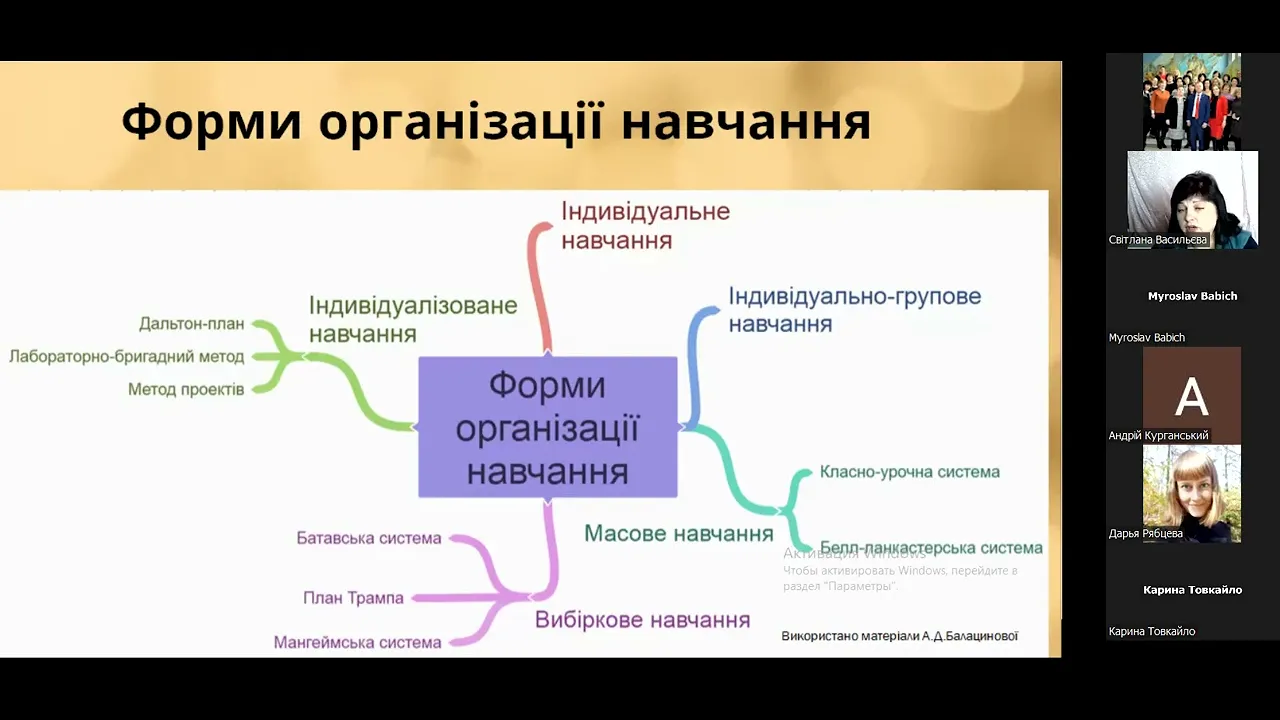
- Classification by student count includes mass education for events like school-wide competitions and collective learning within a single class.
Group Work Organization
- Group work organization is emphasized through dividing classes into teams for collaborative tasks or pair work arrangements.
Individualized Learning Approaches
- The importance of individualized learning approaches is discussed through micro-group learning methods involving small groups working together.
Innovative Teaching Formats Beyond School Hours
This part explores alternative educational formats conducted outside regular school hours to enhance learning experiences.
Extracurricular Activities
- Extracurricular activities like excursions, independent study sessions, or workshops are highlighted as valuable extensions to traditional classroom learning.
Facilitating Learning Beyond Classroom Hours
Lecture Formats and Evolution of Teaching Methods
The transcript discusses the evolution of teaching methods, focusing on lecture formats and various educational approaches throughout history.
Lecture Formats in Schools
- Lectures are more common in higher education institutions than in middle or high schools due to their passive nature.
- Different types of lectures exist, depending on how teachers organize them to avoid monotony.
- Other forms of teaching include practical work, workshops, and specialized classes with varying durations.
Historical Development of Teaching Methods
- Historically, education involved knowledge transmission from parents to children, evolving into individualized teaching methods.
- Individual group teaching emerged as a response to the limitations of individual instruction, initially challenging due to varying student levels.
Innovations in Educational Systems
- Individual group teaching required teachers to assign tasks for students to study independently before review sessions.
- Johann Sturm introduced class divisions and exams in education systems, laying the foundation for structured learning environments.
Impactful Pedagogical Figures
- Comenius advocated for systematic class organization and individualized learning through his work "The Great Didactic."
- Lancaster and Bell proposed cooperative learning models where older students taught younger ones under teacher guidance.
Modern Educational Approaches
- Dalton Plan introduced by Helen Parkhurst emphasized individualized learning tailored to each student's pace and needs.
- The Lancasterian system aimed at efficient mass education through peer tutoring but faced challenges in maintaining quality.
Ongoing Educational Reforms
- Continuous efforts have been made to move away from traditional classroom structures towards personalized learning approaches like the Dalton Plan.
Organizational Forms of Education
The speaker discusses various organizational forms of education, including the Batavian system and individualized learning approaches.
Planning Work with Students
- Detailed planning involved in organizing lessons without traditional classrooms.
- Utilization of laboratories equipped for independent student learning.
- Implementation of the Batavian system involving division of teaching into group lessons and individual sessions for struggling students.
Educational Systems and Approaches
The discussion delves into educational systems like the Mangheimska system and its impact on student categorization.
Mangheimska System
- Introduction to the Mangheimska system founded by Josef Antoine.
Student Categorization and Differentiated Learning
Exploring student categorization based on abilities and the implementation of differentiated learning strategies.
Student Categories
- Classification of students into groups based on abilities, including gifted children.
Duration and Structure of Learning
Examining the duration and structure of learning within different student groups.
Learning Duration
- Varied lengths of study periods ranging from four to six years based on student categories.
Evolution of Educational Methods
Tracing the evolution of educational methods such as the Trump Plan and project-based learning.
Educational Innovations
- Introduction to the Trump Plan implemented in American schools.
Project-Based Learning Approach
Discussing project-based learning as an innovative educational approach.
Project-Based Learning
- Origin and development of project-based learning by David Lloyd in 1956.
Contemporary Educational Practices
Analyzing modern educational practices, emphasizing project-based activities in European systems.
Modern Applications
- Wide adoption of project-based activities in European education systems.
Advantages of Traditional Classroom System
Highlighting the benefits and drawbacks of traditional classroom structures in education.
Classroom System Benefits
Understanding the Structure of Learning Lessons
In this section, the speaker discusses the structure of learning lessons and the components involved in assimilating new material.
Components of Assimilating New Material
- The process begins with awareness, where students or learners first encounter a task and question its purpose and relevance.
- This stage is termed as comprehension, focusing on understanding why the material needs to be learned.
- Subsequently, there is mediated perception, distinguishing between known and unknown information.
- The assimilation of new knowledge involves analysis and synthesis to grasp essential information.
- Consolidation follows through practice exercises to solidify knowledge into skills.
Stages of Lesson Assimilation
This part delves into the stages involved in lesson assimilation, emphasizing key processes for effective learning.
Stages of Lesson Assimilation
- The stages include awareness, perception, consolidation, application, self-assessment, and evaluation.
- Various classifications exist for lessons based on their objectives such as introductory lessons or those focused on applying acquired knowledge practically.
Types of Lessons Based on Didactic Purpose
The speaker elaborates on different types of lessons categorized by their didactic purposes and educational objectives.
Types of Lessons
- Lessons can be classified into acquiring new scientific knowledge, reinforcing existing knowledge systems, or mastering intellectual and practical skills.
- Combining various didactic tasks results in mixed or combined lessons serving multiple educational goals.
Elements of Lesson Structure
This segment highlights the essential elements comprising a lesson's structure for effective teaching and learning outcomes.
Key Elements
- Organizational aspects like setting lesson objectives and motivating students are crucial across all lesson types.
Learning Methods and Lesson Organization
The section discusses teaching methods and lesson organization according to Lozova and Trotsky, emphasizing the organizational element as the first step in a lesson.
Organizational Element of a Lesson
- Teaching starts with the organizational element.
- Importance of normalizing students' psychological state and setting the tone for the lesson.
- Teacher's entrance into the classroom, hygiene requirements, student preparation on desks.
- Students' essentials on desks: notebook, textbook, pen; teacher greets and checks attendance.
Lesson Structure Components
This part delves into components like lesson theme, purpose, tasks, motivation, and checking understanding.
Components of Lesson Structure
- Writing lesson theme, date, classwork on the board.
- Emphasizing that lesson objectives should include educational-developmental and upbringing components.
- Importance of motivation in activities by understanding their purpose in life applications.
Teaching New Material
Focuses on introducing new material effectively to facilitate learning retention.
Teaching New Material Effectively
- Highlighting the significance of revisiting new content multiple times for better comprehension.
- Revisiting material for primary and secondary learning stages multiple times for effective learning.
Lesson Progression: Activities & Assessments
Discusses activities like knowledge recall exercises and assessments within lessons.
Activities & Assessments in Lessons
- Activating prior knowledge before starting a new topic is crucial for building upon existing knowledge.
- Structuring lessons to include comprehension activities, reinforcement exercises, summarization, homework assignments.
Lesson Evaluation & Follow-up
Examines evaluation methods such as tests and follow-up strategies post-assessment.
Evaluation & Follow-up Strategies
- Transitioning from knowledge reproduction to practical application during assessments is essential for comprehensive learning outcomes.
New Section
The section discusses the structure of a lesson, including the progression from introducing new knowledge to applying it through various activities like cognitive tasks, self-assessment, and homework.
Lesson Structure
- The teacher imparts new knowledge, followed by students engaging in exercises that transition into a combined type of lesson.
- Contrasting the lesson stages according to Mykhailo Kokolayovych Fitsula's model reveals differences in structure, starting with homework.
- For lessons focusing on acquiring new knowledge, the initial step involves presenting new material and understanding the core idea of the lesson.
New Section
This part delves into the detailed breakdown of a combined lesson format, emphasizing its prevalence in schools and outlining organizational aspects such as psychological preparation and checking homework.
Combined Lesson Format
- Various types of tasks are utilized for cognitive engagement, including self-assessment against standards or programmed quizzes.
- Key elements like motivation through real-life connections and emotional impact are highlighted for effective learning experiences.
New Section
This segment explores diverse teaching methods within lessons, encompassing verbal techniques, research methods, creativity demonstration by teachers, and summarizing lesson outcomes.
Teaching Methods Diversity
- Teachers employ creative approaches like artistic work or testing to reinforce learning during lessons.
- Lessons conclude with reflections on achievements through mutual assessment and activity evaluation.
New Section
The discussion shifts towards flexible lesson structures tailored to problem-solving contexts. It emphasizes individual method selection within predefined templates for varied classroom experiences.
Flexible Lesson Structures
- Problem-oriented lessons offer adaptable structures allowing method choice within set templates for unique classroom dynamics.
- Exploring cognitive activities' components reveals traditional versus non-traditional lessons' distinctions based on search-based versus standard formats.
New Section
This part elaborates on communication-focused lessons ranging from oral journals to debates. It underscores language diversity utilization for independent material processing and critical thinking development.
Communication-Focused Lessons
- Lessons emphasizing communication skills leverage varied linguistic tools for independent material processing and interactive discussions.
Educational Strategies and Lesson Planning
The discussion revolves around the importance of incorporating educational games and activities into lesson planning, emphasizing the need for a balanced approach to maintain engagement while considering individual student preferences.
Incorporating Educational Games
- Educational games like improvisation and role-playing are valuable tools in teaching.
- Activities such as dramatization, storytelling, and puppet shows foster cooperation and unity within the learning group.
- There is a call for more innovative lesson plans to cater to diverse learning styles and enhance cognitive and emotional development.
Pedagogical Preparation for Lessons
This segment highlights the pedagogical requirements for effective lesson planning, stressing the significance of considering students' individual characteristics and tailoring teaching methods accordingly.
Pedagogical Considerations
- Teachers must account for students' age and individual traits when designing lessons.
- It is crucial to adapt teaching methods to suit students who may not respond well to theatrical activities.
- Evaluating each student's progress based on their own capabilities is essential for effective teaching strategies.
Effective Teaching Practices
The focus here is on creating a positive classroom atmosphere through engaging teaching practices that promote active learning and student development.
Creating a Positive Learning Environment
- A positive psychological climate enhances learning outcomes by fostering enthusiasm among students.
- Encouraging student autonomy in accessing information contributes to self-directed learning.
- Educational goals should encompass moral, ethical, and vocational aspects to ensure holistic development.
Teacher Preparation for Lessons
This part emphasizes the meticulous preparation required by teachers before conducting lessons, underscoring the dual aspects of preliminary and immediate preparation.
Teacher Readiness
- Prior preparation involves understanding curriculum content thoroughly and selecting appropriate instructional materials.
Lesson Structure and Homework Assignments
The discussion revolves around structuring lessons, providing homework assignments, and considering the nature of these assignments in terms of creativity or reproduction.
How to Provide Homework Assignments
- Mandatory homework involves giving instructions, creating a lesson plan, assessing one's readiness for teaching, ensuring student preparation, and evaluating their existing knowledge.
Organizing Learning Activities During Lessons
- Various forms of organizing learning activities during lessons include frontal, group, cooperative, collective, pair work, and individual work. Individual work entails students independently completing tasks within their academic capabilities with or without teacher assistance.
Frontal Work Discussion
- Frontal work involves simultaneous task execution by all participants under the teacher's guidance. It includes verifying understanding through discussions and interactions with students.
Effective Teaching Methods
This section delves into different teaching methods such as frontal work, collective work, group work, and pair work.
Frontal Work Explained
- Frontal work involves assigning tasks to the class collectively and subsequently verifying individual contributions through sequential questioning. It emphasizes collaborative learning while allowing each student to add unique insights.
Collective Work Benefits
- Collective work focuses on achieving a common goal through shared responsibilities that consider each student's interests and abilities. It fosters teamwork skills essential in the 21st century.
Group Work Dynamics
- Group work enhances teamwork abilities by establishing clear communication rules and task distribution among members. It nurtures collaboration skills necessary for successful completion of tasks.
Varieties of Group Work