Statements and Non-Statements (Screencast 1.1.1)
Understanding Statements in Mathematics
Definition of a Statement
- A statement in mathematics is defined as a declarative sentence that can be classified as either true or false, but not both.
- The term "declarative" indicates that the sentence asserts something rather than posing a question or making an exclamation.
Examples of Statements
- "January is the first month of the year" is a true statement, while "July is the first month of the year" is false. Both are clear examples of statements with definite truth values.
- Truth values depend on definitions; for instance, if "year" refers to a fiscal year instead of a calendar year, it alters the truth value of related statements.
Understanding Non-Statements
- Questions like "What time is it?" do not qualify as statements because they do not declare anything definitively. Similarly, subjective judgments like "Red is pretty" lack definitive truth values and are thus non-statements.
- An equation such as "2x + 10 = 14" does not have a single truth value since its validity depends on the variable x; hence, it’s categorized as an equation rather than a statement.
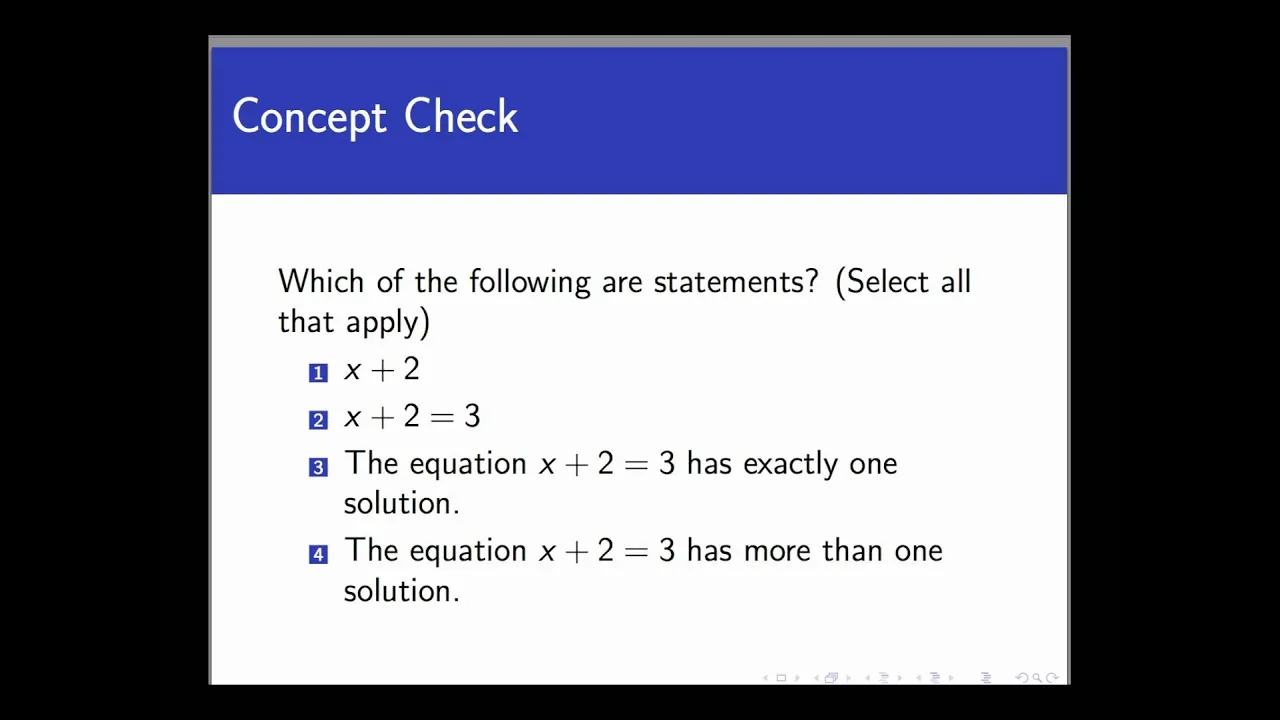
Concept Check: Identifying Statements
- The screencast includes concept checks to assess understanding; viewers are encouraged to pause and reflect on which options qualify as statements based on previous discussions. For example:
- “X + 2” (not a statement)
- “X + 2 = 3” (not a statement due to indeterminate truth value)
- “The equation X + 2 = 3 has exactly one solution” (true statement)
- “The equation X + 2 = 3 has more than one solution” (false statement).
Summary of Key Learnings
- Statements must be declarative and possess definite truth values; questions and equations dependent on variables do not meet these criteria.