Poker Combos: Everything You Need To Know | SplitSuit
Understanding Combos in Poker
Introduction to the Series
- James Sweeney, also known as Split Suit, introduces his first video in a series focused on understanding combos in poker.
- He provides a brief introduction about himself, mentioning his experience and background in poker coaching and content creation.
Importance of Combos
- Combos are essential for hand reading and understanding ranges rather than pinpointing exact hands.
- Ranges help players understand the likelihood of opponents holding certain hands based on their actions.
Structure of the Video
- The video will cover preflop combos first, including an introduction to basics, weight considerations, and real-time examples.
- Post-flop combos will be discussed later with similar structure: basic intro, weight analysis, and examples.
Types of Hands and Their Combos
Overview of Hand Types
- There are effectively four types of hands preflop: paired hands, unpaired hands, suited hands, and unsuited hands.
- Each pocket pair has six combos; unpaired hands have 16 combos; there are 12 unsuited combos; and four suited combos exist for each type.
Weight Considerations in Ranges
- Understanding the weight within ranges is crucial. For example, if someone opens with pairs plus Ace-King, pairs dominate that range.
- Adding broadway cards like Ace Queen or King Queen shifts the weight towards unpaired Broadway combinations due to their higher combo count (16 vs. 6).
Analyzing Range Weight
Practical Application of Weight Analysis
- Players should consider how ranges react to different actions such as three-betting or calling based on their weighted composition.
- An example is given where an opponent raises 10% from early position (EP), indicating a mix between pairs and broadway cards.
Understanding Ranges and Weight in Poker
Introduction to Ranges
- The speaker emphasizes learning through practical examples rather than theoretical discussions, introducing the concept of hand ranges in poker.
- A default opening range is assigned: Deuces plus, Ace 10 plus, and King Jack plus, which reflects a typical range for players from middle position (MP).
Analyzing Opening Ranges
- The breakdown of pairs from Deuces to Aces reveals 78 combinations of hands; suited combos like Ace 10 suited yield 24 combinations; unsuited hands such as Ace Jack off contribute 72 combinations.
- The total opening range is approximately 174 combinations. While this number is significant for calculations, it’s impractical to recall exact counts during gameplay.
Practical Application of Range Understanding
- Players should develop an innate understanding of hand combinations through practice with tools like PokerStove rather than memorizing specific numbers.
- This foundational knowledge allows players to make quicker decisions without getting bogged down by complex calculations during play.
Continuing with C-Ranges
- The discussion shifts to continuation ranges (C-ranges), focusing on hands that opponents are likely to continue with after the flop.
- A sample C-range includes tens plus and Ace King, totaling around 46 combos. This leads to calculating fold percentages based on these ranges.
Calculating Fold Percentages
- To estimate how often an opponent folds, one can use the formula: (100% - continuing hands / total opening hands). In this case, it suggests a fold rate of about 73.6%.
- With high fold rates observed, players may find opportunities for profitable light three-betting regardless of their own cards.
The Importance of Blockers in Poker
Understanding Blockers
- Blockers refer to having certain cards that reduce the likelihood of opponents holding strong hands related to those cards.
Examples of Blocker Effects
- Holding an Ace-Four suited blocks potential combos for pocket fours and reduces the number of ways opponents can have strong holdings like pocket aces.
Impact on Opponent's Hand Combinations
- By holding an Ace, a player limits their opponent's possible combinations significantly—reducing six combos down to three for pocket aces and affecting other strong hands like Ace King or Queen.
Understanding Blockers in Poker Strategy
The Impact of Blockers on Opponent's Range
- Discusses how blockers can significantly reduce the strength of an opponent's range by removing powerful hands like Aces and Ace-King from consideration.
- Highlights the added equity gained from having specific blocker hands, which can lead to more favorable outcomes if the opponent calls a three-bet.
- Explains how blocking combinations of strong hands (e.g., Ace-King and pocket Kings) affects both opening and continuation ranges, crucial for aggressive betting strategies.
Analyzing Opening Ranges with Blockers
- Introduces a scenario where a three-bet is considered, emphasizing the importance of analyzing the opponent's opening range based on blockers held.
- Assigns specific hand ranges to the opponent, illustrating how blockers change their potential holdings from 174 combos down to 152 due to reduced options.
- Details how holding an Ace blocks several strong combinations (like Ace-Ten and pocket Aces), further narrowing down the opponent’s possible hands.
Continuation Ranges and Fold Percentages
- Examines how blockers affect not only opening ranges but also continuation ranges, leading to fewer viable options for opponents when facing aggression.
- Notes that as a result of reduced combos, there is an increase in fold percentages—74.3% calculated based on adjusted ranges—indicating greater likelihood of success with aggressive plays.
Evaluating Expected Value (EV)
- Discusses calculating EV changes resulting from altered ranges; even small differences in EV can be significant at higher stakes where edges are thinner.
- Emphasizes that generating slight advantages through strategic use of blockers can greatly benefit overall profitability in poker.
Strategic Considerations for Three-Betting
- Cautions against indiscriminately three-betting just because one has blockers; emphasizes understanding opponents' tendencies before making aggressive moves.
- Warns about facing players who may not fold often or who might expand their continuing range, which could negate any advantage gained from using blockers effectively.
Conclusion: Integrating Blocker Strategies into Gameplay
- Reiterates that understanding both opening and continuation ranges through blocker analysis is essential for improving pre-flop aggression strategies.
Understanding Post-Flop Strategy in Poker
Importance of Off-Table Work
- Emphasizes the significance of off-table work to enhance profitability, suggesting that mathematical analysis can simplify decision-making.
Transitioning from Pre-Flop to Post-Flop
- Introduces the shift from pre-flop strategies to post-flop considerations, focusing on how combos and blockers play a crucial role.
Analyzing Combos on Different Boards
- Discusses analyzing various board types (e.g., XYZ type boards) and calculating possible combos for pocket pairs and sets.
- Explains the "631 rule" for determining combos: six for missed sets, three for hit sets, and one for quads if the board is paired.
Calculating Top Pair Combos
- Describes how to calculate top pair combos using unseen cards; e.g., with a King-high board, there are 12 combos of Ace-King.
- Extends this concept to two-pair scenarios, illustrating how many combinations exist based on unseen cards.
Understanding Flush Draw Combos
- Highlights common misconceptions about flush draws; emphasizes that players often overestimate their opponent's range.
Simplifying Combo Calculations
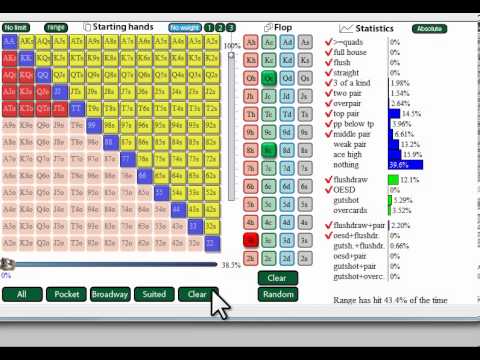
- Suggests that combo calculations can be simplified through multiplication of unseen cards; introduces Flopzilla as a helpful tool.
Utilizing Flopzilla for Better Decision Making
Introduction to Flopzilla
- Recommends using Flopzilla as an essential program for understanding poker ranges and improving strategic decisions.
Features of Flopzilla
- Outlines key features such as predetermined ranges and dead card inputs which help analyze opponents' potential hands effectively.
Practical Application of Flopzilla
- Demonstrates how to use Flopzilla by assigning ranges and observing how opponents hit different categories like pocket pairs or flush draws.
Evaluating Opponent Ranges with Examples
Understanding Flush Draws and Opponent Ranges in Poker
The Impact of Flush Draws on Decision Making
- The speaker discusses the statistical likelihood of flush draws, estimating them to be around 24% of hands. They express indifference towards this percentage, suggesting it is not a significant concern.
- By considering all suited combinations, the estimated chance of encountering a flush draw increases to about 15%. The speaker emphasizes that this should not cause panic among players.
- Many players tend to overreact when facing a flush draw board; however, the speaker argues that opponents typically do not hold many flush draws, so there’s no need for excessive caution.
- Protecting against potential flush draws is deemed an ineffective strategy. Instead, good poker involves maximizing value against an opponent's range rather than worrying about small portions of it.
Analyzing Opponent Ranges with Flopzilla
- The discussion shifts to analyzing opponent ranges using Flopzilla. A tight opening range (e.g., pairs and Ace-Queen) is considered, revealing how often opponents hit certain boards.
- On an Ace-high board, opponents can have multiple sets and top pairs due to the density of their hand ranges. This highlights the importance of understanding how different cards affect hitting probabilities.
- As more low-value cards are added to the analysis (like lower pairs), the likelihood of hitting strong hands decreases significantly for opponents.
Strategic Considerations Based on Board Texture
- If an opponent C-bets on a favorable board for them but has only hit top pair one-third of the time, aggressive play may be warranted as they could fold weaker holdings.
- Blockers play a crucial role in decision-making; having specific cards can limit what strong hands your opponent might hold. For example, holding pocket fives reduces their possible combinations significantly.
Evaluating Aggression and Hand Strength
- When assessing aggression from opponents who are C-betting less frequently (around 40%), it indicates they likely have stronger hands. Thus, caution is advised when responding aggressively.
- Holding Ace Queen can dramatically reduce an opponent's top pair percentage since it blocks some key combinations they could have.
Practical Application of Flopzilla Insights
- Understanding unseen card combinations helps gauge how many strong hands remain available for opponents based on visible community cards.
- Players should be cautious if their hand strength falls within the bottom tier against aggressive actions from opponents who may hold higher value hands like Ace King or Ace Queen.
- Using simple multiplication methods allows players to calculate unseen combos effectively—this aids in making informed decisions during gameplay.
Understanding Range and Weight in Poker
Importance of Practice
- Emphasizes the need for an inherent understanding of range and weight in poker. Suggests practicing for about 30 minutes a day over two weeks to internalize these concepts.
- Encourages players to explore practical examples, indicating that real-time application is crucial for mastering strategies.
Analyzing a Hand Example
- Introduces a hand scenario where the player steals from the cutoff with 9♠7♠, facing a call from the small blind who is described as a standard TAG (tight-aggressive) player.
- Discusses making a continuation bet (C-bet), noting that this is standard practice when analyzing ranges using tools like Flopzilla.
Evaluating Betting Decisions
- Highlights the importance of assessing fold equity; mentions that if the C-bet works at least one-third of the time, it can be profitable.
- Explains how to evaluate potential hands in an opponent's range, considering both strong hands and those likely to fold against a bet.
Calculating Combos and Equity
- Breaks down specific combos within an opponent's range, emphasizing that identifying at least 16 folding combos is necessary for justifying a bet.
- Discusses blocking certain pocket pairs while also recognizing other hands that may float on the flop, which influences betting strategy.
Strategic Considerations for Bluffing
- Stresses evaluating how many combos beat you versus those that will logically fold when deciding whether to bluff.
- Notes that if opponents are likely to call with top pairs or better, then betting becomes less favorable due to reduced fold equity.
Adjusting Strategies Based on Opponent's Range
- Points out how adding more combinations (like King-Jack into an opponent’s range) changes your strategy significantly by increasing required folds.
Understanding Bluffing and Combos in Poker
The Importance of Bluffing
- The speaker emphasizes the significance of bluffing in poker, noting that they often rely on creative strategies to gain an edge since they don't hit many hands.
- It is crucial to practice these strategies off the table until they become automatic, ensuring effective real-time application during games.
Analyzing Opponent's Actions
- A scenario is presented where the speaker opens with Queens from the hijack position and faces a check-raise from the big blind on a board showing A77.
- Players should assess how many combinations of hands can beat them and what hands their opponents might logically play in such situations.
Evaluating Hand Combinations
- The analysis includes counting specific combos: one combo of quads (pocket sevens), three combos of Aces (likely folded pre-flop), and various suited connectors like six-seven and eight-seven.
- Understanding whether an opponent plays suited or offsuit combinations can significantly impact hand evaluation post-flop.
Player Type Considerations
- If the opponent is perceived as a smart player who understands showdown value, it’s less likely they would bluff with strong hands like Ace-Jack or Ace-King.
- Assuming limited bluff potential from a tight player allows for more aggressive calling decisions when facing check raises.
Adjusting Strategy Based on Opponent Behavior
- The speaker contrasts reactions to bluffs from skilled players versus "fish," indicating that experienced players are less likely to make nonsensical bluffs.
- Using available information about an opponent's tendencies helps create better lines for decision-making post-flop.
Value Betting Against Fish
Setting Up Value Bets
- In another example, after opening from the cutoff against a fish, the speaker aims for value betting with second pair against common mistakes made by weaker players.
Assessing Turn Action
- After hitting a turn card (six), the speaker decides to continue betting for value, anticipating calls from second-best hands due to typical fish behavior.
River Card Analysis
- When a ten appears on the river, it complicates potential holdings for the fish. Since he didn't raise earlier rounds, it's unlikely he has strong 10x hands.
Understanding Betting Strategies in Poker
Value Betting and Opponent Analysis
- The speaker discusses the importance of determining how much to bet for value, especially when holding a strong hand. They consider betting smaller amounts to entice calls from weaker hands.
- Emphasizes that against less skilled players (referred to as "fish"), betting for value is more effective since they tend to call with a wider range of hands, including high cards or lower pairs.
- Highlights the difference in strategy when playing against better opponents, noting that they are less likely to call multiple bets unless they have a strong hand. This necessitates adjusting one's approach based on the opponent's skill level.
Combos and Strategic Adjustments
- Discusses the concept of "combos" in poker, which refers to different combinations of hands an opponent might hold. Understanding these can help inform decisions about betting lines and expected value (EV).
- The speaker shares their preference for aggressive check-raising on boards where opponents are likely to continuation bet with their entire range, making it difficult for them to continue without strong hands.
Practical Application and Learning
- Encourages viewers to practice off-the-table exercises related to poker strategies so that these concepts become second nature during actual gameplay.
Turn any video into a summary like this
YouTube links, meetings, lectures. With transcripts, search, and chat.