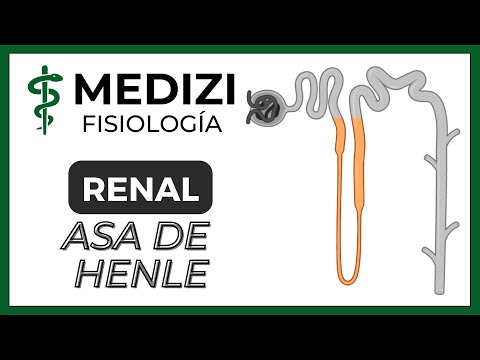
Fisiología Renal - Reabsorción y secreción tubular renal (Asa de Henle) (IG:@doctor.paiva)
Reabsorption and Secretion in the Loop of Henle
Overview of Renal Physiology
- The class introduces renal physiology, focusing on reabsorption and secretion processes in the Loop of Henle.
- The Loop of Henle is divided into three segments: thin descending limb, thin ascending limb, and thick ascending limb.
Structural Characteristics
- The thin segments have a fine epithelial membrane with low metabolic activity, while the thick segment has a thicker membrane and high metabolic activity due to sodium-potassium ATPase pumps.
- Thin segments possess fewer mitochondria compared to thick segments, which have microvilli for increased surface area and more mitochondria for energy production.
Water Reabsorption Mechanisms
- In the thin descending limb, water reabsorption is high while solute reabsorption (like sodium) is minimal; this leads to an increase in tubular osmolarity as fluid progresses through.
- The thin ascending limb and thick ascending limb are impermeable to water even in the presence of antidiuretic hormone (ADH), causing a decrease in tubular osmolarity.
Key Functions of Ascending Limb
- The thick ascending limb actively reabsorbs solutes like sodium, chloride, potassium via sodium-potassium ATPase pumps against concentration gradients.
- This segment also utilizes co-transport mechanisms (e.g., Na-K-Cl cotransporter), facilitating further solute absorption while maintaining impermeability to water.
Electrolyte Transport Dynamics
- Approximately 20% of filtered water is reabsorbed in the thin descending limb; however, this segment does not significantly absorb solutes.
- In the thick ascending limb, active transport mechanisms create a positive charge that drives cations like magnesium and calcium from tubular fluid into interstitial space.
Acid-base Balance Mechanism
- Sodium-hydrogen exchangers facilitate sodium reabsorption while secreting hydrogen ions; bicarbonate is also reabsorbed similarly to proximal tubule mechanisms.
Understanding the Function of Nephron Segments in Diuretic Action
Key Functions of Nephron Segments
- The descending thin segment of the nephron primarily absorbs water while minimally absorbing solutes, which is crucial for maintaining fluid balance.
- In contrast, the thick ascending segment actively absorbs many solutes, particularly sodium (Na+), chloride (Cl-), and potassium (K+), facilitated by the sodium-potassium-chloride co-transporter.
- Important to note is that loop diuretics like furosemide act on the thick ascending limb by inhibiting the sodium-potassium-chloride transporter, leading to increased excretion of these ions along with water.
Mechanism and Impact of Loop Diuretics
- Loop diuretics enhance urinary excretion of sodium, chloride, potassium, and consequently water, resulting in a potent diuretic effect.
Turn any video into a summary like this
YouTube links, meetings, lectures — with transcripts, search, and chat.