The Nature of Science

The Nature of Science

Understanding the Nature of Science

What is Science?

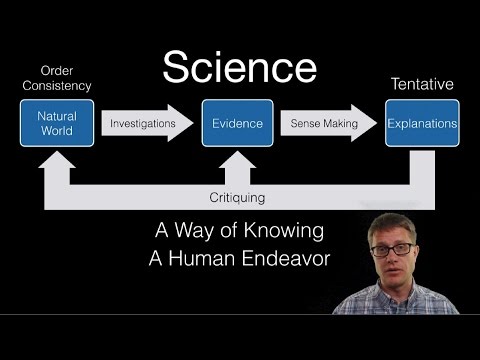
  • Science is described as a "way of knowing" that distinguishes itself from other forms like religion and philosophy. It focuses on understanding the natural world through observation and evidence gathering.
  • The scientific process involves curiosity-driven investigations, where scientists make observations, gather evidence, and develop explanations through hypotheses and theories. This knowledge is considered tentative and subject to change over time.

The Human Element in Science

  • Science is fundamentally a human endeavor, influenced by individual experiences and biases. Despite this, it remains an exciting field that encourages exploration and understanding of the natural world.
  • Skepticism plays a crucial role in science; it relies on evidence-based explanations while acknowledging that our understanding evolves with new findings. Scientists critique existing knowledge to improve their grasp of the natural world.

Limitations of Scientific Inquiry

  • There are questions beyond the scope of science, such as those concerning the supernatural or ethical values. While science can provide evidence related to these topics, it cannot definitively answer them. For example, questions about God's existence lie outside scientific inquiry.
  • As we expand our view from Earth to distant galaxies, science operates under the assumption that universal laws apply consistently across time and space; however, many mysteries remain unexplored (e.g., multiverses).

The Role of Technology in Scientific Discovery

  • Scientific advancements often intertwine with technology; discoveries may arise from hypothesis-driven research or serendipitous findings. Once new information is uncovered, scientists share their results at symposiums or publish in peer-reviewed journals for replication by others in the field.
  • Open access journals have made scientific research more accessible online, allowing broader engagement with current studies despite some complexity in content for lay readers. Examples include qualitative and quantitative data collection methods used in various experiments.

Case Study: Gravitational Waves

  • Einstein's theory regarding gravitational waves proposed that massive objects like black holes could create ripples through spacetime when they collide; this was confirmed by LIGO's observations starting in 2016 after extensive data collection efforts across multiple locations to ensure accuracy.
  • Observations serve as facts (e.g., an apple falling), while laws describe consistent patterns (e.g., gas laws). Hypotheses offer testable explanations for observed phenomena but must be validated through experimentation before evolving into comprehensive theories (e.g., evolution vs natural selection).

Evolution of Scientific Understanding

  • Historical shifts illustrate how scientific theories evolve; for instance, John Snow's cholera investigation debunked miasma theory by identifying water contamination as the disease source instead of bad air—leading to germ theory acceptance over time due to rigorous testing and evidence collection methods employed by scientists like Pasteur who developed sterilization techniques using flasks that allowed air but not bacteria inside them.

Modern Implications: CRISPR Research

  • Current research exemplifies ongoing changes within science; Jennifer Doudna’s work on CRISPR gene editing showcases how rapidly evolving technologies can redefine our understanding of genetics while emphasizing collaboration among researchers sharing insights via social media platforms like Twitter for wider dissemination beyond traditional academic circles.(420)

Conclusion: The Essence of Scientific Inquiry

  • In summary, science seeks to understand the natural world through systematic investigations aimed at gathering evidence leading towards coherent explanations while remaining open to critique and revision—a dynamic process reflecting humanity’s quest for knowledge amidst uncertainty.(446)
Video description

In this video Paul Andersen explains the nature of science. He describes how science is a way of knowing about the natural world. Scientists develop investigations to gather evidence and make explanations about how the natural world works. These explanations are constantly critiqued over time. Most importantly science is a human endeavor. Alex Dainis - Science Vlog - https://www.youtube.com/watch?v=YAiZFJBKwZg Do you speak another language? Help me translate my videos: http://www.bozemanscience.com/translations/ Music Attribution Intro Title: I4dsong_loop_main.wav Artist: CosmicD Link to sound: http://www.freesound.org/people/CosmicD/sounds/72556/ Creative Commons Atribution License Outro Title: String Theory Artist: Herman Jolly http://sunsetvalley.bandcamp.com/track/string-theory All of the images are licensed under creative commons and public domain licensing: Agriculture, U. S. D. of. (2012). U.S. Department of Agriculture (USDA) Agricultural Research Service (ARS) nematologist/pathologist Lynn Cart and Electron and Confocal Microscopy Unit director Gary Bauchan use a low temperature scanning electron microscope. Retrieved from https://commons.wikimedia.org/wiki/File:Scientists_use_a_low_temperature_scanning_electron_microscope_(LT-SEM)_to_view_anatomical_structures_needed_to_identify_nematodes_like_the_Parasitorhabditis_-_USDA-ARS.jpg al, B. P. A. et. (2016). English: LIGO measurement of gravitational waves. Retrieved from https://commons.wikimedia.org/wiki/File:LIGO_measurement_of_gravitational_waves.svg atmos, J. (2009). English: Diagram of the possible mechanism for CRISPR. Retrieved from https://commons.wikimedia.org/wiki/File:Crispr.png Colvin, A. Z. (2011). English: A diagram of Earth’s location in the Universe. Retrieved from https://commons.wikimedia.org/wiki/File:Earth%27s_Location_in_the_Universe_SMALLER_(JPEG).jpg decltype. (2010). English: A blackboard used by Albert Einstein in a 1931 lecture in Oxford. Retrieved from https://commons.wikimedia.org/wiki/File:Einstein_blackboard.jpg Diliff. (2005). English: Hopetoun Falls, Beech Forest, near Otway National Park, Victoria, Australia. Taken with a Canon 10D and 17-40 f/4L lens. Retrieved from https://commons.wikimedia.org/wiki/File:Hopetoun_falls.jpg Henze, N. R. C. ([object HTMLTableCellElement]). English: Numerical simulations of the gravitational waves emitted by the inspiral and merger of two black holes. Retrieved from https://commons.wikimedia.org/wiki/File:MergingBlackHoles_V2.jpg hqdefault.jpg (480×360). (n.d.). Retrieved June 14, 2016, from https://i.ytimg.com/vi/avM1Yg5oEu0/hqdefault.jpg Inkscape, Gy. vector image was created with. (2007). Français : Retrieved from https://commons.wikimedia.org/wiki/File:Coldecygne.svg Instructional Leadership for Science Practices. (n.d.). Retrieved June 9, 2016, from http://www.sciencepracticesleadership.com/ Komm.avd, F. H. F. (2014). Slovenščina: May-Britt Moser. Retrieved from https://commons.wikimedia.org/wiki/File:May-Britt_Moser_2014.jpg Mysid. (2015). English: Lattice analogy of the deformation of spacetime caused by a planetary mass. Retrieved from https://commons.wikimedia.org/wiki/File:Spacetime_lattice_analogy.svg Nadar. (1895). English: Studio portrait of Louis Pasteur Retrieved from https://commons.wikimedia.org/wiki/File:Louis_Pasteur,_foto_av_F%C3%A9lix_Nadar_Crisco_edit.jpg NASA, N. H.-G. I. of. (1995). In 1995, the majestic spiral galaxy NGC 4414 Retrieved from https://commons.wikimedia.org/wiki/File:NGC_4414_(NASA-med).jpg PoorLeno. (2008). English: Hydrogen Density Plots for n up to 4. Retrieved from https://commons.wikimedia.org/wiki/File:Hydrogen_Density_Plots.png poster session. (n.d.). Retrieved June 18, 2016, from https://www.flickr.com/photos/wwworks/14893251363/ Rainbow of journals. (n.d.). Retrieved June 9, 2016, from https://www.flickr.com/photos/moonlightbulb/6307961852/ Reid, D. A. (2005). English: Retrieved from https://commons.wikimedia.org/wiki/File:Scientist_working_in_laboratory_(1).jpg RMoranisJr. (1998). English: Nature Magazine 1998 Cover. Retrieved from https://commons.wikimedia.org/wiki/File:Nature.July.16.1998.Cover.Eink.JPG Seymour, R. (1831). Retrieved from https://commons.wikimedia.org/wiki/File:Cholera_art.jpg Snow, J. (1854). Original map made by John Snow in 1854. Cholera cases are highlighted in black. Retrieved from https://commons.wikimedia.org/wiki/File:Snow-cholera-map-1.jpg Umptanum. (2006). English: Northern arm of the LIGO interferometer on Hanford Reservation. Retrieved from https://commons.wikimedia.org/wiki/File:Northern_leg_of_LIGO_interferometer_on_Hanford_Reservation.JPG User:Sese_Ingolstadt, S. T. (2007). Retrieved from https://commons.wikimedia.org/wiki/File:Bahnsteiguhr.jpg Wikipedia, T. original uploader was R. at E. (1856). Dr. John Snow (1813-1858), British physician. Retrieved from https://commons.wikimedia.org/wiki/File:John_Snow.jpg